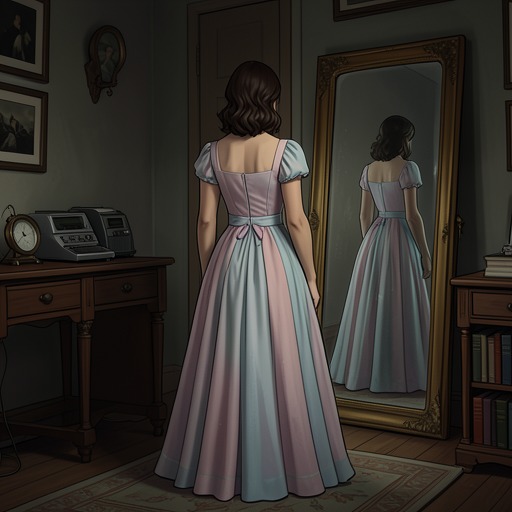
Conflict over Ella wearing her mother's dress to the family dinner
Cinder & EllaThe conflict over Ella wearing her mother’s dress to the family dinner is a defining rupture between Ella and her father’s household. A yellow cocktail dress chosen to keep her dead mother close becomes the focus of a demand that Ella conceal her scars; when her father and Jennifer fail to stand by her, she withdraws rather than attend dinner on those terms.
Causes and Background
As the family prepared to go to Providence, Ella felt out of place among the Colemans, who were dressed up for the occasion. Sent to her room to change, she searched her closet, convinced she would find nothing that could make her look as though she belonged with them. Instead, she found her mother’s small canary-yellow cocktail dress among the clothes her father had packed.
The dress carried a history of a rare indulgence. Ella and her mother had not often been able to dress up: though they were not truly poor, they had to watch their spending and save for anything special. When Ella was about thirteen, her mother dated a professional salsa dancer for several months. He loved taking her dancing, and she bought the dress for those outings, spending more than usual. Ella remembered how beautiful her mother had looked in it and had been relieved to find it among the packed belongings.
Holding the dress to her face, Ella breathed in. It no longer smelled like her mother, but it remained her favorite of the clothes she had worn. She whispered that she missed her mother and needed her, grieving that she had to face the evening without her. The dress offered no literal return of her mother; it gave Ella a concrete way to carry her memory into a family occasion that already felt difficult.
Choosing the Dress
Before fully thinking through the decision, Ella pulled the dress on. It fit her so closely that the fit seemed fateful. With spaghetti straps and a hem at her knees, it left her scars visible. The prospect of going out that way caused her physical pain, but Ella reasoned that people would stare at her regardless. She chose to take a part of her mother with her because she expected to need that comfort to get through dinner.
She added the pearl necklace her mother had worn with the dress and pinned her hair up in the same style. Looking at herself in the mirror, Ella could almost feel human again if she put her scars out of mind. She recognized her mother in her reflection, seeing a resemblance interrupted only by her eyes. Before taking her cane and setting out to face the family, she quietly told her mother she loved her.
The Family’s Objection
Ella made her way slowly to the front entrance, where the others were waiting. When she came around the corner, everyone froze. Anastasia immediately objected to the dress. Ella defended it, pointing out that the other women were wearing dresses too. The exchange moved quickly from what Ella was wearing to what the family found difficult about seeing her in it.
Jennifer tried to clarify that she did not consider the dress indecent. Ella understood the hesitation differently: she concluded that Jennifer, like Anastasia and Juliette, wanted her to change because the dress exposed her scars. Jennifer shook her head, her eyes filling with tears, and buried her face against Ella’s father’s shoulder. He put his arms around Jennifer, looked angrily at Ella, and told her that going through a hard time did not give her the right to trample on the feelings of other family members. He ordered her to stop being stubborn and change.
Rupture and Aftermath
Ella had not intended to make a point by wearing the dress. She had wanted her family with her at dinner, and she refused to accept that she should have to change because they were embarrassed to be seen with her. Her father’s response made her feel that even her own flesh and blood would not be seen with her if her scars remained uncovered. In the heat of the argument, she said she could not help that they all found her disgusting.
Her father then realized the effect of what he had said. He went pale and began to apologize, but Ella cut him off: his apology came too little and too late. She rejected his repeated claim that he, Jennifer, and the twins were her family. In her view, her mother would have embraced her in the dress and been proud of her courage; she would never have asked Ella to cover herself. The contrast between her mother’s imagined acceptance and the household’s actual response gave the dress its painful force: it represented not only grief, but the kind of love Ella believed she had lost.
Ella turned and slowly went back to her room, wishing she could run. She would not go anywhere with the others. If her father wanted her to leave the house, she concluded, he would have to carry her over his shoulder. The conflict therefore ended not with reconciliation or a change of clothes, but with Ella withdrawing from the family outing and refusing to make her scars invisible to preserve its appearance of togetherness. The scene makes belonging conditional in the Colemans’ eyes, while Ella’s return to her room asserts that she will not purchase acceptance by disowning either her body or her mother’s memory.