Ella’s burn injuries and resulting disability
Cinder & EllaElla’s burn injuries and resulting disability are not a single mark of past catastrophe but an ongoing bodily reality: they affect how she walks, dresses, enters a car, and is seen by others. The novel gives the injuries concrete dimensions—burns over more than seventy percent of her body, extensive scarring, altered toes, pain, and a pronounced limp—while showing how exclusion and unwanted protection can compound the physical effects. Recovery restores some movement, but it does not erase either the scars or Ella’s claim to make decisions about her own life.
Injury and Physical Consequences
The injuries originate in a car fire. Ella tells Brian Oliver that the flames burned more than seventy percent of her body. The damage extends across her right side and over everything below her hips; her feet are so badly burned that her toes are deformed. Her fingers are also injured and scarred. These details make the consequences specific rather than abstract: her hands, feet, and legs are affected, and her mobility remains painful and visibly altered.
Ella says doctors considered it remarkable that she could walk again at all. She has fought through pain and regained much of her mobility, but the recovery has not returned her to an uninjured body. Her limp is pronounced, walking is slow, and movement hurts. When she first arrives at her father’s home, she uses a cane to pull herself upright and is proud that she can walk without another person’s help. The hard, awkward effort matters alongside the recovery: independence is real, but it is achieved through labor rather than granted by a simple return to normal.
Mobility in Everyday Settings
The injuries shape ordinary logistics as well as dramatic moments. At school, Ella cannot climb into the back seat of a car when Anastasia Coleman moves the front passenger seat forward. Anastasia tells her to walk instead, refusing to spend a year sitting in the back. Ella explains that she is physically unable to climb in; Juliette Coleman intervenes and tells Anastasia to get in. The exchange exposes a practical access need and the conflict that arises when another person treats accommodation as an inconvenience.
A different kind of barrier appears in the school uniform. Ella has spent the summer covered from head to toe whenever she has been made to go outside, and the school’s short-sleeved shirts and knee-length skirts make her fear that her scars will be exposed. The uniform does not cause her injuries, but its rules leave little room for the way she has learned to protect her body from scrutiny. Her anxiety is tied not just to appearance but to what she expects other teenagers to do with what they see.
Scars, Visibility, and Stigma
Ella describes how the accident changes her social identity: she becomes, in other people’s eyes, the girl with a dead mother, the girl with burdens, and the girl with scars and a disability. She is stared at, whispered about, and mocked. At school, bullying takes place even though classmates have seen only her hand and her uneven walk; she expects that revealing more of her body would expose her to still greater cruelty. Concealing her scars is therefore a response to an environment she experiences as hostile, not simply a private preference about clothing.
When Ella finally tells Brian about her disability, she explains that the staff she used as part of her FantasyCon costume also serves as a cane. Her friend arranged for it to be made for that double purpose, allowing Ella to leave her ordinary cane at home. The crafted prop makes mobility support possible within the occasion, but it also conceals the support’s everyday function from someone who has not yet understood her physical condition. Brian had been distracted at their earlier fan gathering and had not noticed the cane’s significance.
After revealing that she needs a cane, Ella tells Brian that she is disabled. She has anticipated that the knowledge might make him treat her differently, a fear she connects to his public fame and her own changed status after the accident. His surprise makes visible the gap between what she has told him—that she was injured—and what he has not understood about the lasting consequences. The disclosure is an act of trust, but Ella does not treat affection as a substitute for telling him plainly what living in her body entails.
Disclosure and Being Witnessed
At the restaurant, Brian takes Ella’s damaged fingers carefully and kisses the scarred skin. She stiffens but does not pull away; apart from her doctors, he is the first person she allows to touch her scars. The moment is both intimate and painful for her. His touch does not undo the injury, and her willingness to accept it does not make exposure easy; it registers a new degree of trust amid her vulnerability.
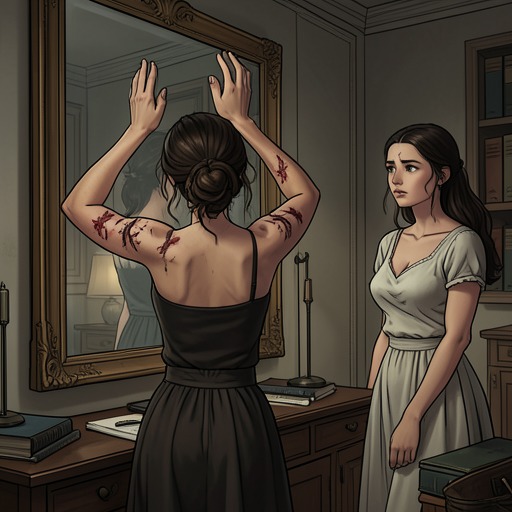
Ella then chooses to show him as much of the damage as she can. In a secluded corner, with Brian seated beside her and shielding her from the rest of the room, she removes the cloak from her shoulders and turns so he can see her back. She describes the extent of the scars, including the damage across her right side and below her hips and the deformity of her toes. She has shown this much of her body only to her doctors and Vivian Euling. By deciding what to reveal and when, Ella makes the disclosure her own rather than letting other people’s staring define it.
Recovery, Care, and Autonomy
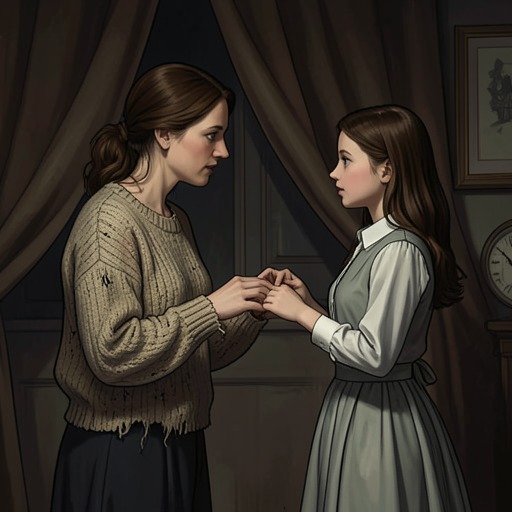
The novel places Ella’s regained mobility beside the limits imposed by care arrangements. While preparing to leave treatment, she asks her father and Dr. Parish to end her father’s guardianship when she is ready to leave the clinic. She is an adult but cannot make her own decisions, and she argues that what her father considers best for his family may not be best for her. Her request is for people who trust her. The scene broadens the meaning of recovery: physical progress matters, but so does the ability to direct one’s life rather than remain the object of other people’s protective decisions.
Across these episodes, Ella’s body is neither a problem solved by recovery nor merely a device for eliciting sympathy. The cane, the inaccessible back seat, the prescribed uniform, and the scars others scrutinize show how injury meets everyday arrangements and social attitudes. The narrative acknowledges the effort behind walking again without making that effort a demand that Ella overcome every barrier alone. Her emerging independence includes both practical support and the right to decide who sees her scars, who touches them, and who is entitled to make choices on her behalf.