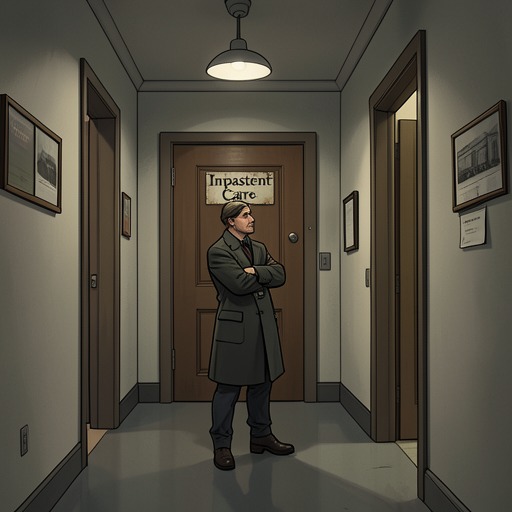
Ella’s mental-health crisis and inpatient treatment
Cinder & EllaElla’s mental-health crisis and inpatient treatment mark a turning point in which accumulated distress becomes impossible to contain, and care itself becomes a question of both safety and self-determination. After harassment intensifies, she breaks down, expresses a wish that she had died with her mother, and accepts Dr. Parish’s proposal that she be admitted. The clinic offers structured support, but its restrictions also sharpen Ella’s need to be trusted and to have a say in her life.
Background: strain in body, school, and family
Ella’s crisis develops in the aftermath of a car accident that killed her mother and left her with lasting mobility limitations. She has regained much of her movement through painful effort and can walk without another person’s assistance, but she still relies on a cane and does not want to spend her life confined to a wheelchair. At school, her fear of exposure is intensified by a uniform requiring short-sleeved tops and knee-length skirts: after spending much of the summer covered from head to toe, she anticipates the cruelty of teenagers and feels unprepared to show her scars.
The obstacles she encounters are not only physical. When Anastasia tells her to walk rather than climb into the back seat of the car, Ella explains that she is physically unable to do so. The incident gives a practical form to a wider pattern: her limitations are treated as inconvenience or unwillingness rather than as access needs. Later, at FantasyCon, Ella explains to Brian Oliver that the staff she carries as part of her costume also serves as a cane, specially made by a friend so she could leave her regular cane at home. She describes her pronounced, painful limp and the time it takes her to move between venues, then names herself as disabled. These details establish the daily realities she manages even before the immediate crisis.
Family conflict compounds that pressure. Juliette admits that she was initially angry about Ella’s arrival, but says Anastasia has made matters worse by trying to turn the school against Ella and intimidating anyone who might be kind to her. Juliette also identifies her own grievance: she believes Ella treats their parents unfairly despite their efforts to help, including her father’s repeated hospital visits in Boston and the work of preparing a room for her. She says Ella’s arrival has intensified conflict in the household and damaged the family’s previous closeness. Ella apologizes, but the accusation that she is making life harder for everyone deepens her sense of being an unwanted intruder.
That sense is reinforced when Ella hears her father and the twins laughing together in the kitchen. Their ease initially makes her smile, then leaves her convinced that the family is happy because she is absent. Rather than enter and interrupt them, she takes her homework to the porch, believing they need a respite from her. Later, Juliette challenges Anastasia’s resentment, saying Ella did not take Rob’s affection or Juliette’s relationship with her; Juliette also argues that the family, not Ella, had effectively taken Ella’s father from her. These exchanges show the household’s conflicts as entangled with grief, divided loyalties, and the family’s efforts to find a place for Ella.
Crisis and decision to seek inpatient care
The immediate breakdown follows renewed harassment. After a brief physical examination, those around Ella conclude that she has a bruised hip and will need extra exercises in physical therapy, but that she is otherwise physically all right. Dr. Parish then asks how she feels. Ella bursts into tears and questions why people are cruel to her and what she has done to deserve it. Reassurance that she has done nothing wrong does not resolve her despair: she says that just as life at school had begun to improve, her tormentors found new material and the ordeal began again, worse than before.
Her questions turn from the latest episode to the prospect of a life defined by repeated mistreatment because she is different. She says she cannot keep trying when it seems to make no difference, is tired of being hurt, and wishes she had died with her mother in the accident. Her father draws her into his arms, but she insists that the thought reflects how she feels. The room falls silent as she sobs. When Dr. Parish suggests hospital admission a few minutes later, Ella is so unhappy that she does not resist; in that moment, admission seems preferable to continuing in her current state.
Life inside the clinic
Ella’s rehabilitation clinic in Beverly Hills is quiet and comfortable, with only a handful of residents, whom the facility calls guests. The setting can feel like a wellness hotel, but treatment structures each day. Dr. Parish visits daily; Ella joins group therapy every other day; a dietitian discusses her meal plan with the kitchen staff; and Cody, her nurse, continues his weekly visits. Daniel, her physiotherapist, also works with her daily. Because of the bruised hip, he increases his visits from the three times a week they had previously scheduled, and his company becomes a welcome part of the routine.
The clinic’s quiet depends on strict separation from the outside world. Ella is allowed to speak only with her doctors, and visitors are initially barred because Dr. Parish considers Ella’s family a major source of stress. Friends, her phone, television, and the internet are also off limits, keeping the scandal around Brian Oliver away from her during treatment. Ella misses her friends and is deeply bored, yet she does not miss the media attention. The restrictions are presented as protective measures, but they also make clear how little control she has over contact with the people and information that shape her life.
About a week after admission, Dr. Parish permits Ella’s father and Jennifer to visit, provided the meetings are supervised. The visit functions as family therapy, and Dr. Parish recommends that Ella and her father continue such sessions regularly. Ella is surprised when her father agrees without hesitation. He tells her that he will do what is needed to repair their relationship, says he has enjoyed having her back in his life, and apologizes for having let her down. His willingness to take part offers a concrete change in their relationship, even as Ella remains unsure that the family home is a place where she can recover.
Autonomy, family conflict, and significance
In a later conversation with Dr. Parish and her father, Ella asks for her freedom. Although she is an adult, her father’s guardianship means that he makes decisions for her; she wants Dr. Parish to lift it when she is ready to leave the clinic. Ella acknowledges that her father is trying to do his best, but argues that what is best for him and his family may not be best for her. What she needs, she says, is people who trust her. Dr. Parish encourages her to explain this directly to her father rather than letting the request remain unspoken between them.
Ella also tells him that recovery is difficult in the presence of his family. In his house she feels unable to breathe, like an outsider and an unwelcome guest who brings trouble to everyone. Her father replies that the situation is an adjustment and that he wants her there. Ella distinguishes his wish from the acceptance she needs from Anastasia and Jennifer. The exchange does not resolve the family conflict, but it gives Ella language for the difference between being cared for and feeling that she belongs.
The crisis is therefore not framed as a problem of physical injury alone or as a simple consequence of Ella’s individual fragility. Her mobility needs, fear of public exposure, school harassment, grief, and strained place in a blended family converge; the clinic offers treatment and distance from immediate pressures, while supervised visits reopen difficult relationships. At the same time, Ella’s request to end her father’s guardianship makes autonomy part of the recovery she seeks. The movement from silent withdrawal on the porch to direct negotiation with her father and Dr. Parish is a significant change: treatment creates space for Ella not only to be protected, but to state what kind of support she needs.