Ellamara Valentina Rodriguez
Cinder & EllaEllamara Valentina Rodriguez is a teenager whose life is first framed as an imperfect but ordinary story, then violently transformed by a car crash that kills her mother and leaves her with severe burns and impaired mobility. Her early trajectory turns the fairy-tale language she uses to understand hardship against the unromantic reality of grief, bodily injury, and social exclusion. Through her blog, her friendship with Cinder458, and her return to school, Ellamara’s identity emerges not only from what happened to her but from the names and connections she works to keep.
Identity and Early Perspective
Ellamara introduces herself through a skeptical reading of fairy tales. Their heroines, she observes, are often made compelling by tragedy and deprivation, experiences that supposedly give them depth and strength. The logic may work as a story-making principle, but it offers little comfort to the heroine required to endure the hardships. Ellamara’s own life, she says, had not been particularly fairy-tale-like: her father had an affair and left her and her mother when Ellamara was eight, but she otherwise considered herself fortunate.
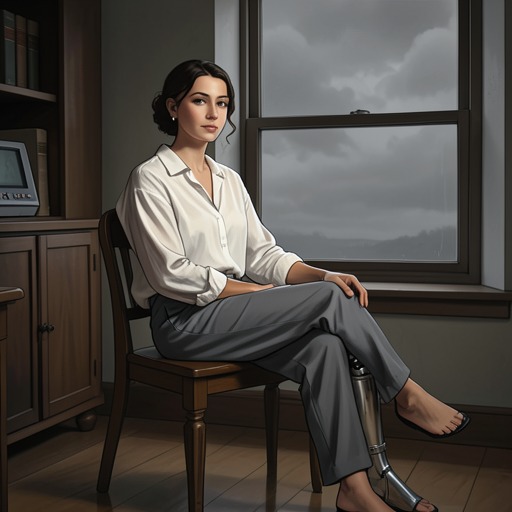
Before the accident, her self-description emphasizes ordinary teenage security rather than exceptional destiny. She is academically capable without much studying, relatively popular, and rarely short of friends or a date on Saturday night. She is also conscious of her appearance: her long, wavy black hair and smooth golden-brown skin come from her mother’s Chilean ancestors, while her large blue eyes resemble her father’s. That account of a life that is good enough, if not magical, makes the crash a rupture in an existence she had not understood as tragic.
Writing and the Friendship with Cinder458
Books and films are central to Ellamara’s interests, and she gives those interests a public form through her blog, “Ellamaras Worte der Weisheit.” She began it at fifteen to review books and movies. As the story opens, she is approaching the blog’s third anniversary, a small marker of continuity in a life soon divided into before and after.
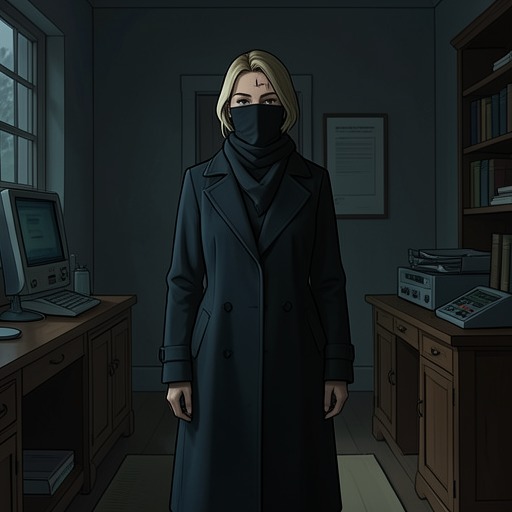
The blog also lies behind her closest friendship outside her mother. Cinder458 discovered it two years earlier, and he and Ellamara have exchanged emails constantly since. She calls him Cinder and considers him one of her best friends, yet their intimacy remains bounded by anonymity: they have never met in person or spoken by telephone. Their written connection is both sustained and incomplete, a relationship that matters deeply to Ellamara without yet having entered ordinary face-to-face life.
Cinder’s messages bring news from the film industry because his father is a powerful figure in that world. When a film adaptation of a popular novel is confirmed, Ellamara is eager to learn who will play its celebrated hero. The question is left unanswered when the crash interrupts the exchange, making the ordinary excitement of a fan conversation part of the life abruptly taken from her.
The Crash and Its Immediate Consequences
A truck carrying long timber slides across a patch of black ice and into the two-lane road where Ellamara and her mother are travelling. Ellamara is looking at her phone and does not see the truck approaching. Her last clear impressions are her mother screaming, her body thrown against the seat belt, and the airbag exploding in front of her face; then consciousness ends. The accident is not a trial arranged by a fairy-tale plot for the heroine’s eventual benefit. It is a sudden collision whose consequences arrive without the consolations of a chosen ordeal.
Ellamara wakes three weeks later in a Boston burn clinic, as doctors bring her out of an induced coma. She has second- and third-degree burns over seventy percent of her body. Her mother has died. These facts establish the scale of the loss in stark succession: Ellamara survives, but waking means entering a life in which her mother is absent and much of her body has been injured. Her earlier expectation that she would learn the casting news is overtaken by the irreversible news of the crash.
Family, Name, and Belonging
After the accident, Ellamara enters her father’s household and meets his daughters, Anastasia Coleman and Juliette Coleman. He introduces her as their new stepsister and presents the twins as his daughters, a distinction Ellamara notices. His easy pride in the family he now stands with sharpens her sense of being newly placed within it, rather than simply returning to the family life she had known before.
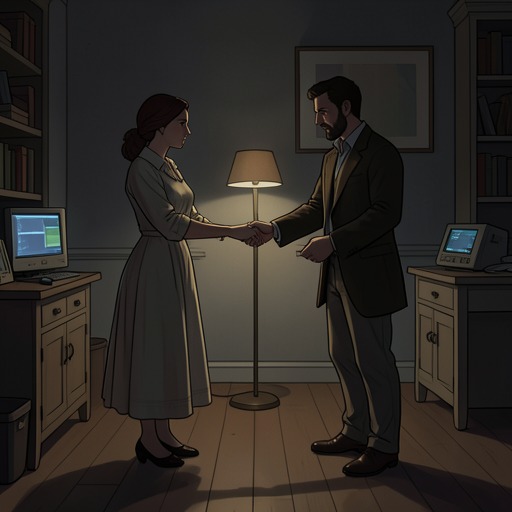
When Ellamara offers a hand, neither twin takes it. Juliette questions the surname Rodriguez, implying that Ellamara should instead be called Coleman. Ellamara answers that she took her mother’s maiden name at twelve. The exchange makes her name more than a point of introduction: it preserves a connection to her mother at the moment when she is being absorbed into her father’s household. Her reply is restrained, but the refused handshake and the challenge to her surname make the limits of welcome immediately visible.
Return to School and Social Exclusion
At her first day back at school, Ellamara wears the winter uniform despite the continuing heat because it covers her skin. Concealment does not spare her from attention. Other students stare at her gait and cane, her long sleeves and tights, and what they know lies beneath the clothing. Her injuries are thus present in the social scene whether exposed or hidden: covering them changes what can be seen but does not make her invisible.
The reactions divide between strained politeness and open cruelty. Some students try not to look, only to let their eyes return to her; they offer forced smiles or speak to her when courtesy requires it. Others gawk, laugh, point, or tease her to entertain their peers. Ellamara receives no invitation to sit with anyone at lunch, and no one attempts to befriend or defend her. Even students who appear sorry for her stay out of it, seemingly afraid of becoming targets themselves. The absence of support compounds the visible injuries with a second barrier: the school’s social environment leaves her isolated precisely when solidarity might have made her return less hostile.
Narrative Significance
Ellamara’s opening arc tests the fairy-tale idea that suffering produces a more compelling heroine by showing the costs that such a neat formulation leaves out. Her accident brings death, a long interruption in consciousness, extensive burns, and a school life reorganized around the way others look at and treat her. The narrative does not make hardship meaningful simply by calling it a path to strength; Ellamara’s early reflections insist that what gives a character depth can still be terrible for the person living through it.
Her relationships and choices nevertheless establish threads of continuity. The blog records an interest she had pursued before the crash, while Cinder’s prompt reply after she writes to him again offers relief and the possibility that she has not lost every friend. In her new family, retaining Rodriguez connects her to her mother, while the first school day reveals how little welcome she can expect from her peers. Together, these details define Ellamara not as a passive emblem of injury, but as a young person negotiating grief, identity, friendship, and a body whose treatment by others becomes part of daily life.