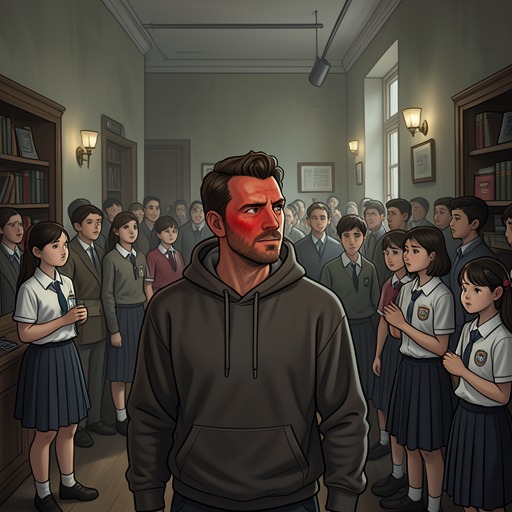
Jason bullies Ella and causes a school altercation
Cinder & EllaJason bullies Ella and causes a school altercation, turning the hostility she had endured in silence into a crisis that others can no longer overlook. The conflict is significant not only for the incident itself, but for what it reveals: Ella’s apparent composure has been a strategy for surviving a school environment where visible difference invites scrutiny, while the people around her have mistaken that silence for evidence that she is coping. The aftermath brings her safety and suicidal history into the open, even as she chooses to withdraw her complaint against Jason.
Background: Harassment and anticipated rejection
Ella’s vulnerability at school is shaped by the injuries she tries to keep covered and the mobility impairment she cannot conceal. Her right side and the area below her waist bear extensive burn scars; she also walks with a limp and uses a cane. When she flies from Boston to Los Angeles, she is mostly covered by shoes, trousers, and long sleeves, yet strangers stare, whisper, point, and recoil at the visible scars on her right hand and her gait. At school, even a winter uniform worn through the heat does not protect her from attention. Students look at her cane, her long sleeves, and her tights, seeming to know what her clothes hide.
The reactions vary in manner but leave her isolated all the same. Some students feign politeness or try not to stare, only to keep looking back; others openly laugh, point, or tease her to entertain their peers. No one befriends her or stands up for her, and even those who appear sympathetic are too afraid to intervene. Ella suspects that some have themselves been bullied and fear becoming targets. The school’s social atmosphere thus makes exclusion feel collective: cruelty is visible, but so is the silence of bystanders.
For weeks, Ella adapts by keeping her head down, doing her schoolwork, and ignoring the taunts she hears from a distance. She does not cry at school; she waits until she is alone in her room. There, she writes to Cinder, whose silly stories and irreverent comments about books and films reliably make her argue back and laugh. He asks about the accident, her mother, and her new family, but she says she is fine or refuses to discuss sad subjects. Cinder does not press her. The correspondence offers relief, but it also helps Ella keep the harsher parts of her life hidden, even from someone she trusts.
The altercation and its immediate aftermath
The available account identifies a school incident involving Jason as a point when the harassment gets out of hand. Ella later tells Cinder that a boy at school had picked on her and that the situation had escalated; she describes the incident as an accident. She does not give him a detailed account of the confrontation in this exchange, and the evidence does not establish precisely how it unfolded. What becomes clear is that the incident has drawn adult attention: her father and the principal learn that she has been bullied and contact Dr. Parish.
The same day, Ella goes to the police station to formally withdraw her complaint against Jason. She then attends an appointment with her surgeon at the burn clinic, accompanied by her father. By the time they return home, after four o’clock, she is exhausted and heads for her room. Her father reminds her of Dr. Parish’s instructions, his voice tense and helpless. The juxtaposition matters: Ella has just taken a formal step that may ease the immediate conflict, but the adults around her are now trying to monitor a risk she has not been willing to discuss openly.
Ella tells Cinder that her father and Principal Johnson have discovered the bullying and contacted her therapist because they fear she might try to kill herself again. She insists that she has been struggling with those thoughts since school began and that the difference is simply that others now know. Her disclosure surprises Cinder, who reacts with alarm and asks what she means by trying again. Ella immediately regrets letting the information slip. The conversation makes the incident a turning point in disclosure: an ongoing crisis that she had kept private has entered the network of adult care, but she has not yet chosen to explain it fully to her closest confidant.
Withdrawing the complaint and changing perceptions
Ella’s decision to withdraw her complaint has a social meaning beyond the police procedure. Juliette later tells her that people at school had been discussing how cool it was of Ella to drop the case against Jason. This report unsettles Ella, who has assumed that she is broadly hated. Juliette argues that, while some students have been cruel, many respect Ella for enduring the bullying without complaining or getting anyone into trouble. Her restraint, initially a way to get through the day, has become visible to others as a kind of resolve.
Juliette also reveals a more personal motive behind the hostility. Rob Loxley had shown interest in Ella and asked Anastasia whether she thought Ella might go to the dance with him. Anastasia had expected Rob to ask her instead; Juliette says that Anastasia became angry and egged Jason on to hurt Ella. The account links the school altercation to jealousy and rivalry, rather than treating the harassment as detached from the relationships among the students. Ella is stunned but believes Juliette, distinguishing her from Anastasia, whom she does not trust. Juliette offers to give Rob Ella’s number, presenting the possibility of a new connection in the aftermath of the conflict.
That support does not erase the harm or make the school safe. Ella is still frightened that a closer relationship would expose her to rejection, and she imagines Cinder judging her scars as other people have. When she later reveals the extent of her injuries to him, she describes a pattern of people staring, laughing, and saying cruel things; students have bullied her despite seeing only her hand and her limp. Her expectation of humiliation is therefore rooted in repeated experience, not simply a private misunderstanding.
Consequences: support, exposure, and lasting fear
The school’s discovery of the bullying changes Ella’s day-to-day circumstances. Her father follows Dr. Parish’s instructions to keep an eye on her, and her therapist’s concerns become part of family life. Yet increased supervision does not automatically mean Ella feels understood: when she tries to retreat to her room after the police station and clinic, her father’s anxious reminder makes his helplessness audible. The incident brings adults closer while also exposing how little they had known about the strain she was carrying.
The wider record of harassment shows why that strain persists. At school, Ella’s scars and limp make her a target even when they are partly concealed. Later, after Ella has formed closer bonds with Juliette, Vivian, and Rob, classmates deface her locker with insults including “Psycho,” “Stalker,” “Whore,” “Loser,” “Freak,” and “Cripple.” She tells herself that these are only words, that her classmates may be jealous, and that having three friends who support her matters more. Still, seeing the locker vandalized hurts. Juliette responds by offering to call their parents so Ella can leave school for the day. The gesture contrasts sharply with the earlier absence of anyone willing to sit with her at lunch or intervene.
The altercation also foreshadows the larger conflict between private survival and public exposure. Ella fears that, if the world learns the details of her accident, her scars and suicidal history will become entertainment. When she later ends her relationship with Brian, she cites the prospect of reporters spreading images of her injuries and turning the loss of her mother and her suicide attempt into public spectacle. She also fears that the attention would damage Brian’s career and subject her to renewed ridicule. In a subsequent therapy conversation, she links that fear to the earlier fallout: after only an hour with Brian, she had become a national target, and he had been forced to lie publicly about their relationship. The school bullying is not the same as media harassment, but both teach her to anticipate that other people may seize control of her story.
Narrative significance
The conflict is presented through Ella’s limited first-person perspective, which distinguishes what she knows from what she fears. She initially experiences the school as a place where everyone sees her injuries and no one will defend her; later, Juliette’s account complicates that certainty by revealing respect, interest from Rob, and Anastasia’s jealousy. The change does not invalidate the cruelty Ella has endured. Instead, it shows how isolation leaves her with little access to the motives or sympathies of those around her.
The episode also makes the difference between bodily injury and social disablement concrete. Ella’s scars, limp, and cane are real features of her daily life, but the staring, mockery, exclusion, and reluctance to intervene turn those differences into grounds for mistreatment. Withdrawing her complaint can be read as a choice that other students admire, yet the narrative does not present that choice as a cure: it coexists with suicidal distress, guarded communication, and fear of future exposure. The school conflict thus marks both a limit to Ella’s silent endurance and the beginning of a more visible support network, while leaving the underlying threat of stigma unresolved.