Juliette Coleman
Cinder & EllaJuliette Coleman, one of Ella Coleman’s twin stepsisters, develops from a distant and often unkind presence into one of Ella’s defenders. Her arc is neither a sudden conversion nor uncomplicated affection: she initially participates in ignoring Ella, but steps in when Ella is hurt, helps her find a friend, and eventually confronts both Anastasia’s hostility and her own assumptions about Ella’s place in the family.
Identity and Introduction
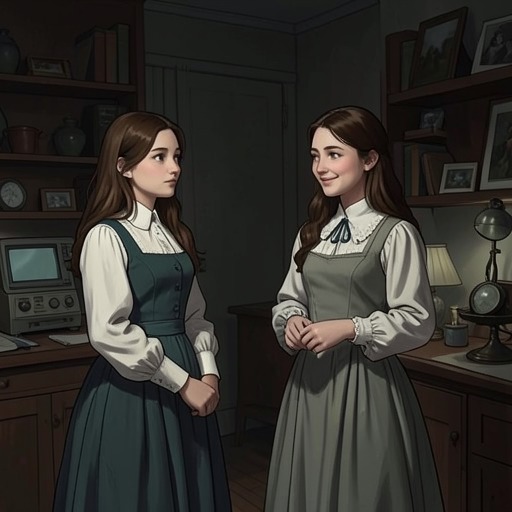
Juliette is the blonde twin, with long curls falling in waves to her waist; her sister Anastasia wears a sharply angled bob. The two resemble each other closely enough to be mistaken for one another, and both are tall, strikingly beautiful, and more than a year younger than Ella. Their appearance offers an immediate visual contrast with Ella, who arrives in a family already formed around her father, Jennifer Coleman, and the twins.
At their first meeting, the twins respond not with a welcome but with alarm about Ella’s appearance after her burns. Juliette says they had searched online for images of burn victims and found the scars disgusting. Jennifer gently rebukes the girls for speaking about another person’s disfigurement, but Ella hears the remark as evidence of how the family sees her. Juliette’s first impression is therefore bound up with the book’s recurring conflict between a person’s lived body and the assumptions other people impose on it.
Distance and School Conflict
On Ella’s first day at Beverly Hills Prep Academy, classmates stare, laugh, point, or avoid her, while few are willing to risk befriending her. Juliette and Anastasia offer no refuge: although they share classes and the same lunch period with Ella, they follow what Ella understands as a strategy of pretending she does not exist. After school, when Anastasia refuses to let Ella sit in the front of the twins’ small convertible and tells her to walk rather than climb into the back, Juliette initially goes along with the trip. She eventually tells Anastasia to get in, but the exchange leaves Ella exposed to her stepsisters’ contempt as well as the school’s.
Juliette’s willingness to intervene becomes clearer during Jason’s attack on Ella. When Jason yanks up Ella’s arm and tears the vulnerable skin near her elbow, Ella cries out in pain. Juliette arrives with a teacher, pulls Jason away, and angrily denounces him before kneeling beside Ella to ask whether she is all right. The response contrasts sharply with her earlier passivity: when Ella’s injury is no longer an abstract difference to comment on but an immediate act of violence, Juliette acts on her behalf.
Her defense does not mean that she has fully understood the danger Ella faces. Juliette later reveals that Jason had asked Anastasia to attend the Halloween dance with him again, and Anastasia had agreed only if he could make Ella show her scars to everyone. The disclosure explains a motive behind Jason’s harassment and reveals that Ella’s body has been treated as an object of spectacle in the twins’ conflict. Juliette’s disclosure makes the scheme known to Ella and her father, even though Juliette herself had not prevented the original plan.
A Difficult Turn Toward Friendship
Juliette’s change is most visible in an apparently small gesture: she introduces Ella to Vivian at lunch. Juliette presents them to each other, lets them shake hands, and leaves after announcing that her job is done. Vivian soon suggests that Juliette is trying to set them up as friends. The introduction is a deliberate attempt to give Ella a companion, undertaken despite Juliette’s lingering reluctance to be close to her herself.
That gesture follows a confusing stretch in their relationship. Juliette has moved from open unfriendliness to ignoring Ella and then to defending her from Jason; now she risks Anastasia’s anger to help Ella meet someone. Ella cannot reconcile the kindness with her impression that Juliette still dislikes her. Later, after Anastasia storms away and tells Ella to stay away, Juliette dismisses her sister’s reaction and goes to do homework. Ella joins her in the living room, offers her a fruit juice, and asks what Juliette’s problem with her is. The question turns their strained cohabitation into a direct confrontation rather than leaving resentment unspoken.
Juliette answers that she resents Ella’s treatment of Jennifer and their father, Richard Coleman. She believes they have done everything possible to make Ella comfortable: her father spent so much time in Boston while Ella was hospitalized that he nearly lost his job, and the family renovated her room and provided what she needed. In Juliette’s view, their efforts to make Ella happy are met with blame. Her anger exposes the mistaken account through which she has interpreted Ella’s behavior, but it also shows that her hostility is rooted in protectiveness toward her parents rather than simple indifference.
Defending Ella and Rethinking the Family
Juliette’s clearest break with Anastasia comes when her sister complains that Ella has taken Rob’s attention and Juliette’s friendship. Juliette rejects both accusations. Ella, she points out, has been honest with Rob about her feelings for Cinder; Rob is the one who continues to pursue her. Juliette also insists that Ella has not stolen her from Anastasia. She says she cannot bear Anastasia’s constant complaints about Ella and argues that their father ought to give Ella more attention because he abandoned her. If anyone has taken someone from someone else, Juliette says, it is the twins who took Ella’s father from her.
This argument revises Juliette’s earlier emphasis on what the family has done for Ella. She recognizes that the new household’s generosity cannot erase the history of Ella’s loss, and that expecting Ella to forgive them is itself asking something substantial of her. The shift does not remove their disagreements, but it changes Juliette’s understanding of which person in the family has been deprived and why Ella’s hurt cannot be dismissed as ingratitude.
Juliette also reframes the timing of Brian Oliver’s renewed contact with Ella. She is glad that Cinder has managed to reach her because the good news gives Ella something to focus on other than the first anniversary of the worst day of her life. In defending Ella’s happiness, Juliette asks Anastasia to recognize that not every event should revolve around her resentment. Her advocacy connects private family repair with the broader support Ella needs as the anniversary of the accident returns.
Ongoing Support and Significance
Juliette’s support takes practical forms as well as verbal ones. When she and Ella are preparing to attend FantasyCon, Juliette’s involvement is part of the chain that brings Ella a costume assembled with Vivian’s help: Vivian explains that she nearly revealed the surprise, but Juliette would have been furious. The outfit includes a sleeveless, backless gown that makes Ella fear exposing her scars, as well as a white cape and long satin gloves that can cover them. Juliette’s role in arranging the surprise is indirect in the available account, but it shows her participating in an effort to help Ella enjoy something she loves while retaining control over what she reveals.
Later, when Ella discovers cruel slurs written across her locker, Juliette stands with Vivian and Rob as they see the words. Ella tries to tell herself that the insults are false and that the support of three friends should be enough, but the vandalism still hurts. Juliette places a hand on her shoulder and suggests calling their parents so Ella can be excused from school for the day. The gesture does not erase the abuse; it offers immediate care and a way out of the hostile setting.
Juliette’s arc gives the blended family’s reconciliation a necessary complication. She is not simply kind from the start: she participates in Ella’s exclusion, misreads Ella’s pain as unfairness toward their parents, and must confront how the family’s past looks from Ella’s position. Yet she becomes capable of defending Ella before teachers, classmates, and her own twin, and of translating that recognition into friendship-making and practical support. Her movement from silence to intervention shows that belonging in this family is not automatic; it has to be made through changed perception and acts that place Ella’s needs alongside, and sometimes ahead of, the twins’ grievances.