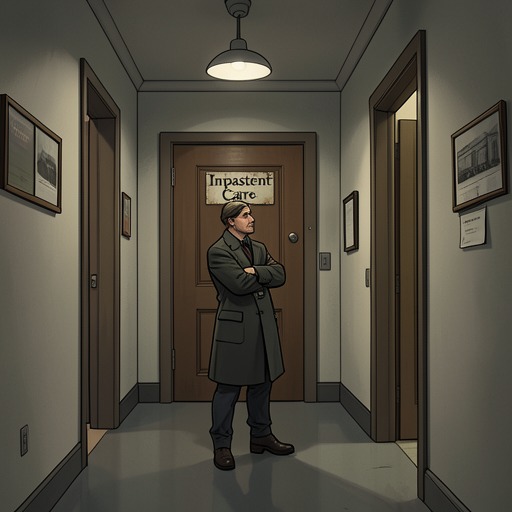
The treatment center’s isolation and visitation rules
Cinder & EllaThe treatment center’s isolation and visitation rules structure Ella’s early inpatient care as both protection from overwhelming pressures and a restriction she must eventually move beyond. They exclude visitors and contact with friends, phones, television, and the internet, then gradually permit supervised family visits; the shift exposes the tension between creating safety for Ella and allowing her to regain control over her relationships and decisions.
Purpose and Scope
Dr. Parish explains that Ella’s stay is meant to give her a calm, stress-free environment in which to rest and recover. The no-visitors rule reflects the clinicians’ view that Ella’s family is a major source of stress. The bans on friends, her phone, television, and internet access serve a separate but related purpose: keeping the public storm surrounding Brian Oliver away from her.
The restrictions therefore address two kinds of pressure at once. They limit difficult personal contact while also cutting off the media environment that has made Ella’s connection to Brian a public spectacle. Ella misses her friends and finds the enforced inactivity intensely boring, but she also acknowledges that she does not miss the media attention. Her response makes the policy neither simply welcome nor simply resented: it isolates her, yet temporarily removes a burden she has no wish to carry inside treatment.
From Isolation to Supervised Contact
The full separation does not last indefinitely. About a week after Ella is admitted, Dr. Parish allows her father and Jennifer to visit, on the condition that the time together is supervised. The visit is effectively family therapy rather than an ordinary reunion, and Dr. Parish recommends that Ella and her father continue such sessions regularly.
The change is a deliberate transition from exclusion to structured contact. Supervision preserves a clinical boundary around a relationship that remains emotionally difficult, while the therapeutic setting gives Ella a chance to address what has gone wrong between them. Her father accepts the recommendation without hesitation, surprising Ella; the rules thus become a route toward direct conversation, not only a barrier against outside contact.
Family Conflict and the Limits of Protection
The need for those boundaries is rooted in the strained relationships within the Coleman household. Juliette tells Ella that she has grown tired of Anastasia trying to turn the school against her, but she also confronts Ella about how she treats their parents. Juliette believes her father and Jennifer have tried hard to help Ella, while Ella’s arrival has intensified arguments at home and conflict between the twins. Later, Ella hears the family laughing together in the kitchen and stays outside rather than interrupt what she reads as their happiness, convinced that her presence makes the atmosphere collapse.
That sense of not belonging carries into the supervised conversations. Ella tells her father that being around his family makes recovery harder: she feels like an outsider and an unwelcome source of trouble. The clinical boundaries can regulate contact, but they cannot make the blended family feel safe or resolve the competing experiences of care, resentment, and obligation. The visits bring those conflicts into the open instead of concealing them behind the appearance of a reunited household.
Recovery, Trust, and Autonomy
Ella’s request to be trusted is shaped by an earlier crisis and by the legal restrictions that followed it. At seventeen, after months in hospital, repeated operations, severe pain, grief for her mother, and being told she might never walk again, she attempted suicide. Later, at eighteen, she planned to remain in Boston, finish high school online, and attend Boston University; her father responded by having her declared mentally unstable through the courts and forcing her to move to California. By the time she asks to leave the treatment center, the restrictions on contact sit within a larger struggle over who gets to decide what safety and recovery mean.
In a family-therapy conversation, Ella asks her father to let her go and asks Dr. Parish to lift his guardianship when she is ready to leave. She says that being an adult without authority over her own decisions leaves her dependent on someone who feels almost like a stranger, and that what she needs is people who trust her. She is not asking to erase the relationship with her father: she proposes getting to know one another through meals, movies, and conversation, while rejecting coercion into a family role she does not feel is hers. The rules’ movement from total isolation to supervised visits parallels her larger demand that care should support recovery without becoming permanent control.
Ending and Significance
By the film premiere, the guardianship has ended: Juliette reminds their father that Ella is nineteen and that he is no longer officially her guardian. His joking attempt to impose a one o’clock curfew shows that the old protective authority still lingers in family habits, while Juliette’s protest recognizes Ella’s restored legal independence. The treatment center’s restrictions are therefore part of a temporary framework whose endpoint matters: Ella can accept support and maintain ties without remaining cut off or having every decision made for her.