Traumatized body and social stigma
Cinder & EllaElla’s scarred and disabled body is both the material aftermath of the car accident and the focus of social stigma. The novel traces how burns, pain, and impaired mobility affect her daily life, while other people’s stares, slurs, and assumptions turn those injuries into exclusion. Concealment offers Ella a measure of control, but it cannot keep prejudice out of the spaces she must enter; when she finally chooses to be seen by Brian, that private disclosure is exposed to cameras and recast as public scandal.
Injuries, mobility, and everyday life
Ella’s recovery is measured in difficult, hard-won movement. Doctors initially doubted that she would walk again, but she fights through the pain and regains much of her mobility. By the time she returns to her father’s home, she can get out of the car and stand using her cane, then make the long, slow walk up the driveway without another person’s help. Her pride in this achievement sits beside the limits that remain: she has a pronounced limp, walking hurts, and she moves slowly. She is grateful to be walking, but does not want a wheelchair to define the rest of her life.
The injuries are extensive as well as disabling. Ella tells Brian that the car caught fire and that burns cover more than seventy percent of her body. The scars run down her right side and cover the area from her hips downward; her feet are badly burned, leaving her toes deformed. The damage is not an abstract sign of suffering: it affects how she walks, what she can wear, how long it takes her to get places, and how much of herself she is willing to show. She relies on a cane, and at FantasyCon her friend arranges for her costume staff to serve as a substitute so she can leave her ordinary cane at home.
Ella’s account also makes clear that recovery has not erased the consequences of the accident. She faces a thirty-seventh operation in January and is still grieving her mother while struggling to live with the changes to her body and future. Her determination to walk is meaningful, but the story does not treat regained mobility as proof that the injury is over. Pain, repeated medical treatment, and the need for practical support remain part of her life.
Concealment and the social gaze
Ella learns to manage other people’s reactions by managing what they can see. On the flight from Boston to Los Angeles, she wears shoes, trousers, and long sleeves; only the scars on her right hand are exposed, along with her limp. Even so, fellow passengers stare, whisper, point, and flinch. The experience makes her anticipate what will happen when she goes out in a tank top and shorts. The threat is not simply that her scars might be visible: she expects visibility to make her an object of scrutiny.
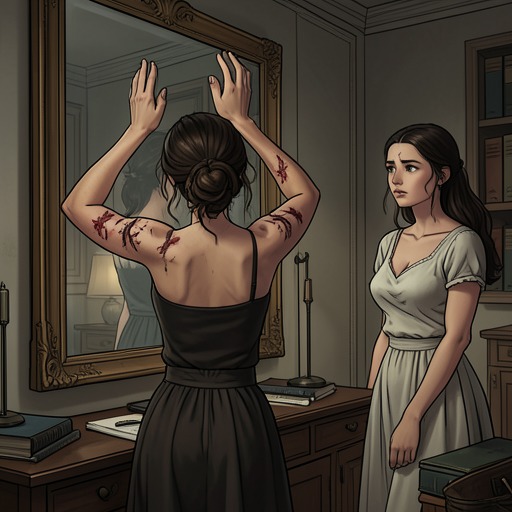
At home, the word “deformities” makes that fear personal. When Juliette describes burn victims’ facial scars as disgusting, Jennifer gently objects to speaking that way about other people, but Ella hears the stigma in the word and wonders whether Jennifer sees her as deformed. Her face escaped injury, yet the right side of her body from shoulder downward and everything below her waist are covered in thick, rough, reddened scar tissue that contrasts with her ordinary skin tone. The family scene shows how a supposedly general judgment about injured bodies can suddenly become a judgment about someone present in the room.
Clothing and school rules make concealment harder. At Beverly Hills Prep Academy, Ella wears the winter uniform despite the continuing heat because its long sleeves and tights cover her skin. The school’s usual uniform includes short-sleeved white polo shirts and pleated navy skirts, garments that would expose more of her scars. Yet covering herself does not make her disappear: classmates stare at her cane, her long sleeves, and her tights, seeming to know what she is hiding. Some force themselves to look away or offer strained politeness; others openly laugh, point, and tease her. No one befriends her or invites her to sit with them at lunch, and even students who seem sympathetic are too afraid to stand beside her.
The novel also shows stigma operating through access, not just appearance. After a difficult school day, Anastasia refuses to sit in the back of the car for the year and tells Ella to walk instead. Ella explains that she physically cannot climb into the back; Juliette intervenes and tells her sister to get in. The exchange exposes the gap between a mobility impairment and other people’s willingness to accommodate it. Ella’s limitations are real, but the added barrier comes from a step-sister treating access as an inconvenience rather than a need.
Trust, disclosure, and the scarred body
Ella’s fear of rejection shapes her relationship with Cinder before she knows his identity. She is already in love with him, but assumes that a handsome boy who can have anyone he wants would not want her once he saw her scars. She worries he might remain her friend but be ashamed to introduce her to attractive friends, like her step-sisters, or recoil from her as Jennifer did. A meeting would make the change irreversible, so she keeps the truth that she lives in Los Angeles to herself. Concealment protects not only her body but the intimacy she fears losing.
At FantasyCon, Ella’s costume gives that tension a visible form. Her family gives her tickets to the convention, while Vivian helps create her character’s outfit: a sleeveless, backless dress, a white cape, and long white satin gloves. Ella loves the dress but knows it will reveal many scars. The gloves are an accommodation, covering her arms while letting her take part in the event dressed as a favorite character. They allow her to choose how much to disclose, rather than making participation depend on either hiding completely or exposing everything.
When Ella and Brian meet privately at the restaurant, she decides that knowing his true identity means he should know the truth about her. She explains that the staff she carries is also a cane, that walking is painful and slow, and that she is disabled. Then she pulls off one glove and offers him her scarred hand. Brian draws in a breath, but takes her damaged fingers gently and kisses the scarred skin. Ella stiffens, yet does not withdraw; apart from her doctors, he is the first person she has allowed to touch her scars. In that moment, the body she has learned to guard becomes part of an intimacy she is choosing rather than merely enduring.
Ella continues the disclosure by removing her cape and showing him the scars across her right side and lower body, including her badly burned feet. She tells him that strangers stare, laugh, and say cruel things, and that students bully her despite having seen little beyond her hand and the way she limps. She also exposes the scars on her wrists, which carry a different and deeply personal history. The disclosure is not a simple revelation of appearance: it is a carefully chosen act of trust, made possible by Brian’s attention and the privacy of their secluded corner.
Public exposure and renewed stigma
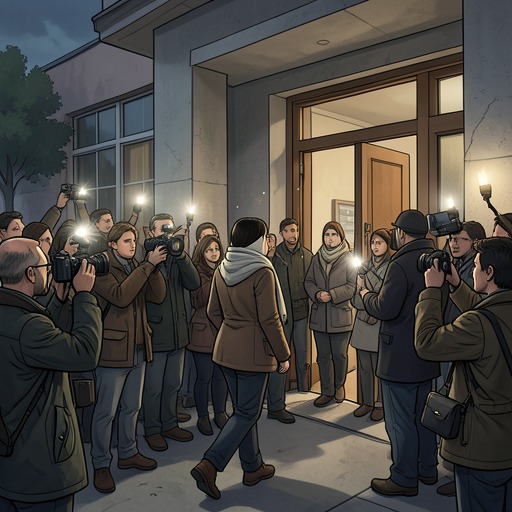
That privacy does not last. When other people notice Ella’s scars and question Brian about them, she realizes that she is uncovered: she has neither cape nor gloves. Photographs are being taken, and she expects them to reach news outlets before she can get home. Brian pulls the cape back around her shoulders and holds her as she sobs, but his protection cannot prevent the images from being made. A moment she chose to share with one person becomes an involuntary public spectacle.
The scandal turns the visible and the concealed into weapons against her. Brian’s false account may protect his reputation, but it leaves Ella framed as a disturbed stalker who tried to come between him and Kaylee, the supposedly perfect couple. Her email fills with hate, and cruel comments overrun her blog and social-media accounts. At school, classmates call her a liar for claiming to know Brian, although she had never even implied that they were friends. The stigma attached to her body becomes entangled with a false story about her character.
The harassment takes material form on Ella’s locker, where classmates write insults including “Psycho,” “Stalker,” “whore,” “Loser,” “Freak,” and “Cripple.” Rob, Vivian, and Juliette accompany her toward the school building and challenge students who approach, but their presence only keeps some of the bullies at a distance; it does not stop the laughter and taunts. Juliette offers to call their parents so Ella can leave school for the day. Ella tries to tell herself the words are untrue and that the support of three friends matters more, yet seeing the defaced locker still hurts. Friendship offers a counterweight to isolation, not immunity from it.
Bodily difference, stigma, and autonomy
Across these episodes, the novel distinguishes the physical effects of injury from the social burdens imposed on Ella. Burned skin, pain, a limp, and limited mobility are not invented by prejudice; nor does positive attention erase them. But staring, mockery, exclusion, inadequate accommodation, and unwanted publicity add barriers that the injuries alone do not explain. Even well-meant concern can make Ella feel reduced to a spectacle, as when a family member’s reaction to seeing her scars leaves her exposed to someone else’s shock rather than met as an ordinary person.
The repeated acts of covering and uncovering register a struggle over control. Long sleeves and tights help Ella limit what classmates see, while the gloves and cape at FantasyCon let her participate on terms that account for her scars. Her deliberate removal of the glove and cape for Brian reverses the usual pattern: for once, she decides who sees her and why. The cameras undo that choice by carrying the image beyond the private encounter and removing her control over its audience.
The same question of control informs Ella’s later request to leave her father’s guardianship when she is ready to leave the clinic. She says she is an adult who cannot make her own decisions and asks for people who trust her. The request extends the conflict beyond concealment: support and safety matter, but they cannot substitute for self-determination. Her scars and mobility needs are part of her life, not a reason for other people to claim permanent authority over it. The novel’s treatment of the scarred body therefore joins physical recovery to a broader demand: to be seen without being reduced to injury, and to receive care without surrendering the right to choose.