Anastasia Coleman
Cinder & EllaAnastasia Coleman, the twin daughter of Jennifer and Rich Coleman, is Ella Rodriguez’s stepsister and an early, persistent antagonist in Ella’s life after moving to Los Angeles. Her polished appearance and social confidence stand in stark contrast to her treatment of Ella: she regards Ella’s burns and mobility disability as a source of embarrassment, excludes her at home, and is identified as the chief bully at school. Though Juliette later challenges Anastasia’s behavior and speaks in Ella’s defense, Anastasia’s hostility helps shape Ella’s sense that she must conceal her body and protect herself from public scrutiny.
Identity and First Impressions
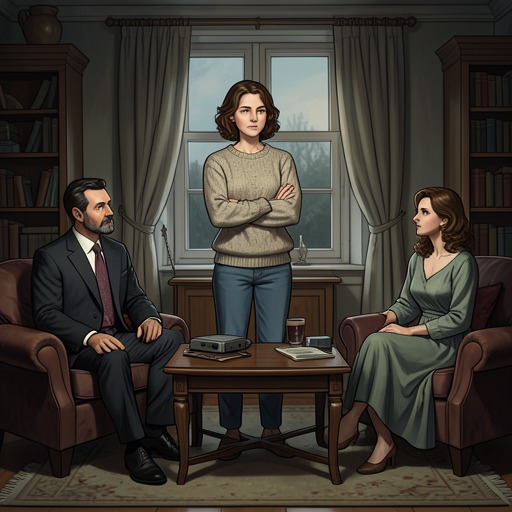
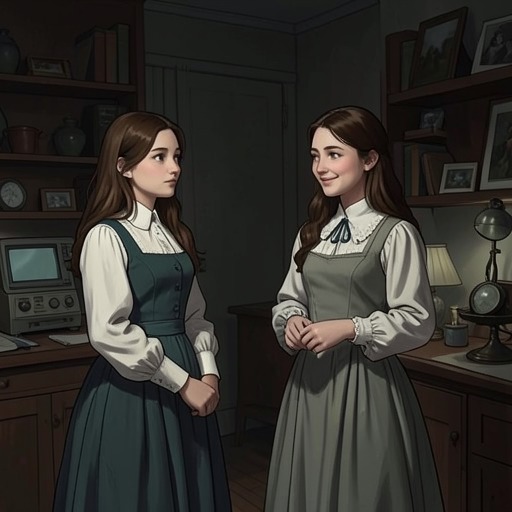
Anastasia arrives home with her twin sister Juliette, and the two are initially easy to confuse. Juliette’s long blonde curls distinguish her from Anastasia’s sleek, angled bob, which falls across her face and ends at her chin. Both girls are strikingly beautiful, blue-eyed and tall; wearing heels, they are nearly Rich’s height despite being more than a year younger than Ella. Anastasia’s immaculate hairstyle and composed, fashionable presentation establish the polished family image that Ella feels she cannot match.
The twins do not begin with a simple greeting. Anastasia presses a hand to her chest in relief that Ella’s face has not been disfigured. Juliette follows by saying that they had searched online for images of burn victims and found the scars disgusting. Their remarks make clear that the sisters have approached Ella’s arrival through the spectacle of injury rather than through curiosity about her as a person. Jennifer mildly rebukes them for speaking of other people’s disfigurement, but Ella registers the word as a judgment of her own body: although her face escaped injury, thick, rough, red scar tissue covers her right side from the shoulder down and extends below her waist.
Rich introduces the twins as his daughters, rather than as stepdaughters, and presents Ella as their new stepsister. Ella offers her hand and introduces herself as Ella Rodriguez, explaining that she took her mother’s maiden name at twelve. Anastasia does not accept the gesture; Juliette instead challenges the surname, asking why Ella is not a Coleman. The exchange sets up a family in which Ella’s place is formally recognized by Rich but not readily welcomed by his daughters.
Exclusion at Home and School
Anastasia’s hostility becomes a repeated domestic routine. Ella tells Dr. Parish that she and the twins speak mainly when they call to tell her to hide in her room before bringing friends home, or to notify her when it is safe to come out again. Anastasia makes the purpose explicit when she phones Ella before visitors arrive: she calls her a derogatory name for a stepsister, says her friends are frightened of dogs, and orders Ella to lock herself in her room. The friends’ laughter in the background makes the call a performance of humiliation rather than a considerate warning. Dr. Parish suggests that the calls might be an awkward attempt to include Ella; Ella points out that the insult and the audience make that interpretation untenable.
At school, the twins share at least one class with Ella and have lunch at the same time, but Anastasia and Juliette follow what Ella experiences as a strategy of acting as if she does not exist. Their only exchange that day occurs in the parking lot. Anastasia opens the passenger door of her tiny convertible and says that parking in a disabled space is embarrassing. Juliette takes the driver’s seat and points out that the space is convenient because it is close to the exit and helps them avoid traffic. Anastasia then pulls the passenger seat forward and gestures for Ella to climb into the back. Ella explains that she cannot climb in that way. The episode turns an ordinary ride home into a pointed demonstration that the twins do not accommodate her mobility needs and treat the access arrangements she requires as a social inconvenience.
Ella’s first day at school supplies a wider context for Anastasia’s conduct. Even in a winter uniform that covers her skin despite the heat, Ella is stared at for her cane and the clothes that conceal her scars. Some students laugh, point, and tease her; others avoid intervening or inviting her to sit with them. Anastasia’s behavior at home is of a piece with this public isolation, and Ella anticipates that her stepsisters will offer no protection from it. Over the following weeks, Ella learns to keep her head down, complete her schoolwork, and hold back tears until she is alone in her room.
Bullying and Its Consequences
The family eventually confronts the school bullying, and Juliette names Anastasia when Rich demands to know who is leading it. The room falls silent. Juliette says that Anastasia outdoes everyone else at the school with ease. This accusation changes the shape of the conflict: Anastasia is not merely one more student participating in a hostile atmosphere but, in her twin’s account, its principal instigator. Rich reacts with shock and anger, while Ella later notices that Anastasia has been reprimanded and apparently received a severe punishment. Anastasia’s glare tells Ella that the discipline has not produced an immediate change in her attitude.
Anastasia also exposes Ella’s private connection with Cinder. When Ella asks Rich whether she may speak to her online friend in her room, Anastasia recognizes the name from the comments he leaves on Ella’s blog and loudly announces that Ella has an Internet friend, calling her a freak. Her outburst is loud enough that Cinder may hear it through the call. Instead of treating Ella’s friendship as a source of comfort, Anastasia turns it into another public occasion for ridicule, intruding on a relationship that Ella has kept emotionally important and carefully protected.
The effects of such stigma extend beyond Anastasia’s insults. On the flight from Boston to Los Angeles, Ella had covered nearly all her scars with shoes, trousers, and long sleeves, yet other passengers still stared, whispered, pointed, and flinched at the scars on her right hand and her limp. At school, she likewise covers her body and is still watched. Anastasia’s contempt reinforces the expectation behind Ella’s concealment: that a visible difference will be treated not as part of her lived experience but as something that makes her unfit for ordinary company. Later, when Ella tries to imagine meeting Cinder, she fears he might be ashamed to introduce her to his attractive friends, as she believes her stepsisters are ashamed of her.
A Contrast with Juliette
The twins’ responses to Ella eventually diverge. Juliette reads Ella’s exchanges with Cinder and finds the writing entertaining; she describes the pair’s banter as resembling a romance heroine trading barbs with a pirate. More importantly, she tells Anastasia that Ella is funny, clever, kind, and, overall, someone Anastasia might like if she gave her a chance. Juliette directly names the imbalance in their relationship: Anastasia has been mean to Ella since she arrived, while Ella has accepted Anastasia better than she deserves.
Anastasia answers that Ella never gave her a chance either, but Juliette challenges the excuse by pointing out that Anastasia’s own cruelty has prevented such a chance. The exchange marks a meaningful contrast between the sisters. Juliette, once distant, comes to speak up for Ella and is surprised by the force of her own defense; Anastasia remains resistant, treating herself as the injured party rather than acknowledging how her conduct has shaped Ella’s response. The disagreement does not establish a reconciliation, but it shows that Anastasia’s hostility is not accepted by every member of the family as inevitable or justified.
Narrative Significance
Anastasia’s role is closely tied to the novel’s treatment of visible disability and social stigma. Ella’s scars and limp are repeatedly made subjects of other people’s looks, comments, and decisions about where she may belong. Anastasia contributes to this pressure at home by treating Ella’s body as an embarrassment, on the way to school by treating accessible parking as shameful, and in public settings by turning Ella’s private friendships into material for mockery. Her conduct helps make Ella’s fear of being seen more than a private insecurity: it is a response to repeated, concrete acts of exclusion.
That pressure becomes especially consequential as Ella grows close to Brian Oliver, whom she also knows as Cinder. At FantasyCon, Ella’s costume includes a sleeveless, backless dress that would reveal many scars; a white cloak and long satin gloves allow her to wear the character’s look while covering them. When she later shows Brian the extent of her injuries, she explains that only her doctors and Vivian have seen them, and connects concealment to the cruelty and bullying she has endured. She worries that the people surrounding Brian’s career and his fans would reject her, and that public attention would expose her accident, her mother’s death, and her past suicide attempt as entertainment. Anastasia is not responsible for those later media fears, but her earlier treatment belongs to the pattern that makes Ella anticipate rejection and choose concealment.
After Ella refuses to begin a relationship with Brian, she tells Dr. Parish that his warning about his public world proved right: within an hour of being with him, she had become a national joke, and Brian had been made to pretend she meant nothing to protect his career. She fears further public judgment about her appearance and does not want to damage him. Anastasia’s earlier insults do not explain the whole decision, but they form part of the history through which Ella understands what exposure may cost. As a character, Anastasia therefore functions both as a particular family antagonist and as a domestic embodiment of the stigma that later expands into school harassment and public scrutiny; Juliette’s willingness to challenge her offers a contrasting, limited possibility of solidarity.