Belonging in a blended family and repairing the father-daughter relationship
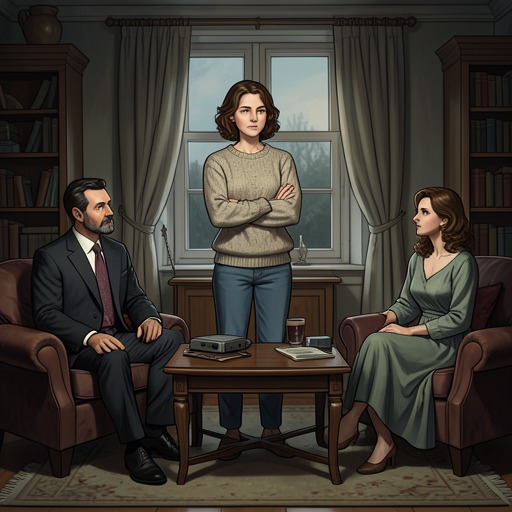
Cinder & EllaBelonging in a blended family and repairing the father-daughter relationship form a sustained, uneasy process rather than a clean reunion. Ella enters the Coleman home carrying the memory of a father who disappeared from her childhood, while the family she joins already has its own bonds and history. Her father’s efforts to help and welcome her coexist with her grief, anger, and envy; the new household’s conflicts, in turn, make her feel that her presence is damaging the family. The possibility of repair emerges when these feelings are spoken plainly, not erased: her father offers to be there for her, and Ella accepts the possibility of a relationship while insisting that trust will take time.
A divided history of fatherhood
Ella’s difficulty feeling at home begins before she arrives in the Coleman household. When she was eight, her father left without saying goodbye, leaving no note and making no call. She grew up without him, while he built a close family life with Jennifer and her daughters. That contrast turns his new household into more than unfamiliar surroundings: Ella sees the father she wanted embracing and caring for the girls who call him Dad. She fears that he took her in because he had to, rather than because he wanted her.
The Coleman family’s past is also shaped by a different kind of rupture. Jennifer tells Ella that her former partner treated her and the girls badly. She met Rich while he was doing free legal work for a battered women’s shelter in Boston, where Jennifer was living with her daughters and hiding them from their father. Rich helped them, and they came to love him; Jennifer describes him as entering their lives like a guardian angel. Anastasia, in particular, has always been close to him and fears that Ella could take her father away. The same man therefore occupies sharply different places in the family’s memory: to Jennifer and her daughters he is the protector who arrived, while to Ella he is the father who left.
Jennifer’s account helps explain how Rich became central to the Coleman household, but it does not make Ella’s abandonment less painful. Indeed, the image of Rich as a rescuer sharpens her question about why he could help others while leaving her and her mother alone. The family’s different histories of attachment cannot be reconciled by simply naming him a good father or a bad one; the story places his care for Jennifer’s daughters beside the harm his absence caused Ella.
The strain of becoming a family
The arrival of a new family member unsettles relationships across the household. Juliette admits that she was initially angry about Ella moving in, but argues that Ella keeps to herself and that Anastasia is the one making matters worse by trying to turn the school against her and discouraging others from being kind. Juliette says that she is tired of the conflict and believes everyone’s life would be easier if Anastasia stopped escalating it. Her account shows how hostility spreads beyond the two girls: the family’s attempt to absorb a newcomer is entangled with school life and with the twins’ own relationship.
Juliette also explains her resentment in terms of Ella’s treatment of their parents. She says Rich nearly lost his job because he spent so much time in Boston while Ella was hospitalized; the family renovated Ella’s room and tried to give her what she needed, hoping to make her happy. In Juliette’s view, Ella responds by blaming them. Juliette’s defense of Rich is personal: although he is not her biological father, he has raised her since she was seven and has never treated her as less than his daughter. She sees Ella’s anger toward him as unfair, while Ella sees Juliette’s closeness to him as a reminder of the love she was denied.
The confrontation makes the competing injuries explicit. Ella recalls years of sending her father photographs, drawings, cards, and letters saying she missed and loved him and begging him to visit. He did not write back or call; at first, she received an occasional birthday or Christmas card, and then even those stopped. She eventually gave up because repeated rejection became unbearable. Against that history, Juliette’s claim that the family has done everything it can sounds to Ella like a demand that she disregard the years before she came to live with them.
Juliette, meanwhile, says the household was happy before Ella arrived and that her parents now argue while she and Anastasia barely speak except to fight. She understands that Ella is struggling, but tells her that the strain has made life difficult for everyone and accuses her of destroying the family. Ella does not dismiss the charge as meaningless: she apologizes and says she would change things if she knew how. Later, when she hears her father and the twins laughing freely together in the kitchen, the sound first makes her smile, then confirms her fear that they are happier without her. She stays outside on the porch to do her homework, hoping to give them a brief respite. The scene shows how a family’s existing ease can register to an excluded newcomer not as reassurance but as evidence of her own unwantedness.
Care, grief, and tentative repair
The story gives belonging a material and emotional shape through memories of Ella’s mother. Before a family dinner, Ella searches her closet for clothes that might help her fit the Colemans’ polished appearance, then finds her mother’s small canary-yellow cocktail dress. Her mother had bought it when Ella was about thirteen, during a period when she was dating a professional salsa dancer who liked taking her out dancing. Ella presses the dress to her face, though it no longer smells like her mother, and remembers how beautiful she looked in it. The garment offers a connection to the family life Ella lost, even as she prepares to enter a new one; she whispers that she needs her mother and cannot face everything alone.
A meal later offers a modest counter-image to the family’s earlier estrangement. Ella proposes helping her father cook, explaining that she cannot easily chop but can tell the others what to do. They wear matching white aprons with pink dots while Rich lays the ingredients out on the counter. Jennifer takes a photograph as he proudly poses beside Ella; it is the first picture the two have taken together in more than nine years. Ella is surprised by how much she wants a copy. The dinner goes well, and even Anastasia eats without insulting her. Rich praises Ella’s enchiladas, giving her what she describes as her first sincere compliment from him. The shared cooking does not undo their history, but it creates a concrete moment in which father and daughter cooperate, appear together, and make something the family can share.
Grief keeps intruding on that possibility. When Ella mentions making her grandmother’s sopaipillas at Christmas, she is struck by a painful wave of loss and hides her eyes behind a cloth napkin. Her nineteenth birthday carries an even heavier double meaning: it is also the first anniversary of her mother’s death. The year before, her mother had woken her with an off-key birthday song and planned a Vermont ski trip, an expensive dinner, and a dessert with a candle. The plans ended with the accident. Ella also fears that her father will forget her birthday, as he had in several earlier years; her mother had once tried to make the day special enough to compensate for his repeated forgetfulness. Her ambivalence about joining the Colemans is therefore inseparable from mourning the person who once made her feel celebrated and secure.
Speaking plainly and setting a pace
A turning point comes when Rich sees Ella with concern and pride rather than as a stranger or someone to fear. The look unsettles her: she wants a relationship, but the part of her that has been hurt is not sure she is ready to trust him or forgive him for leaving. Rich acknowledges that he was not there when he should have been and asks to be there for her now. Ella answers that she will try. Her response is an opening, not absolution; she remains unsure whether she can forgive him, and the distinction matters to the tentative nature of their repair.
Later, in a conversation with Dr. Parish, Ella explains that she wants her father’s love and wants to be known by him, but has not let him close. She tells him that seeing him happy with Jennifer and the twins tore her apart. She wants a relationship, yet feels jealous of the family she believes received the father she needed. In another direct attempt to name the problem, she says that in his house she feels unable to breathe, like an outsider or an intruder who brings trouble and is not wanted. Rich responds that the change is difficult but that he wants her there. Ella distinguishes his welcome from the question she still cannot answer: whether Jennifer and Anastasia want her too. The exchange makes belonging a relationship to be negotiated among family members, rather than a feeling her father can grant on their behalf.
Ella ultimately tells Rich that she would like to grow closer, but needs time and will have to make an effort. He accepts that pace. Her willingness marks real change: she recognizes her own guardedness even as she names his responsibility for leaving, and she allows hope without pretending the anger has vanished. The reconciliation remains unfinished, but it is no longer wholly unspoken.
Significance within the family story
The family’s conflict is not presented as the fault of one isolated troublemaker. Ella’s arrival shifts a network of attachments already shaped by Jennifer’s history, Rich’s role as a rescuer and stepfather, Anastasia’s fear of losing her closeness to him, and Juliette’s loyalty to a father who raised her. The twins’ conflict, the parents’ arguments, and Ella’s isolation reinforce one another. Juliette’s later defense of Ella underscores the imbalance at the heart of the family’s story: she says Ella did not steal her from Anastasia, and that Rich ought to make an effort toward the daughter he abandoned. If anyone took something from Ella, Juliette argues, it was the family that received her father while she grew up without him.
The anniversary of the accident brings that imbalance into contact with Ella’s relationship outside the household. Cinder remembers the date because he was chatting with her when the accident happened; for him it is the day he lost her, while for Ella it is both her birthday and the day she lost her mother. He had promised to find a way to distract her and help her enjoy the day. Juliette later points to the birthday tribute as something good that happened for Ella on a day otherwise defined by loss. That support does not substitute for the father-daughter relationship, but it clarifies the broader meaning of belonging in the story: care can arrive from more than one direction, while family repair requires the people who caused the wound to acknowledge it.
The same tension between intimacy and exposure appears when Ella later tells Brian how vulnerable she felt after showing him her scars. She says the moment had made her feel beautiful, special, and loved, but that the photographers’ questions and the prospect of public ridicule threatened to turn it into entertainment. This episode does not resolve the conflict with Rich, yet it echoes its central demand: closeness must be met with care, and vulnerability cannot be treated as permission to control the person who has offered it. Across these relationships, Ella’s movement toward connection remains measured by whether she can speak, set limits, and be welcomed without being asked to deny what happened to her.