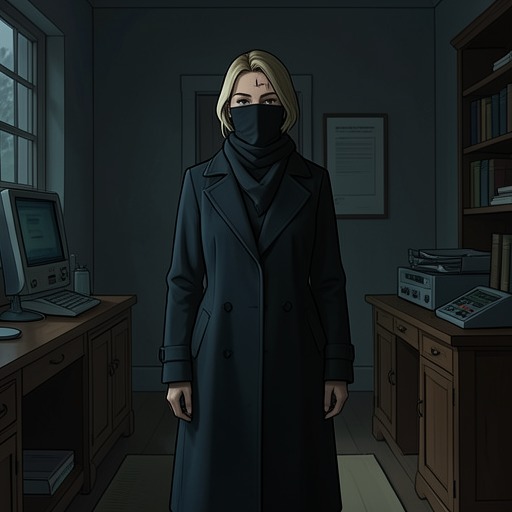
Court-ordered guardianship over Ella
Cinder & EllaCourt-ordered guardianship over Ella is the legal arrangement that places an adult Ella under her father’s authority after a suicide attempt. It shapes her move from Boston to California, limits her control over decisions at school and in treatment, and becomes a central test of whether care can protect her without replacing her judgment. Its decisive change comes when Ella asks for the guardianship to end and her father agrees to help plan for her independence rather than insist on deciding for her.
Background and Legal Authority
After spending three months in the hospital and undergoing seventeen operations, Ella attempted suicide during a low point in rehabilitation. She was in severe physical pain, could barely move, had been told she might never walk again, and was grieving her mother. In the aftermath, people no longer accepted her assurance that she was not a danger to herself. Though eighteen, Ella wanted to stay in Boston, complete high school online, and attend Boston University; she had saved enough money for college. Once her father learned of these plans, he had her declared mentally unstable through the courts and compelled her to move to California under his guardianship.
The legal arrangement therefore followed a real crisis but also displaced a plan Ella had formed for her own future. Ella regarded the move not as a choice but as a restriction imposed on an adult who believed she could manage independently. Her unused monthly support checks, which her mother had deposited for years, had accumulated enough to pay for college; to Ella, those savings were evidence that she had been capable of building a modest life without her father’s control.
How the Guardianship Operates
The arrangement becomes concrete when Ella’s father invokes his court-ordered authority after Jason attacks and tears her arm. Although Ella is over eighteen, her father tells the police that he has legal custody and insists on pressing charges. The officers accept that he can make the decision, leaving Ella unable to determine the response to an assault on her own body. She pleads with her father to trust her and explains that a prosecution or lawsuit would make her situation worse; she believes Jason did not understand the harm he could cause and wants the school’s punishment to suffice.
The conflict also intersects with decisions about school and mental-health care. After the attack, Principal Johnson questions whether the school is the right place for Ella, while her father points out that attending has not improved her condition. Dr. Parish rebukes both men for discussing Ella as if she were absent and reminds them that she is the victim and needs support, not resentment. When hospitalization is raised, Ella breaks down at the prospect of being isolated again, falling further behind at school, and becoming a target of ridicule. Her father then tells her he will trust her judgment and does not force the proposed admission.
Protection, Trust, and Clinical Judgment
Dr. Parish distinguishes a decision about where Ella should live from a judgment that she is ready to live alone. She is willing to work toward an independent apartment if that is best for Ella, but will not approve it until Ella can show she will not be completely unsupported. Dr. Parish identifies the risk of another severe depression and asks Ella to build a dependable network—through friendships, a support group, or renewed contact with old friends in Boston. In this framework, safety is not simply obedience to a guardian: the clinical condition for independence is having people Ella can rely on.
That condition leaves Ella frustrated, but it also makes clear that the guardianship is not the only authority shaping her choices. Dr. Parish’s professional assessment bears on whether Ella can leave her father’s home or treatment, while her father holds court-granted power over decisions such as whether to pursue charges. The story distinguishes these forms of authority by showing how they can constrain Ella, and how listening to her can make care more responsive: her father’s decision not to force hospitalization follows her direct account of what that would mean to her.
Ella’s Request and the Arrangement’s Change
During treatment, Ella states plainly that she needs freedom and asks Dr. Parish to lift her father’s guardianship when she is ready to leave the clinic. She acknowledges that her father is trying, but argues that he is nearly a stranger to her and that what suits him and his family may not suit her. What she needs, she says, is people who trust her. Her request is not a rejection of all connection: she invites her father to build a relationship with her through meals, films, and conversation, while insisting that he not keep her captive or force her into a family she does not feel belongs to her.
Her father asks whether this is truly what she needs. Ella answers without hesitation and adds that it is what Anastasia needs, too. He agrees that, while she remains in the clinic, the immediate focus should be her recovery; when she is ready for discharge, they will make a plan. He asks to participate in that planning, and Ella accepts this as a workable compromise. The exchange changes the guardianship’s emotional meaning: rather than treating his authority as unquestionable, they begin to negotiate a transition that includes Ella’s wishes.
Ending and Significance
By the time Ella arrives at the film premiere red carpet, she is nineteen, and Juliette points out that her father has officially ceased to be her guardian as of the previous day. The change does not erase their complicated relationship: her father still jokingly tries to impose a one-o’clock curfew, and Juliette immediately reminds him that Ella is an adult. The moment makes the legal transition visible in an everyday family exchange, where affection and parental habit remain but no longer carry the same authority.
The guardianship arc is therefore neither a simple vindication of unrestricted independence nor an endorsement of coercive protection. Ella has survived a serious crisis, and the need for dependable support remains part of the discussion; at the same time, her adulthood cannot be reduced to a past suicide attempt. The resolution turns on trust, participation, and a planned return of decision-making power, showing that support can continue without treating Ella as permanently incapable of directing her own life.