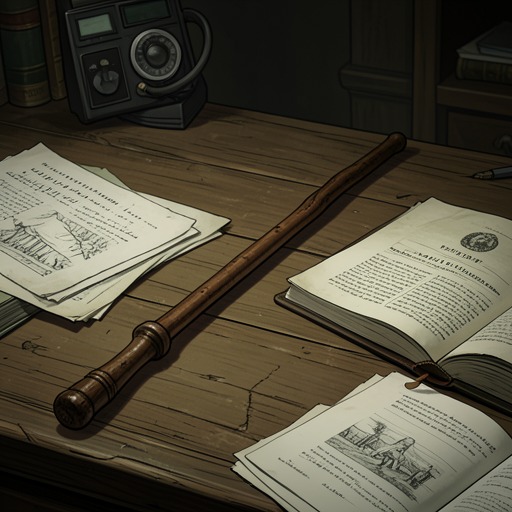
Ellas Gehstock
Cinder & EllaElla’s cane, listed in the canonical name table as Ellas Gehstock, is a mobility aid shaped by her recovery from a car accident and a recurring, highly visible object in her life. It helps her walk without assistance, but the scenes around it also show how physical access depends on other people’s choices: the cane cannot make an inaccessible car seat or a hostile social environment accommodating. Later, its elaborate transformation into part of her costume allows it to signify both the care of her friends and Ella’s insistence that her disability be recognized as real.
Recovery and Everyday Mobility
After getting out of the car, Ella’s father hands her the cane and waits while she pulls herself upright. Walking up the driveway is exhausting and ungainly, but she is proud to manage without anyone’s help. Doctors had initially doubted that she would walk again; through painful rehabilitation, she regains much of her mobility and resists the prospect of spending the rest of her life in a wheelchair. The cane belongs to that hard-won recovery, without making the pain or scars disappear.
The contrast between bodily progress and daily barriers becomes stark at school. Ella’s new uniform exposes more of her skin than she is comfortable showing after spending the summer covered from head to toe, and she anticipates the cruelty of teenagers. On another day, when Anastasia moves the front passenger seat forward and expects Ella to climb into the back, the arrangement proves physically impossible. Anastasia tells her to walk instead of expecting her to sit in the back for a year. Ella explains that she is not being difficult: she cannot climb in. The cane supports her walking, but it cannot solve an access problem created by the car’s seating arrangement or another person’s refusal to accommodate her.
Remade for a Costume
When Ella panics about trying on a formal dress, Vivian redirects her attention by announcing that she will give the cane a small makeover. The friends’ work turns the practical object into a shared creative project. As Stefan and Glen kneel to pin blue-green feathers to the dress’s hem, Vivian uses a hot-glue gun to attach fabric pieces to the cane’s metal shaft. Ella jokes about whether the result will resemble a beautiful patchwork quilt or a prop from a Tim Burton film. The cane is no longer merely a piece of equipment in the background: its material form becomes part of the scene’s imaginative collaboration.
The makeover accompanies Ella’s appearance in a queenly dress that covers her legs while leaving her back, shoulders, and right arm exposed. The people present notice her scars but do not stare for long; their attention moves on to the whole of her appearance. In this setting, the decorated cane participates in a moment of friendship and self-presentation rather than concealing Ella’s body or making her mobility disappear. Vivian’s care is expressed through adapting the cane to Ella’s chosen costume, not replacing it with an image of an able-bodied version of her.
Prop, Aid, and Disability
The distinction between costume and mobility aid becomes explicit at FantasyCon. Ella tells Brian Oliver that the staff she carries is not simply part of her costume: Vivian had it made so Ella could leave her ordinary cane at home, and it serves as her cane that day. Ella explains that walking after the accident is painful, slow, and visibly marked by a pronounced limp; she identifies herself as disabled. The disclosure corrects Brian’s assumption that the staff is only an accessory and makes the practical purpose of the object impossible to overlook.
Across these scenes, the cane’s changing appearance does not change its underlying function. It helps Ella move, becomes a barrier to climbing into an unsuitable car seat only in the sense that mobility needs have been disregarded, and is adapted by Vivian so it can accompany her into a public costume event. Its significance lies in holding these facts together: Ella has regained substantial movement, still experiences pain and disability, and can accept practical support without surrendering her authority over how she is seen or what she needs.
Mobility and Autonomy
The cane’s role resonates with Ella’s later demand for freedom while she is receiving inpatient care. She asks her father and Dr. Parish to end her father’s guardianship when she is ready to leave the clinic, explaining that she is an adult who needs people to trust her decisions. That conversation is not about the cane itself, but it sharpens the object’s broader context: assistance and care matter, yet they do not entitle others to decide what is best for Ella without her participation. The cane enables movement; the question of who controls her life remains Ella’s to press.