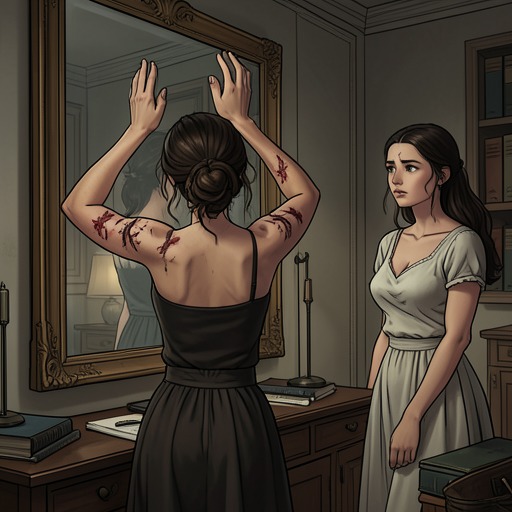
Narben als Zeichen von Stärke und Schönheit
Cinder & EllaThe concept Narben als Zeichen von Stärke und Schönheit brings together two conflicting meanings attached to Ella’s scars: the public stigma that makes her fear being seen, and the intimate recognition that her marked body records what she has survived. It does not erase the harm of cruelty or make Ella instantly confident; instead, it changes the terms on which beauty and worth can be understood, through Brian’s affirmation and Jennifer’s belated explanation of her protectiveness.
The scars under public scrutiny
Ella’s fear is concrete and social, not merely a private dissatisfaction with her appearance. She tells Dr. Parish that she spent only an hour with Brian before the relationship became a source of public humiliation: people hated her, and Brian’s team had to lie about their relationship to protect his career. She expects the same pressures to continue, including people calling her ugly and pathetic. Her refusal to enter a relationship with Brian is therefore bound up with the expectation that his fame will expose her to further judgment of her scars and disability.
When Brian later explains Ella’s rejection on Kenneth Long’s program, he names the fear she had struggled to voice: she believed people would not accept her because of her disability and scars. Since her accident, people have treated her so cruelly that she no longer believes she is beautiful. The public gaze has made a conclusion about her body feel like a fact, and her concern about Brian’s reputation compounds that injury: she thinks her visibility could damage the career of someone she loves.
Brian’s counter-reading
Brian does not describe Ella’s scars as flaws to be overlooked or repaired. He says they make her more beautiful in his eyes because they show her strength. His account places the scars within a history of endurance: Ella has suffered, survived, and lost much, yet when he asked her to be his girlfriend, she worried first about what the relationship might cost him. He reverses her fear that she is not good enough for him, saying instead that he does not deserve her and calling her the strongest and most impressive woman he has met.
That reversal is significant because it answers the stigma without pretending the stigma has disappeared. Brian’s words do not undo the public abuse or guarantee that others will accept Ella. They offer a different witness to the meaning of her body: the scars are not proof of ugliness or inadequacy, but visible evidence of strength. Rob and Vivian affirm Brian’s judgment while Ella listens, making the moment one of support rather than a solitary declaration of beauty.
Jennifer’s history of appearance-based judgment
The idea also gains complexity in Ella’s conversation with Jennifer. When Jennifer proposes that Ella wear her mother’s revealing dress to a public event, Ella immediately fears that television cameras and hundreds of people will see her scars. Jennifer’s suggestion seems to challenge her earlier caution about Ella being exposed to cruelty, and Ella asks why she would encourage that risk now. Jennifer answers that she was never ashamed of Ella; she had been worried about Ella’s feelings and had tried to protect her.
Jennifer explains that her fear came from her own experience as a model. At hundreds of castings, she was criticized for her thighs, backside, nose, breasts, eyes, and weight. She says that she once took every comment to heart, became depressed, developed an eating disorder, and hurt herself because of insecurities about her appearance. Her history gives a specific cause for her protective impulse: she wanted to spare Ella the cruelty she knew firsthand, especially while Ella was grieving her mother and adjusting to a new family. But the attempt to protect Ella from hurt also left room for Ella to interpret caution as shame.
From protection to recognition
Jennifer’s account does not equate her experience with Ella’s injuries. Rather, it reveals a shared vulnerability to other people’s judgments of appearance and the different forms those judgments take. Jennifer recalls that criticism shaped how she saw herself; Ella has been made to question her beauty because of the scars left by her accident. Jennifer says she has learned not to give her critics’ comments weight, and that her father’s love makes her feel beautiful. Her example suggests that acceptance need not depend on winning over every observer, even as Ella still fears the audience waiting beyond the family conversation.
The conversation turns from Jennifer’s reassurance to Ella’s own memory of Brian. She recalls the evening they met, when he kissed her scarred knuckles and told her she was beautiful; at the time, she believed him. That remembered gesture makes the concept bodily and particular: Brian’s acceptance is not abstract praise, but tenderness directed toward a part of her body she fears showing. Jennifer wonders whether Brian might make Ella feel beautiful, and Rob observes that if Brian makes her smile, then he deserves her. Ella realizes she is smiling and blushes under the family’s attention.
Meaning and limits
Across these scenes, scars become a contested sign rather than a simple emblem. To Ella, they are linked to real harassment, anticipated exposure, and the risk that her presence will damage Brian’s public image. To Brian, they testify to resilience and intensify her beauty; to Jennifer, Ella’s fear is recognizable because she has lived through a different form of appearance-based cruelty. The novel lets these meanings coexist instead of making affirmation a cure for stigma.
The concept’s force lies in its movement from concealment toward the possibility of being seen without being reduced to a wound. Ella has not yet been promised universal acceptance, and the public harm she describes remains part of her decision-making. What changes is the presence of people who can witness her body without treating it as a defect: Brian kisses her scarred knuckles, Jennifer explains rather than defends her old caution, and Rob and Vivian stand with Brian’s praise. In that network of recognition, beauty is not presented as the absence of scars, but as something that can include the survival they represent.