Boston
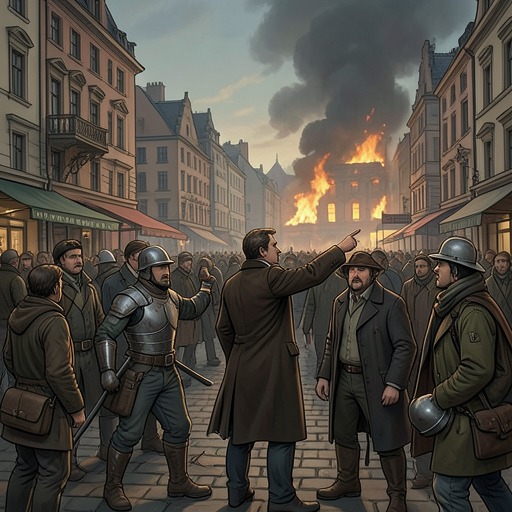
Common SenseBoston serves as the book’s starkest illustration of what the colonies stand to lose by remaining dependent on Great Britain. Described as a city of recent ease and affluence turned into a “seat of wretchedness,” it makes the precariousness of American property and the human cost of British authority impossible to treat as distant abstractions.
The City as Evidence of Insecurity
The argument asks readers who live far from suffering to imagine themselves in Boston. Its inhabitants have been reduced to a choice between staying and starving or leaving to beg; neither option offers security. The city’s sudden reversal—from comfort to destitution—shows how quickly property and ordinary life can be made vulnerable under the existing political connection.
That vulnerability is not merely economic. Those who remain in the city face fire from their own side, while those who leave risk being plundered by soldiers. Boston’s residents are therefore described as prisoners without hope of redemption: danger encloses them within the city, and escape exposes them to another danger beyond it. Even a general attack intended to relieve them would place them in the fury of both armies.
From Local Suffering to Continental Argument
Boston’s predicament gives force to the broader case against dependence on Great Britain. The author argues that submission involves the continent in European wars and quarrels, alienating nations with which the colonies otherwise have no grievance. Because America’s trade depends on European markets, attachment to British political conflicts threatens not only Boston but the commercial interests and security of the colonies as a whole.
The city also sharpens the author’s challenge to advocates of reconciliation. Those at a distance, he suggests, can hope for renewed friendship because the danger has not reached their doors; Boston’s residents cannot treat the question so lightly. Their circumstances make the human consequences of continued dependence immediate, and help frame separation as a response to lived insecurity rather than pride, faction, or resentment.
Political and Narrative Significance
Boston is not developed as a setting through a sequence of narrated incidents; it is invoked as a concentrated example in a political argument. Its inhabitants’ constrained choices and exposure to violence supply the passage’s most concrete measure of what is at stake. The city’s transformation from affluence to distress lends urgency to the claim that delay leaves American life and property at risk, while connecting a local crisis to the larger case for continental separation.