Government is a necessary evil
Common Sense“Government is a necessary evil” is Thomas Paine’s compact account of political authority: people form society through shared needs and affection, while government is imposed to restrain misconduct and provide security when mutual virtue proves insufficient. Its necessity does not make it intrinsically good or unlimited. Government is justified by the protection it provides, and when it becomes a source of danger rather than security, the grounds for obedience fail.
Society and the Need for Government
Paine separates society from government by their origins and functions. Society grows from human wants and the need for companionship and assistance; it unites people and encourages their intercourse. Government arises from human wickedness, restrains vice, establishes distinctions, and punishes. Society is therefore a positive good, whereas government answers a problem that society alone cannot reliably prevent.
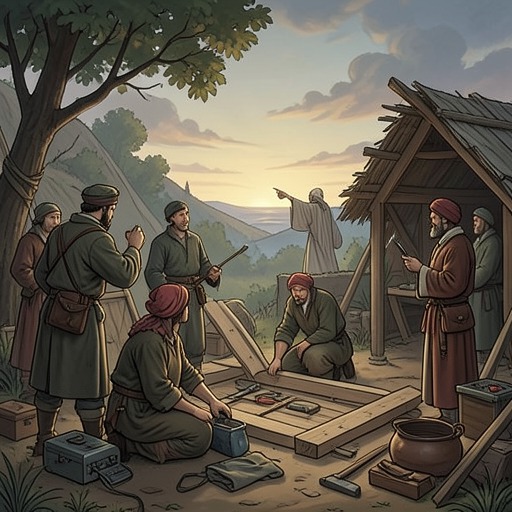
To explain how political authority becomes necessary, Paine imagines a small group settling in an isolated part of the world. In a state of natural liberty, they would first form a society: a single person could not readily meet all his needs, build a dwelling, or endure illness and misfortune without help. Four or five people could raise a home in the wilderness where one person might labor fruitlessly for years. Their reciprocal assistance would initially make laws and government unnecessary, so long as they remained just toward one another. As immediate hardships eased, however, their shared attachment and sense of duty would weaken. Government would then be needed to supply what declining moral virtue no longer provided.
A Limited and Conditional Authority
Government, in Paine’s formulation, is a necessary evil even at its best and intolerable at its worst. Its existence marks a loss of innocence: if conscience were consistently clear and obeyed, people would need no external lawgiver. Since it is not, people prudently surrender part of their property to protect the rest. That sacrifice is justified by security, government’s true design and end—not by the mere fact that a government exists.
The standard for judging political forms follows directly: whichever form is most likely to ensure security with the least expense and greatest benefit is preferable. The expression thus makes government conditional and instrumental. Its authority is not an end in itself, and its claim to obedience weakens when it fails to protect those whose resources sustain it.
From Failed Protection to Resistance
Paine applies this principle to the conflict with Britain by distinguishing the cost of resisting a financial law from the grounds for defending people against violence. Taking up arms merely to secure repeal of a pecuniary law, he argues, would not justify the loss of life. The destruction of property by armed force, invasion, and threatened violence against the colonies’ inhabitants, by contrast, could make defensive arms conscientious. In his account, subjection to Britain should have ended when that form of defense became necessary; independence should be understood as dating from the first musket fired against America.
This reasoning is tied to a chronology of failed remedies and escalating consequences. Paine says peaceful methods had been ineffective and petitions rejected, while repeated petitioning had strengthened royal obstinacy rather than secured protection. He recalls that before the nineteenth of April 1775 he had been a strong supporter of reconciliation; once news of that day’s hostilities arrived, he rejected it. He warns that delay and timidity could defeat the cause even if Britain or Europe could not do so by force, and treats the winter then at hand as a precious opportunity for decisive action. Reconciliation, in his view, could not restore security after the rupture: it risked leaving a later generation to inherit renewed conflict under the misleading names of parent and child.
Law, Political Order, and Independence
The necessity of government also makes the absence of a settled legal order dangerous. Paine describes America as held together by agreement that could change, with no secure framework to protect property or define political offenses. He argues that the lack of law encouraged dissension: the Tories, he says, would not have assembled offensively had state laws made the consequences clear. He distinguishes British soldiers captured in battle, whom he treats as prisoners, from American inhabitants taken in arms, whom he calls traitors subject to a different legal penalty. The argument underscores his insistence that resistance and independence require an operative political order, not only opposition to distant rule.
Paine concludes that independence could ultimately be brought about in three ways: by the legal voice of the people in Congress, by military power, or by a mob. The first offered an opportunity to establish what he calls a noble and pure constitution; the others risked leaving the outcome to force or popular disorder. His warning that virtue is neither hereditary nor perpetual connects the danger of mob rule to his broader objection to inherited political authority. The expression’s lasting force lies in holding two claims together: government is needed because people cannot count on virtue alone, but its legitimacy depends on serving security rather than becoming a new source of harm.