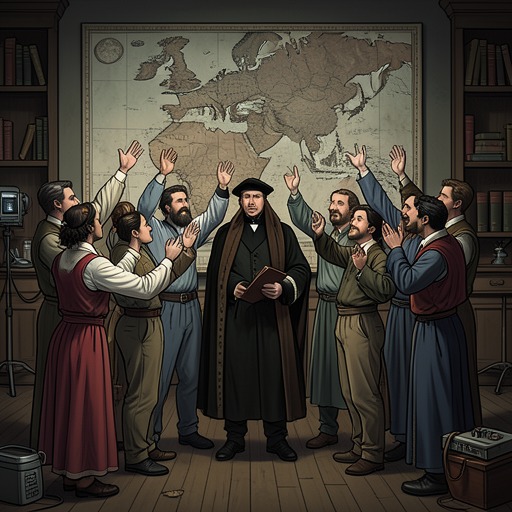
Hold the Continental Congress and draft the Continental Charter
Common SenseThomas Paine’s proposal for a Continental Conference and Continental Charter sets out a route from colonial cooperation to a representative continental government: an intermediate gathering would unite institutional experience with popular authority, draft a binding charter, and then dissolve so that the bodies established under it could govern. The proposal’s decisive principle is to make the constitution precede the officeholders who execute it, securing liberty and shared authority before an unconstituted political condition can invite domination.
Why a Conference Was Needed
Paine’s institutional scheme grows from his distinction between society and government. Society arises from human wants and joins people through mutual affection; government arises because people fail to restrain their vices and must use public authority to restrain them. Society is a blessing, whereas government, even at its best, is a necessary evil. Since its proper end is security, the preferred form is the one that can provide it with the least expense and greatest benefit.
His account of a small settlement explains how political institutions become necessary. People first associate because isolated individuals cannot meet their needs: several can build a dwelling that one person might fail to complete in a lifetime, while hunger, disease, and misfortune make solitary survival precarious. Reciprocal assistance can make law and government unnecessary while everyone remains just toward one another. But as common necessity recedes, people’s attachment and duty may slacken; government must then supply what declining moral virtue no longer reliably provides.
That rationale also shapes Paine’s criticism of distant British rule. He argues that Britain cannot do the continent justice because its government is thousands of miles away and ignorant of local conditions. A petitioner might spend three or four thousand miles traveling, wait four or five months for an answer, and then wait another five or six months for an explanation. A system that once served a purpose, he maintains, must eventually cease to be tolerable. For Paine, the political question is therefore not simply whether authority exists, but whether it is near enough, representative enough, and properly constituted to secure the governed.
The proposal answers a fear that independence lacked a workable plan. Paine acknowledges that people may hesitate when they cannot see a way forward, and offers his suggestions as material for more capable minds to improve, not as a finished design beyond revision. The Conference is meant to provide an orderly passage between the people and their governors: neither an unmediated gathering of everyone nor a self-authorizing Congress alone, but a body in which established political experience can meet authority conferred by the public.
Composition and Representative Design
Paine proposes a committee of twenty-six members of Congress, two from each colony. It would also include two members from each House of Assembly or Provincial Convention, together with five representatives of the people at large from each province. Those popular representatives would be chosen in the capital city or town by qualified voters attending for that purpose; if more convenient, the election could take place in two or three of the province’s most populous areas. The design thus draws on congressional and provincial institutions while adding a direct popular element.
The Conference’s mixed membership is intended to unite what Paine calls knowledge and power. Members of Congress and colonial assemblies or conventions bring experience in public affairs; representatives chosen by the people give the gathering legal authority rooted in public authorization. The proposal treats neither administrative familiarity nor popular legitimacy as sufficient by itself: constitutional deliberation should combine both.
This conference-level design accompanies Paine’s recommendations for the institutions it would establish. Colonial assemblies would meet annually, with a president only; their representation should be more equal, their work wholly domestic, and their authority subordinate to a Continental Congress. The separation of domestic responsibilities from continental authority is a proposed division of jurisdiction, intended to preserve local governance within a larger union.
Paine also sketches a more detailed arrangement for Congress. Each colony would be divided into six, eight, or ten convenient districts, each sending delegates so that every colony had at least thirty. Congress would therefore contain at least 390 members. At each Congress, a colony would be selected by lot, and the delegates would choose its president by ballot from among that colony’s representatives. At the following Congress, the previous president’s colony would be omitted from the lottery; the rotation would continue until all thirteen colonies had taken their turn. To pass a law, at least three fifths of Congress—not a bare majority—would be required. Rotation, broad representation, and a heightened voting threshold are presented as safeguards against any one colony’s or faction’s easy predominance.
The Charter and the Limits of Authority
The Conference’s central task would be to frame a Continental Charter, or Charter of the United Colonies, answering in function to the English Magna Carta. It would set the number and manner of choosing members of Congress and assemblies, specify when those bodies sat, and draw a line between their respective business and jurisdiction. Paine insists that the continent’s strength lies in its continental union, not in provincial isolation; the charter must therefore coordinate the parts without erasing the need to represent them.
The charter is also a bond of obligation among the whole and every separate part. Paine describes it as a solemn compact to support each part’s rights in religion, personal freedom, and property. Its purpose is not merely to distribute offices: it is to bind the political community to protections that no governing body should treat as discretionary. The prospect of a firm bargain and a clear reckoning makes constitutional definition a condition of durable political friendship.
Freedom of religion receives particular emphasis. The charter should secure the free exercise of religion according to the dictates of conscience, and Paine elsewhere assigns government the duty to protect conscientious religious practitioners while denying it any other business in religion. He regards diverse religious opinions as compatible with a shared community, comparing denominations to children of one family who differ in their Christian names. Religious protection is thus part of the constitutional settlement, not a privilege dependent on uniform belief.
Once the charter had been framed, the Conference would dissolve. The legislative and governing bodies chosen in accordance with it would then take up authority for the time being. This endpoint matters: the Conference is a constituent body, convened to establish the rules and institutions, not a permanent rival government. The order of operations is deliberate—first define the authority and its limits, then select those who will exercise it.
Timing, Representation, and Political Risk
Paine argues that the opportunity to constitute government comes to a nation only once. Many nations, he says, have allowed the moment to pass and then received laws from conquerors instead of making laws for themselves. They began with a king and only afterward established a form of government; the sounder order is to make the articles or charter first and delegate people to execute them afterward. The Conference is therefore a proposal about timing as much as institutional machinery: it seeks to establish self-government before circumstances impose a settlement from above.
The example of William the Conqueror sharpens the danger. After subduing England, he gave it law at the point of the sword. Until authority in America is legally and authoritatively occupied, Paine warns, it could likewise be filled by a fortunate ruffian, putting freedom and property at risk. A charter made by the political community is meant to prevent a vacuum from becoming an opening for force.
Paine’s concern about representation is grounded in a specific Pennsylvania example. When the Associators’ petition came before the House of Assembly, only twenty-eight members were present; all eight Bucks County members voted against it. If seven Chester County members had joined them, he argues, two counties alone could have governed the whole province. The incident demonstrates how a small and unevenly distributed body can make a decision for a much larger community without adequately representing it.
He also objects to the Assembly’s attempt to gain undue authority over Pennsylvania’s delegates. Instructions for those delegates, which Paine condemns as deficient in sense and practical substance, were approved by only a very few people outside the Assembly and then passed in the House in the name of the entire colony. His complaint is not simply that particular instructions were poor: a small group claimed to speak for a whole population. The Conference proposal’s popular representatives and the call for equal representation respond to that problem by making the source of authority and the breadth of consent harder to obscure.
The same concern informs Paine’s warning that emergency expedients can turn oppressive if continued. Appointing people from the several Houses of Assembly had been the readiest and most suitable way to consult during America’s calamities, and he credits the Congress’s wisdom with helping preserve the continent from ruin. But an expedient method should not automatically become a permanent constitutional rule. If Congress is likely to continue, its method of selection deserves scrutiny, including whether one body should hold both the power of representation and the power of election. Paine closes that warning with the reminder that political virtue is not hereditary.
Constitutional Significance
The proposal belongs to Paine’s broader case for separation from Britain. He argues that dependence draws the continent into European wars and quarrels, places it at odds with nations from which it might otherwise seek friendship, and makes American trade vulnerable whenever Britain fights a foreign power. Against that dependence, a continental constitution offers a positive account of independence: not merely separation from an imperial authority, but the creation of institutions capable of governing a united continent.
Its constitutional logic joins popular authorization to checks on concentrated power. The people authorize the Conference; the Conference frames a charter; the charter assigns responsibilities and protects rights; and elected bodies govern within those limits. Annual assemblies, substantial representation, rotating congressional presidency, a three-fifths lawmaking threshold, and the division between domestic and continental business all give practical form to the larger concern that power must be both usable and constrained.
Paine imagines the charter’s public proclamation as a declaration of the new order. It would be placed upon the word of God and crowned to show that, insofar as America approved of monarchy, the law—not a human ruler—would reign. The crown would then be demolished and scattered among the people, whose right it was. In this symbolic ending, constitutional authority is made visible and then returned to its source: the people are not subjects of a sovereign person, but participants in a polity governed by law.
The proposed Conference is ultimately a means of beginning government at the right end. It transforms the immediate need for intercolonial coordination into a constituent act, using a charter to make continental unity compatible with local representation, individual rights, and limits on officeholders. Its central safeguard is the order it establishes: public authority is to be designed and authorized before it is occupied.