House of Lords
Common SenseThe House of Lords, described by Thomas Paine as the hereditary body of peers in the English constitution, is presented as an instrument of aristocratic power rather than a representative check on monarchy. Its contrast with Paine’s proposed elected institutions helps expose the weakness of the English system’s supposed balance of powers and clarifies the republican alternative he advocates.
Place in the English Constitution
Paine divides the English constitution into three components: the king, the peers, and the commons. He identifies the king as the remnant of monarchical tyranny and the peers as the remnant of aristocratic tyranny; the commons alone are the new republican element, whose virtue, in his account, determines England’s freedom. The House of Lords thus belongs to the inherited structure of rule, not to the popular element on which freedom depends.
The decisive objection is that both king and peers are hereditary and therefore independent of the people. Paine concludes that, in a constitutional sense, neither contributes to the state’s freedom. The contrast is not simply between two houses or two styles of government: it distinguishes institutions answerable to the public from offices passed down beyond its control.
Critique of the Mixed Constitution
Paine rejects the description of the English constitution as a union of three powers that reciprocally check one another. The familiar account assigns the peers to the king’s side and the commons to the people’s, but he regards this arrangement as a house divided against itself, an elegant formula that obscures rather than resolves the question of authority. If the people fear a power and must continually check it, he asks, how did that power come to be theirs to grant?
His criticism also undermines the peers’ supposed role within the balance. A system of checks cannot guarantee freedom if the competing powers are unequal: the heaviest power will govern, while the others may slow it without stopping it. Paine likens the constitution to a machine whose movement ultimately follows its first moving power; time, even when other parts impede it, enables that power to have its way. The peers’ place in the arrangement therefore does not, by itself, establish an effective safeguard against domination.
Contrast with the Proposed Continental Government
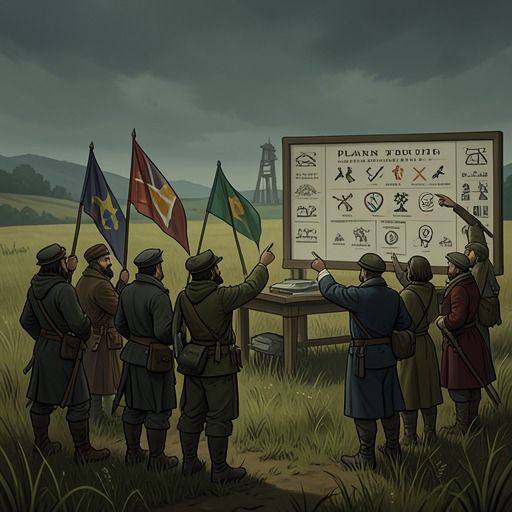
Paine’s alternative is built around elected representation rather than hereditary rank. He proposes annual assemblies for domestic business, under the authority of a Continental Congress, and suggests dividing each colony into districts so it can send delegates. His illustrative scheme calls for at least thirty delegates from each colony and a Congress of at least 390 members, with its president selected by ballot from a colony chosen by lot and the presidency rotated among the colonies.
To give the new political structure a legitimate foundation, Paine proposes a Continental Conference joining representatives of Congress, the colonial assemblies or conventions, and the people. Its task would be to frame a Continental Charter defining representation, terms of sitting, and the jurisdictions of Congress and the assemblies, while securing freedom, property, and the free exercise of religion. This design replaces inherited standing with defined offices and popular authorization; the House of Lords serves as a pointed contrast to the representative order he wants the colonies to establish.