Monarchical order
Common SenseMonarchical order, as Thomas Paine examines it in Common Sense, is a system in which kingship elevates one person above the rest and hereditary succession extends that elevation across generations. Paine argues that this hierarchy has no natural or religious warrant: its history links political authority to idolatry, dynastic conflict, and public danger. His critique is not only an indictment of monarchy in principle but an argument about its consequences in practice, from England’s civil wars to the constraints British rule places on the American colonies. Against rule by a crown, he proposes accountable representation and contends that separation is necessary to political self-government.
Definition and Historical Origins
Paine distinguishes the inequalities that arise in society from the division between kings and subjects. Differences between rich and poor, he allows, may develop through subsequent circumstances; the exaltation of a royal class, by contrast, cannot be explained by the natural distinctions between people or justified as a separate human order. The very idea of a race of rulers set apart from everyone else therefore demands an account, rather than acceptance as an inherited fact.
He places monarchy’s origins outside the earliest biblical social order. In his account, the early ages had no kings and, correspondingly, no wars of the kind associated with royal pride. He points to the quiet lives of the patriarchs and contrasts them with the disturbance that enters the biblical narrative with Jewish royalty. Holland, without a king, supplies a contemporary comparison: Paine says it had enjoyed more peace over the preceding century than monarchies in Europe.
Paine presents kingship as a custom first introduced by the heathens and later copied by the Israelites. He condemns the practice of giving divine honors to deceased rulers and argues that Christian societies carry the same political deference further by venerating living monarchs. The title of sacred majesty, in his view, improperly transfers divine honor to a mortal ruler. Monarchical order thus rests not merely on political convention but on a quasi-religious elevation that he considers an affront to heaven.
His scriptural argument turns on the Israelites’ earlier political institutions. For roughly three thousand years after the Mosaic account of creation, Paine says, they had no kings: except in extraordinary interventions, judges and tribal elders administered a form of republic. The people’s request for a king marked a departure from that arrangement. He treats the request as a national delusion and monarchy as a sin associated with a curse, not as a divinely authorized development.
Hereditary Succession and the Record of Conflict
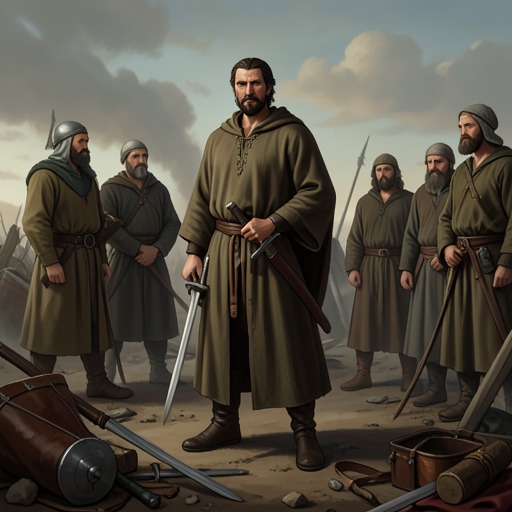
The episode of Gideon supplies Paine’s sharpest contrast between military success and royal authority. After Gideon defeated the Midianites with a small army, the Israelites proposed making him king and extending the title to his son and grandson. Gideon refused to rule over them and refused the prospect of his son ruling, insisting that the Lord would rule. Paine reads this reply as more than personal modesty: Gideon denies the people’s right to confer the sovereignty they are offering, and charges them with turning away from their proper ruler in heaven.
Paine also challenges the claim that hereditary kingship descends from an honorable beginning. He speculates that early kings may have been leaders of violent bands who gained power through force or cunning, then extracted contributions from those seeking protection. Even if their followers initially chose them, he argues, such consent could not reasonably have meant that those electors surrendered political authority for all future generations. Hereditary rule may have arisen first as a practical convenience, perhaps adopted to avoid disorder when a leader died; in time, a convenience was transformed into a claimed right, aided by tradition and invented stories.
England’s royal claim, in Paine’s account, offers no more dignified origin. Since the conquest, he says, England had known a few good monarchs but many bad ones; the claim founded by William the Conqueror was established by an armed French force against the consent of the inhabitants. The example makes hereditary legitimacy look less like a sacred inheritance than a political claim grounded in conquest.
Paine tests other possible foundations for kingship by asking whether the first king was selected by lot, elected, or installed through usurpation. Selection by lot cannot establish hereditary succession: Saul was chosen by lot, but the episode did not create a dynastic right. Election, likewise, can establish a precedent for choosing another ruler, not for depriving future generations of their own authority by choosing an entire royal family in perpetuity. Paine compares this supposed transfer of liberty to the doctrine of original sin: both imagine that an act at the beginning strips later humanity of an earlier freedom. In his deliberately provocative analogy, hereditary succession inherits the dishonor of that comparison, not a title to glory.
The historical case against monarchy culminates in civil war. Paine rejects the claim that hereditary succession preserves a nation from such conflict, citing England’s record since the conquest: thirty kings and two minors had reigned amid eight civil wars and nineteen rebellions, including the Revolution. The dynastic contest between the houses of York and Lancaster gives that statistic human and political shape. Over many years, twelve pitched battles, as well as skirmishes and sieges, were fought between Henry and Edward. Each was at times a prisoner of the other; Henry was carried from prison to a palace, Edward from a palace into exile, and the reversals continued as the crown changed hands. Parliament, Paine observes, followed the stronger side. The conflict began in the reign of Henry the Sixth and was not extinguished until Henry the Seventh united the families, across the period from 1422 to 1489. For Paine, the dynastic mechanism advertised as a safeguard against war instead gave rival claims a continuing cause for it.
The Work and Structure of Government
Paine’s criticism also asks what a king actually does. In some countries, he says, a monarch has little to do and passes a life without benefit to himself or the nation before leaving the same idle position to a successor. In absolute monarchies, by contrast, the full civil and military burden is assigned to the king. The Israelites’ request for a king had invoked the expectation that he would judge them, lead them, and fight their battles; where a king is neither judge nor general, as Paine says is the case in England, his public function becomes difficult to identify.
The smaller the role of a king, Paine argues, the more a government approaches republicanism. England’s constitutional name is therefore unsettled in his description. Although Sir William Meredith calls it a republic, Paine considers that title undeserved in its existing condition: the crown’s control of public appointments has swallowed up the power and weakened the virtue of the House of Commons, the constitution’s republican element. What Englishmen rightly value, he says, is the liberty of choosing representatives from among themselves. When republican virtue fails, the result is slavery; monarchy has, in his image, poisoned the republic by engrossing the Commons.
He reduces the English king’s remaining work to making war and distributing places. Those functions, Paine argues, impoverish the nation and turn its people against one another. Against the lavish allowance and reverence granted to a monarch, he sets the greater social and moral worth of one honest person. The contrast turns royal grandeur into a question of public utility: the status of the office does not establish the value of its service.
Paine’s alternative begins at a smaller, more direct scale. In his account of a new colony, people first gather beneath a convenient tree to deliberate on public affairs. Their initial rules may be called regulations and enforced by public disapproval; at that stage, every person has a natural right to a seat in the assembly. As population and public business grow, distance makes universal attendance impractical. The community can then entrust legislative work to selected representatives, increase their number as the colony expands, and divide the territory so each part is represented.
Frequent elections are central to this proposed arrangement. Representatives who return to the general community after a few months are less likely to form an interest separate from that of their electors. Their prospect of rejoining the public gives them a reason to remain faithful, while repeated exchange between representatives and constituents helps establish a common interest across the community. Paine locates governmental strength and the governed people’s happiness in that reciprocal connection—not in the name of a king.
Monarchical Power and Colonial Dependence
The outbreak of hostilities changes the political argument. Paine says that referring the dispute to arms begins a new era: proposals made before April 19, when hostilities commenced, belong to a political moment that has passed. Before then, both sides aimed at union with Great Britain, differing over whether to pursue it through force or friendship. Force has failed, he argues, and friendship has withdrawn its influence. Reconciliation, once treated as a live prospect, has become an agreeable dream that leaves the colonies where they were.
In Paine’s account, the colonies’ dependence on Britain binds them to European conflicts without giving them a corresponding advantage. He argues that submission to Britain makes America a participant in wars and quarrels with nations that might otherwise seek its friendship. Since Europe is the colonies’ market, he urges them to avoid partial political ties to any European power; dependence on Britain instead makes America a counterweight in British policy. Whenever Britain fights a foreign power, he warns, American trade is endangered by the connection. Separation, by contrast, would allow neutrality to serve as a safer protection than joining Britain’s military cause.
Distance also makes British rule, in Paine’s view, unworkable. The affairs of the continent will become too extensive and complex for a distant authority that knows too little about it. He describes the practical delay built into petitions and decisions: a journey of three or four thousand miles, a wait of four or five months for an answer, and another five or six months to explain the answer received. A connection that may once have been appropriate, he argues, must reach a point at which it ceases to be so. Small islands unable to protect themselves may reasonably be taken under a kingdom’s care; the reverse arrangement, in which an island governs a continent, violates nature’s ordinary scale. He concludes that England belongs to Europe and America to itself.
For Paine, the issue is also one of political status. While the colonies call themselves British subjects, foreign powers see them as rebels if they resist, and cannot treat them as an independent party to a war. Other nations cannot readily mediate a conflict when America still claims subjection to Britain; nor, he argues, should France or Spain assist the colonies merely to help repair and strengthen the British connection. The unresolved combination of resistance and subjecthood is difficult for foreign governments to recognize as a coherent political position.
Paine therefore proposes a different diplomatic act: publish and send a manifesto to foreign courts recounting the colonies’ grievances and their unsuccessful peaceful attempts at redress, declaring that they can no longer live safely or happily under the British court, and affirming their peaceful disposition and desire to trade with other nations. Such a public declaration, he contends, would do more for the continent than another shipload of petitions to Britain. Independence would allow the colonies to take their place among nations and make mediation, recognition, and trade possible on clearer terms.
Independence and Constitutional Design
Paine insists that his case for separation rests neither on pride, party, nor resentment, but on what he considers the continent’s interest. Anything short of independence, he says, is patchwork that cannot produce lasting security and leaves the next generation with the prospect of continued conflict. He argues that delay will make separation harder, not easier. The military capacity available in the present comes from experience gained in the last war; forty or fifty years later, that experience would have disappeared. The continent might then have greater numbers but no living general or military officer to pass on practical knowledge. The suitable moment, in his reasoning, is when enough of that experience remains while the population has also grown.
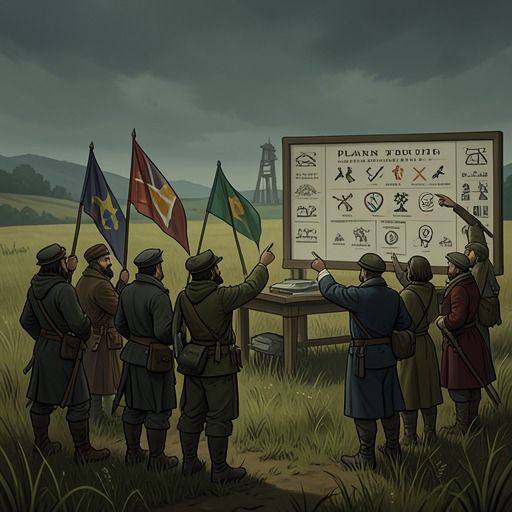
Independence, however, raises the question of what political arrangement should replace monarchy and colonial dependence. Paine identifies the lack of a plan as one source of fear, then offers institutional suggestions as starting points for further work. He proposes annual assemblies with a president only, more equal representation, and a division of responsibilities: the assemblies would manage domestic affairs under the authority of a Continental Congress.
His proposed representation joins local districts to a continental legislature. Each colony would be divided into six, eight, or ten convenient districts, each sending delegates to Congress, with at least thirty delegates from every colony and at least 390 in the full Congress. The delegates would choose a president by ballot after a colony had first been selected by lot. In subsequent Congresses, the colony eligible to supply the president would be drawn from those not yet chosen, so that the thirteen colonies would take their turns. Paine further proposes that a measure require three fifths of Congress to count as a majority, making a larger threshold part of the effort to ensure that laws are satisfactorily just.
The design connects local representation, continental coordination, rotation, and a demanding decision rule. It stands in deliberate contrast to inherited authority: public power is distributed through districts and colonies, and offices are filled through selection rather than succession. Paine presents these provisions modestly, as material that others might improve, but they show that his rejection of monarchical order is paired with a concrete attempt to imagine government without a king.