New England
Common SenseNew England is presented as evidence that America possesses the practical resources to defend and govern itself rather than remain dependent on Britain. Its history of building large warships strengthens the case for a continental navy, while the wider argument places the colonies’ political future in the hands of a united continental body rather than a distant island government.
Maritime Capacity
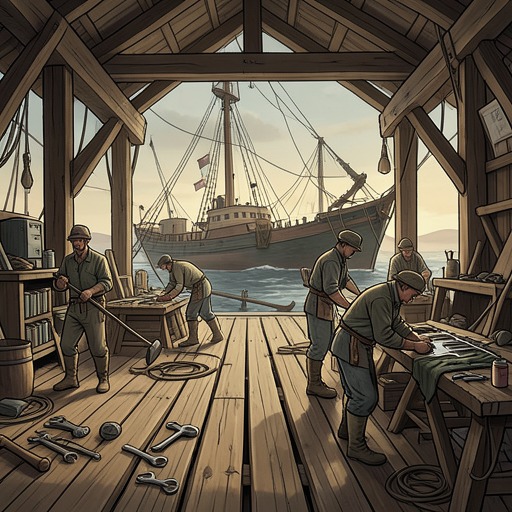
In arguing that America should build a fleet, the text points to New England as proof that the necessary skill and industry already exist. Men-of-war carrying seventy and eighty guns were built there forty years earlier; the question is not whether such vessels can be constructed, but why they should not be built again. The example turns shipbuilding from a speculative future ambition into an established capacity.
The case rests on more than shipwrights’ experience. America has timber, tar, iron, and cordage in abundance, and the text contends that only a small portion of a fleet’s crew need be professional sailors. Experienced seamen could train active landmen in ordinary shipboard work. With fisheries blocked and sailors and shipwrights out of employment, building a navy would put existing materials and labor to use while joining commerce to protection.
From Imperial Dependence to Continental Politics
New England’s maritime example belongs to a broader argument that the old political relationship with Britain has been overtaken by events. Once hostilities began on April 19, proposals made before that turning point were, in the text’s image, like last year’s almanacs: useful in their time but superseded. Earlier advocates for both force and friendship had aimed at union with Britain; the failure of force and the withdrawal of friendship, the author argues, leave that shared objective without a viable path.
The text further maintains that dependence on Britain draws America into European wars and makes its trade vulnerable whenever Britain fights another power. It therefore urges the colonies to avoid partial connections with Europe and argues that their commercial interests would be better served by peaceable relations with all. In this reasoning, America’s future security depends on changing its political status, not merely repairing the imperial connection.
Distance also makes British government impractical, the text argues: petitions and questions must travel three or four thousand miles, and answers may take four or five months, followed by further delays in explanation. A continent, it insists, cannot sensibly be governed in perpetuity by a small island. The argument shifts the issue from a dispute about particular policies to a question of political scale and self-government.
A Continental Framework
The alternative proposed is not simply separation but a system for conducting shared affairs. The text calls for annual assemblies with a president and a more equal representation, their business confined to domestic matters and placed under the authority of a Continental Congress. Each colony would be divided into six, eight, or ten districts and send at least thirty delegates, producing a Congress of at least 390 members.
The presidency would rotate among the thirteen colonies. At each Congress, one colony would be chosen by lot, and the delegates would elect a president from that colony; the next Congress would draw from the remaining twelve, continuing the rotation. Requiring three fifths of Congress for a majority is meant to ensure that laws pass only when considered satisfactorily just. New England thus appears not only within a discussion of material capacity but in a political vision organized around the continent and its constituent colonies.
Independence and Recognition Abroad
The argument for independence also turns on the limits of colonial subjecthood in international affairs. While America calls itself a subject of Britain, other powers cannot readily mediate between the parties, and France or Spain would have little reason to assist a rebellion whose object was merely to restore the British connection. Resistance under the name of submission, the text says, is a paradox that foreign governments cannot easily accept.
A public manifesto, by contrast, could explain the injuries suffered, the failure of peaceful petitions, and the decision to break with Britain, while declaring a peaceful disposition and a desire for trade with other courts. Independence would allow the continent to take its place among nations and be heard abroad. The text closes by likening delay to repeatedly putting off an unpleasant task whose necessity remains inescapable: political separation is presented as the step that would make the proposed continental future possible.