Republicanism
Common SenseRepublicanism in Thomas Paine’s argument is not simply government without a king; it is a design for keeping political power answerable to the people and directed toward their freedom and security. Its institutions grow out of society’s mutual needs, rely on elected representation and frequent elections, and culminate in Paine’s proposed continental charter. Against hereditary rank and the corrupting influence of the crown, republican government makes public accountability—not royal dignity—the source of political strength.
Social Foundations and the Purpose of Government
Paine begins by separating society from government. Society arises from human wants and the affections people develop by joining together; government arises from human wickedness and restrains the vices that society cannot reliably contain. Society is a blessing, while even government at its best remains a necessary evil: it protects people by requiring them to surrender part of their property, and its proper test is whether it provides security with the least expense and greatest benefit. Republicanism therefore does not treat political authority as an end in itself. Its legitimacy depends on what it secures for the people.
To explain how political society might develop, Paine imagines a small group settling in an isolated part of the earth. In natural liberty, society would be their first thought: one person alone could not easily build a dwelling, move felled timber, or withstand hunger, sickness, and misfortune. Four or five working together could accomplish what one person might labor a lifetime to do. Mutual dependence draws the settlers together before any government exists.
So long as they remain just toward one another, their reciprocal obligations can make law and government unnecessary. But when the shared difficulties of settlement recede, people may relax their attachment to one another; government then supplies the deficiency of moral virtue. The imagined origin of government is thus neither conquest nor hereditary right, but a practical response to the failure of people to govern themselves through virtue alone. Freedom and security remain its stated ends.
From Common Deliberation to Representation
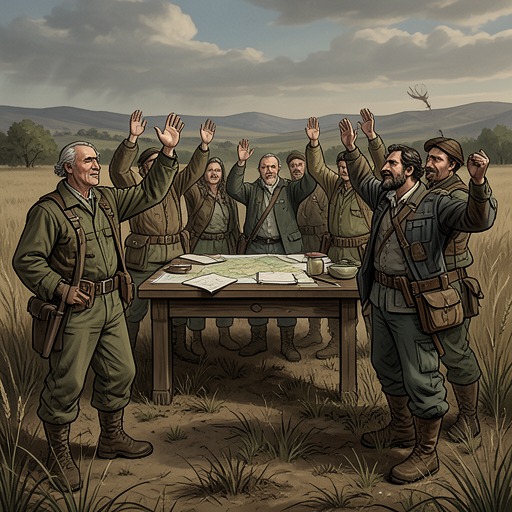
Paine’s first assembly meets beneath a convenient tree that serves as a state-house. The whole colony deliberates on public matters, and every man has a natural right to a seat. Its first rules might be called regulations and enforced by public disesteem rather than formal penalties. This small-scale beginning makes popular participation the original condition of political authority, not a privilege granted by a ruler.
As the colony grows, distance and the increasing volume of public business make it inconvenient for everyone to meet on every occasion. The people can then consent to entrust legislative work to a select number chosen from among them. Those representatives are supposed to share the concerns of their constituents and to act as the whole body would if present. As settlement expands further, the colony can be divided into convenient parts, each sending its proper number, so that the interests of every part receive attention.
Representation alone, however, cannot guarantee fidelity. Paine argues for frequent elections so that elected officials return within months to mix again with the general body of electors. This prospect gives representatives a prudent reason not to injure the public whose company they must rejoin. Frequent interchange also establishes a common interest across the community, allowing its parts to support one another. On this reciprocal bond, rather than on the name of a king, Paine locates the strength of government and the governed people’s happiness.
Republicanism Against Crown Influence
Paine uses the English constitution to show how a nominally representative order can be emptied of republican substance. He describes the House of Commons as the republican part of that constitution, because the people possess the liberty of choosing it from among themselves. But he argues that the crown’s control over appointments has swallowed its power and eaten away its virtue. In his diagnosis, the English government has become nearly as monarchical as those of France or Spain, despite the language used to describe it.
The distinction between names and political reality is central to his critique. Englishmen, Paine observes, glory in the constitution’s republican feature, but that feature cannot protect liberty once republican virtue fails. The crown has engrossed the Commons; monarchy has poisoned the republic. The comparison gives his institutional argument a warning: representative forms do not suffice if another power can bend representatives to interests apart from the public’s.
His broader account of equality reinforces that warning. Paine treats human beings as originally equal in the order of creation and distinguishes the natural difference between male and female from the political division between kings and subjects. Wealth differences may have varied causes, he allows, but hereditary kingship has no comparably natural or religious justification. Republicanism contests this elevated status by refusing to make a birthright of political superiority the foundation of public rule.
A Continental System of Representation
When Paine turns from the small-colony example to American political arrangements, he offers suggestions rather than claiming to present a finished plan. He proposes annual assemblies with a president only, more equal representation, and domestic business subject to the authority of a Continental Congress. The design combines local deliberation with continental coordination rather than treating the colonies as isolated political units.
For the Congress, he proposes that each colony be divided into six, eight, or ten convenient districts, each sending a proper number of delegates, with no colony sending fewer than thirty. The total Congress would therefore contain at least 390 members. Its president would be chosen through rotation among the thirteen colonies: at each Congress, one colony would be selected by lot, and the Congress would choose a president by ballot from that province’s delegates. In the next session, the previous president’s colony would be omitted from the drawing, continuing the rotation until all thirteen had their turn. Paine further proposes that a law require the support of at least three fifths of the Congress to count as a majority, making satisfactory justice a higher threshold than a bare simple majority.
Paine does not regard even a carefully arranged Congress as sufficient authorization for creating a permanent political order. Because the initiative should come from an intermediate body between governors and governed, he proposes a Continental Conference. It would unite twenty-six members of Congress, two from each colony; two members from each House of Assembly or Provincial Convention; and five representatives of the people at large from each province. Those popular representatives would be chosen by qualified voters who attended in the provincial capital or another convenient location, with two or three populous centers available where that would be more practical. In this conference, experience in national affairs would supply knowledge, while delegation by the people would supply legal authority.
The Charter, Public Rights, and Law as King
The Continental Conference’s work would be to frame a Continental Charter, or Charter of the United Colonies, answering to England’s Magna Carta. The document would determine the number and method of choosing members of Congress and the assemblies, set the dates on which they sit, and draw the boundary between their business and jurisdictions. Paine insists that the colonies’ strength is continental, not provincial: the proposed allocation of authority is meant to coordinate the whole while specifying the powers of its institutions.
The charter would also secure freedom and property to all, and, above all, the free exercise of religion according to conscience. Paine later clarifies that a charter is a solemn bond through which the whole promises to support the rights of each separate part, including religious liberty, personal freedom, and property. These guarantees make the charter more than a blueprint for offices: it is a reciprocal commitment binding the common political order to protect its members. Once the conference completed that work, it would dissolve, leaving the bodies chosen under the charter to legislate and govern for the time being.
Paine gives this arrangement a public ceremony that reverses the familiar signs of monarchy. On a day set aside to proclaim the charter, it would be placed on the word of God and crowned, so that the people could see that, insofar as monarchy was approved in America, the law was king. The crown would then be demolished and scattered among the people, whose right it was. The emblem of sovereignty does not rest on a royal head; it is transferred to law and finally returned to the people.
Accountability, Expedience, and the Republican Test
Paine’s institutional proposals answer a persistent danger: those who exercise power may separate themselves from those on whose behalf they act. He warns that a small number of electors or representatives is dangerous, and that unequal representation compounds the risk. As an example, he describes a Pennsylvania Assembly sitting at which only twenty-eight members were present. Eight members from Bucks County voted against the Associators’ petition; if seven members from Chester County had joined them, two counties alone could have governed the whole province. The incident gives numerical inequality a concrete political consequence: a narrow group can determine an outcome in the name of a much larger public.
He also objects to the Assembly’s attempt to impose undue authority over Pennsylvania’s delegates. Instructions prepared for those delegates, which he judges unfit even for a schoolboy, were approved by a very small number of people outside the Assembly and then passed as if they spoke for the whole colony. Paine’s complaint is not only about the quality of the instructions but about the false claim of consent. Political authority cannot be made representative merely by declaring that a limited decision binds everyone.
At the same time, Paine distinguishes expedience from right. The immediate calamities facing America had made it useful to appoint people from the various Houses of Assembly to consult together; he credits their wisdom with helping preserve the continent from ruin. But a temporary method adopted under necessity should not automatically become the permanent method of choosing members of a Congress that is likely to continue. He asks whether representation and election are too great a power for one body to possess at once, and warns those planning for posterity that virtue is not hereditary. Institutions must therefore be designed for the possibility that officeholders will not always act virtuously.
For Paine, republicanism is tested by the relation between political forms and the interests they serve. Assemblies, districts, elections, a rotating presidency, a continental conference, and a charter matter because each is meant to keep authority distributed, publicly authorized, and answerable. Where the crown can absorb a representative body, or where a few can speak for an entire colony without genuine consent, republican language masks a failure of republican practice. The governing principle is not the prestige of the office or the inherited status of its holder, but a public order whose law protects the freedom, security, and rights of the people.