Samuel
Common SenseSamuel’s role in Common Sense is decisive: when the Israelites demand a king, he interprets their request not as a neutral change of government but as a rejection of divine sovereignty. His warning that a king would take the people’s labor, property, and freedom turns a scriptural episode into Thomas Paine’s argument against monarchy and hereditary rule. The people persist despite the warning, and their later fear and remorse make the story a political lesson about the cost of choosing royal authority.
Scriptural and Political Context
Paine situates Samuel’s confrontation with the Israelites within a longer account of government before kings. He describes their earlier political order as a kind of republic, ordinarily administered by a judge and the elders of the tribes, and argues that kingship entered the world through the heathens before the Israelites adopted it. In this interpretation, the demand for monarchy is bound up with imitation of other nations and with a mistaken transfer of authority from God to a human ruler.
The passage follows an earlier example: after Gideon’s victory over the Midianites, the Israelites offered to make him king, with the office passing to his descendants. Gideon refused to rule either them or his son, insisting that the Lord should rule over them. Paine uses that refusal to establish a contrast with the later demand addressed to Samuel: an earlier leader rejects hereditary kingship, while the people subsequently pursue it despite the scriptural precedent.
Paine also invokes Samuel’s episode to argue that scripture itself disapproves of kingship. He distinguishes this claim from the instruction to render to Caesar what belongs to Caesar, noting that the Jews in that setting were without a king and under Roman vassalage. His account thus makes Samuel more than a figure in a national history: the prophet’s words become evidence in a dispute over whether monarchy can claim religious legitimacy.
The Demand for a King
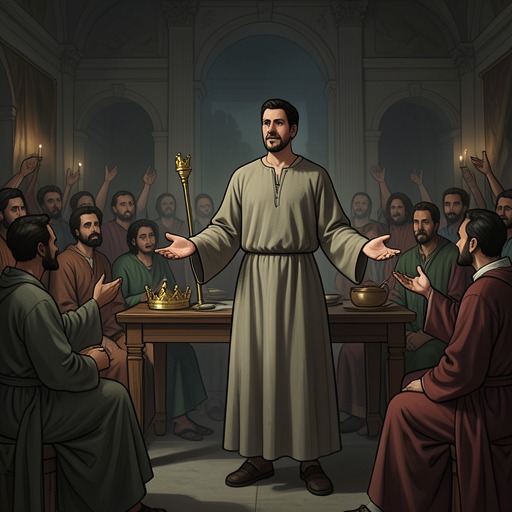
About 130 years after Gideon’s refusal, the Israelites return to the question of royal rule. Samuel is old, and his two sons, entrusted with secular responsibilities, do not follow his ways. The people seize on their misconduct and approach Samuel abruptly, demanding a king to judge them like other nations. Paine stresses that their stated comparison is itself revealing: rather than preserve a distinct political order, they want to resemble the heathens around them.
The request displeases Samuel, who prays to the Lord. The answer, as Paine recounts it, tells him to heed the people because their rejection is not of Samuel personally but of God’s reign over them. The divine response connects this demand with a recurring history of forsaking God and serving other gods, and instructs Samuel to warn the people about the general manner of kings. The warning is therefore framed as both a response to this particular appeal and an account of the costs associated with kingship more broadly.
Samuel’s Warning
Samuel tells the people that a king will claim their sons for his chariots and horsemen, appointing some to run ahead of the royal chariots. He will put others in command or set them to work his land, reap his harvest, and make instruments of war and chariots. Paine draws attention to the progression: royal authority reaches into military service and ordinary labor alike.
The warning extends to the king’s demands on households and property. Their daughters will be taken for work as confectionaries, cooks, and bakers; their best fields and olive yards will pass to the king’s servants. A tenth of their seed and vineyards will go to royal officers and servants, while their menservants, maidservants, best young men, asses, and sheep will also be taken for the king’s use. Paine reads these details as a picture not only of extraction but of royal expense, corruption, and favoritism.
Samuel’s forecast ends with the people becoming the king’s servants and crying out because of the ruler they chose. The warning says that the Lord will not hear them on that day. In Paine’s argument, the specificity of the list matters: monarchy is exposed not simply as an abstract constitutional error but as a system whose claims reach into work, land, family life, and the produce of the community.
Refusal, Warning, and Consequences
The Israelites refuse to obey Samuel. They insist on having a king who will judge them, go before them, and fight their battles, repeating their desire to be like other nations. Samuel reasons with them and sets their ingratitude before them, but the people remain determined. The episode therefore turns on a contrast between the prophet’s warning and the people’s chosen expectations of protection and leadership.
Samuel calls on the Lord to send thunder and rain during the wheat harvest, presenting the weather as a punishment and a sign of the gravity of the people’s act. The Lord sends the storm, and the people greatly fear both the Lord and Samuel. They ask Samuel to pray that they will not die and acknowledge that asking for a king has added evil to their sins. The scene ends not with the request withdrawn, but with the people recognizing its religious meaning and fearing its consequences.
Paine treats the episode as an explicit scriptural protest against monarchy, arguing that it cannot be reconciled away without, in his view, making scripture false. He adds that the conduct of a few good kings cannot sanctify monarchy’s origin, and distinguishes praise of David as a man after God’s own heart from praise of him officially as king. Samuel’s warning thus supports Paine’s wider claim that hereditary royal authority is not justified by scripture or by equal natural rights: the people’s demand is shown as a consequential choice, not an innocent constitutional preference.
Later Political Resonance
Paine’s use of Samuel’s account reaches beyond the biblical episode. In discussing the formation of government in America, he warns that a government’s seat must be legally and authoritatively occupied lest a powerful opportunist fill the vacuum and rule by force. He invokes William the Conqueror’s conquest of England as an example of law imposed by the sword, reinforcing the contrast between a political order deliberately constituted by the people and one imposed on them.
The same dispute over political action appears in Paine’s address to Quakers who claim that setting up or putting down kings and governments belongs to God alone, and that people should not contrive their overthrow. Paine challenges them to apply that principle consistently: if political changes are God’s work, he argues, their doctrine would require accepting what happens to kings as part of that work. The argument echoes the Samuel episode’s central question—whether royal rule should be treated as divinely ordained or as a human political arrangement for which people bear responsibility—without making Samuel a participant in Paine’s contemporary controversy.