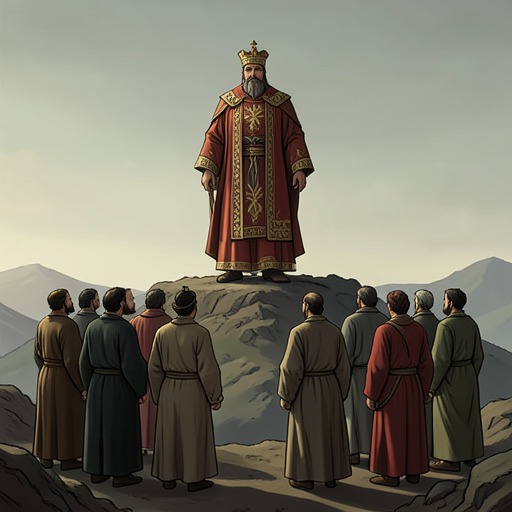
The Law Is King principle
Common SenseThe Law Is King principle is Thomas Paine’s proposed foundation for a free American government: sovereignty should rest in law, not in a monarch. Its emblematic ceremony places a crown on a constitutional charter and then destroys the crown, scattering it among the people. The gesture turns a familiar sign of royal authority into a public declaration that the people’s law, rather than a ruler’s will, is supreme.
From Government’s Purpose to Legal Authority
Paine’s principle belongs to an argument that distinguishes society from government. Society arises from human wants and brings people together; government arises because human beings do not reliably restrain their own vices. Society encourages mutual connection, while government checks wrongdoing. Even at its best, government is therefore a necessary evil, justified not as an end in itself but by its capacity to provide security.
That limited purpose sets a test for political authority. The form of government most worthy of preference is the one most likely to secure the people with the least expense and greatest benefit. The Law Is King principle gives this test a constitutional form: authority is to be exercised through a common law, rather than personalized in a sovereign whose commands can exceed public purpose.
Paine’s account of political origins also points toward this conclusion. In his hypothetical first settlement, people initially cooperate from necessity; while they remain just to one another, reciprocal social bonds can make formal government unnecessary. As shared responsibilities grow and moral obligations slacken, they assemble to deliberate and create rules. The eventual need for government does not erase the political community’s prior importance: law is an instrument developed to address a failure of mutual conduct, not a source of inherent royal privilege.
The Charter and the Crown
Paine proposes that a continental constitutional conference frame a charter for the united colonies. It would establish how representatives are chosen, fix the timing of legislative sessions, divide jurisdiction between Congress and assemblies, and secure freedom and property. Above all, it would protect the free exercise of religion according to conscience. The charter would thus define both the institutions through which authority operates and the liberties that authority must respect.
The proposed proclamation makes the charter’s supremacy visible. On a day set apart for the occasion, the document would be brought forth and placed upon the divine law, the word of God; a crown would then be placed on the charter. Paine’s point is not to enthrone a human ruler under another name. The crown is a temporary emblem, used to make plain that America’s acceptable form of monarchy is that “THE LAW IS KING.” In an absolute government, he observes, the king is law; in a free country, law ought to be king, and there ought to be no other.
The ceremony ends by demolishing the crown and scattering it among the people, whose right it represents. That ending reverses the usual direction of royal symbolism: instead of concentrating authority in a ruler, it returns the emblem to the public. The charter remains as the governing rule, while the crown’s destruction denies any separate personal sovereignty that might rival it.
Independence and Constitutional Security
For Paine, a government of America is a natural right, but leaving the seat of government vacant carries danger. He warns that a popular crisis might enable a desperate adventurer to seize power and sweep away the continent’s liberties; a renewed return to British rule could likewise invite an aspiring conqueror. Establishing a constitution deliberately, while the colonies can still shape their own institutions, is presented as safer than entrusting the outcome to chance.
The proposed framework also answers the practical concern that independence lacks an institutional plan. Paine sketches annual assemblies with a president, more equal representation, and domestic responsibilities subject to a Continental Congress. The charter would coordinate these bodies and mark the boundaries of their authority. The Law Is King principle is therefore more than a slogan about rejecting monarchy: it expresses a design in which offices and institutions are subordinate to publicly established rules.
That design follows Paine’s wider criticism of political dependence. He argues that a distant British government cannot administer the continent justly when decisions require journeys of thousands of miles and months of waiting, and that dependence entangles America in European conflicts. Independence, constitutional government, and legal supremacy accordingly form linked parts of his case: political authority should be near enough to answer the people, organized by a charter, and constrained by law rather than by a crown.
Significance
The principle recasts kingship as a constitutional metaphor. Paine retains the ceremony’s language of monarchy only to empty it of personal rule: the crown is placed on the charter for the world to see, then broken apart so that no ruler can claim it. In this image, law’s authority is public, institutional, and bounded by the liberties the charter is meant to protect.
The Law Is King principle also joins the essay’s account of government as a necessary instrument to its proposal for a new political order. If government is justified by security, it cannot properly become an independent source of domination. A charter, representative institutions, and the supremacy of law offer a way to make political power answer to the community it serves, turning independence from a mere break with Britain into a deliberate constitutional project.