The cause of America is in a great measure the cause of all mankind
Common SenseThe expression “The cause of America is in a great measure the cause of all mankind” gives Thomas Paine’s case for American resistance a universal reach: the struggle concerns the natural rights of humanity, not merely the interests of one country. Its political force lies in the connection it draws between resisting oppression and building a government whose representative structure, continental scope, and protections for individual rights make that universal claim concrete.
From Local Grievance to Universal Cause
Paine presents the American cause as one in which circumstances may be local but principles are not. The prospect of a country laid waste by fire and sword, and of the defenders of natural rights being driven from the earth, makes the issue the concern of every person capable of feeling. He places himself among those who share that concern, regardless of party criticism. The expression thus converts sympathy into a political standard: what is at stake in America bears on the rights by which all people should be judged.
That framing also clarifies why Paine treats resistance as an inquiry into political authority. The King of England has undertaken, in his own right, to support the claims of Parliament, while the people of America suffer under their combination. Their oppression gives them an undoubted privilege to examine the pretensions of both and reject the usurpation of either. The universal claim does not erase the immediate dispute; it explains why the dispute matters beyond its immediate participants.
Society, Representation, and Public Virtue
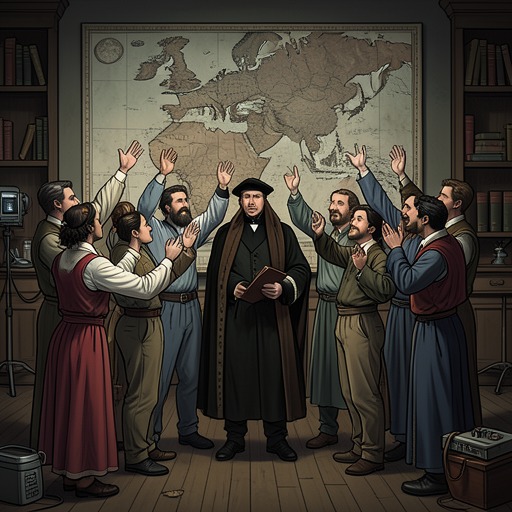
Paine’s account of government begins not with monarchy but with people assembling to meet shared needs. In his imagined growing colony, a convenient tree serves as a State-House where the whole community deliberates. Early laws may be called regulations and enforced through public disesteem; by natural right, every man has a seat in the first parliament. As population and public business expand, distance makes universal assembly impractical, so the community entrusts legislative work to selected representatives.
Representation, however, requires safeguards against a separate interest forming between electors and elected. Paine argues for frequent elections so representatives return to the general body and remain answerable to it. This recurring interchange is meant to establish a common interest across the community; on that mutual support, rather than on the name of a king, rests the strength of government and the governed’s happiness. Government is necessary because moral virtue cannot reliably govern the world, but its design and end are freedom and security.
Paine extends this republican test to England. He argues that the Crown’s control over appointments has swallowed up the power and weakened the virtue of the House of Commons, the constitution’s republican element. English people, he says, take pride in their liberty to choose a House of Commons from their own body; when that republican virtue fails, slavery follows. The contrast sharpens the expression’s implication: a cause directed against domination must also resist the corruption of representation from within.
A Continental Constitutional Design
Paine acknowledges that fear of independence can arise because no plan has yet been laid down. He offers his proposals as hints that might prompt something better, then sketches a continental government in which assemblies meet annually under a president, their business remains domestic, and they are subject to a Continental Congress. Each colony would be divided into six, eight, or ten districts and send delegates, with at least thirty from each colony; the Congress would number at least 390 members.
The proposed presidency would rotate among the thirteen colonies. At each Congress, a colony would be selected by lot, and the delegates would choose a president by ballot from that colony’s delegation. In the following Congress, the previous president’s colony would be omitted from the draw, with the rotation continuing until all thirteen had their turn. Paine further proposes that no measure become law without three fifths of Congress, a higher threshold than a simple majority. These mechanisms aim to distribute authority across the colonies and make continental government answerable to more than a narrow provincial interest.
To establish the system, Paine calls for a Continental Conference as an intermediate body between Congress and the people. Its membership would unite twenty-six congressional delegates, two from each colony, with two members from each House of Assembly or Provincial Convention and five representatives of the people at large from each province. Those popular representatives could be chosen in a provincial capital by qualified voters attending from across the province, or in two or three populous locations. Paine describes the combination as bringing together knowledge, supplied by those experienced in public affairs, and power, supplied by the people’s authorization.
The Conference’s task would be to frame a Continental Charter, or Charter of the United Colonies, comparable to Magna Carta. It would establish the number and manner of choosing members of Congress and the assemblies, specify when they sit, and divide their business and jurisdiction. It would also secure freedom and property for all, and especially the free exercise of religion according to conscience. Once the charter was framed, the Conference would dissolve, leaving the bodies chosen under it to govern. The proposal makes the universal language of the American cause institutional: liberty is to be secured for every part, rather than proclaimed as an abstraction.
Representation, Rights, and the Law as Sovereign
Paine’s insistence on broad representation is reinforced by his criticism of Pennsylvania’s Assembly. When the Associators’ petition came before it, only twenty-eight members were present; all eight Bucks County members voted against the petition. Had seven members from Chester County joined them, two counties would have governed the whole province. For Paine, the episode shows how a small and unevenly distributed group can claim authority over a much larger community. He also objects that a few people outside the Assembly approved instructions for the provincial delegates, which the Assembly then passed in the name of the whole colony.
The lesson is not that immediate arrangements have never served a purpose. Paine concedes that, during America’s calamities, appointing people from the several Houses of Assembly was the readiest and then most suitable way to consult; their conduct helped preserve the continent from ruin. But necessity does not make a temporary method right for the future. Since Congress is likely to remain, the way its members are chosen deserves reconsideration, especially because representation and election in the hands of the same body may concentrate too much power. Planning for posterity requires remembering that virtue is not hereditary.
The charter’s rights protections include religious freedom, and Paine treats differences among religious denominations as compatible with a shared civic family. A charter, in his account, is a solemn bond by which the whole community undertakes to uphold the rights of each part, whether in religion, personal freedom, or property. The expression’s universal principle therefore reaches into the constitutional details: political unity is not sameness, and common government must preserve the distinct rights it binds together.
Paine gives this constitutional vision its most memorable symbolic form in the proposed proclamation of the charter. It would be placed on the word of God and crowned so that the world could see that, in America, the law is king. The ceremony would end by demolishing the crown and scattering it among the people, whose right it was. The image turns sovereignty away from a ruler and toward public law, while making the people—not a monarch—the ultimate source of political authority. Across Paine’s argument, the cause of America becomes a cause for humanity precisely because resistance is paired with a demanding account of how freedom is to be represented, secured, and shared.