Tianhe
Common SenseGod is the highest political authority in Thomas Paine’s argument: the divine sovereignty against which monarchy is measured, and the source of a religious freedom that government must protect rather than control. Paine reads biblical accounts of Israel’s demand for a king as a warning against transferring political allegiance to hereditary rulers, then makes the law—not a human monarch—the rightful sovereign in America. At the same time, his account of divine purpose supports diversity of religious belief and limits government’s proper involvement in religion.
Divine authority against monarchy
Paine argues that monarchy cannot be justified by the natural equality of people or by scripture. He presents the biblical disapproval of kings as a political judgment that monarchical societies have glossed over, and asks newly forming governments to attend to it. In his interpretation, the scriptural instruction to render Caesar his due does not validate kingship: the Jews in that account were without a king and under Roman rule. Paine thus distinguishes obedience within a political circumstance from divine endorsement of monarchy itself.
The account of Gideon supplies a direct example. After Gideon’s victory over the Midianites, the Israelites offered to make him king, with the office to pass to his son and grandson. Paine emphasizes that Gideon refused both personal rule and hereditary succession, declaring that neither he nor his son would rule and that God would rule over the people. He reads this response not as modest refusal of an honor, but as denial that the people had the right to grant such sovereignty in the first place. Gideon’s answer makes divine rule the explicit alternative to human kingship.
Paine then turns to the later demand made to Samuel. The Israelites cited the misconduct of Samuel’s sons and asked for a king so that they could be like other nations. In Paine’s reading, their stated grievance cannot conceal the deeper rejection: God tells Samuel that the people have rejected divine rule. The request is therefore a recurring political error, not simply a practical adjustment to a failed administration. Paine stresses the contrast between Israel’s supposed distinction from surrounding nations and its desire to imitate them.
Samuel’s warning gives that rejection material consequences. As Paine recounts it, a king would take people for military service and labor, appoint officers, claim produce and property, and place the people in a condition of servitude. The warning also depicts royal government as a system of extraction and patronage, rather than a neutral institution. When the people persist, Samuel calls for thunder and rain during the wheat harvest; the people fear God and acknowledge that asking for a king has added to their sins. Paine treats the episode as an unequivocal protest against monarchy, arguing that the later character of any good king cannot sanctify the institution’s origin.
God, law, and political sovereignty
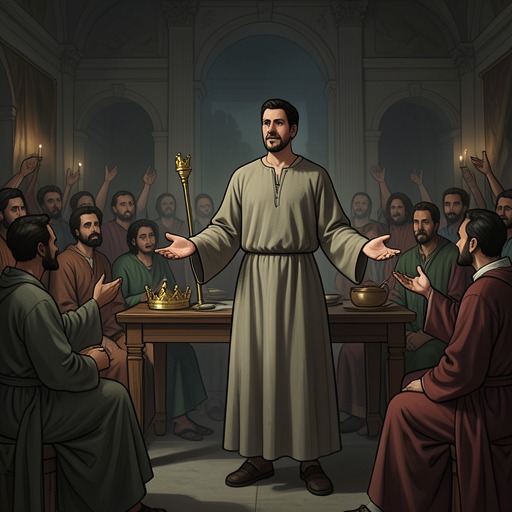
Paine’s proposed American order gives divine authority a different political expression from hereditary rule. He asks where America’s king is and answers that God reigns above, not as a human ruler who harms people. In a public ceremony for proclaiming a continental charter, he proposes placing a crown upon the divine law and then demolishing it and scattering it among the people. The image makes the distinction tangible: divine authority is acknowledged, but the crown is not allowed to remain as an instrument of human sovereignty. In a free country, the law ought to be king, and there ought to be no other.
This proposal joins religious reference to a constitutional program. The charter is to define the selection and terms of Congress and assemblies, allocate their jurisdictions, and secure freedom and property. Paine places the free exercise of religion, according to conscience, among its foremost guarantees. God’s authority therefore does not, in his design, translate into an earthly monarch’s power to legislate at will; it underwrites an order in which public authority is arranged through law and protected rights.
Conscience, diversity, and government
Paine assigns government a duty to protect people who conscientiously profess different religions, while denying it any further proper business in religious affairs. He presents this boundary as a safeguard against suspicion and narrowness, not as a threat to faith. His claim that religious diversity is divinely willed gives difference a positive place: varied beliefs provide a larger field for Christian kindness and make religious dispositions answerable to practice. People of different denominations, in this formulation, are members of one family distinguished by their Christian names.
The same principle informs Paine’s defense of a constitutional charter as a binding compact. The community is to support the rights of each separate part, including religion, personal freedom, and property. Governmental protection of conscience is thus not an isolated concession but part of the reciprocal obligation that holds a political community together. Paine’s argument brings divine authority, civil restraint, and public responsibility into one frame: government must defend religious freedom without claiming jurisdiction over belief.
Political action and providence
Paine’s appeal to divine sovereignty does not lead him to political quietism. In answering Friends who argue that setting up and putting down governments belongs to God and is not a human concern, he tests their public testimony against their stated principles. If political change is God’s prerogative, he argues, those who hold that belief should leave events to divine will rather than issue a political intervention of their own. The publication of a testimony against political action appears to him inconsistent with the passivity it prescribes.
He also rejects the idea that human agency is incompatible with divine providence. Changes in government occur through ordinary human means, Paine argues, not solely through miracles; political action can therefore be understood as part of the way events unfold. This position complements his biblical case against kingship: scripture supplies a standard for judging authority, but people remain responsible for how they establish and conduct government.
The result is a political theology with two linked limits. No hereditary monarch may claim the divine prerogative as a personal right, and no civil government may use religious authority to suppress conscience. God stands above earthly rulers, while the law governs political life and a charter secures the liberty of belief. Paine invokes divine sovereignty not to place religious control in the hands of a king, but to deny that any human ruler can replace it.