
Terror and the Meaning of Strength
ConclaveThe attacks provoke an argument over whether the Church should answer violence with forceful confrontation or with the witness of nonviolence.
increasing Bearing strength in each event
 decreasing
Bearing strength in each eventdecreasingThe First Explosion
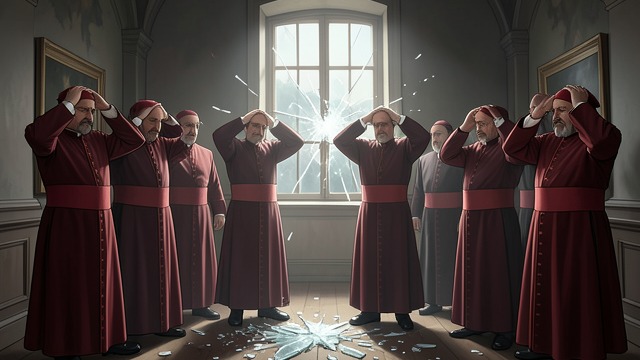
The First Explosion
Violence reaches the chapel
A blast shatters windows in the Sistine Chapel while the electors vote. Security personnel urge evacuation, but Lomeli orders them out and keeps the cardinals inside.
Courage or risk
Some electors see continued voting as defiance; others may see it as danger. The blast turns a secluded election into a direct encounter with public violence.
A Warning Against Panic
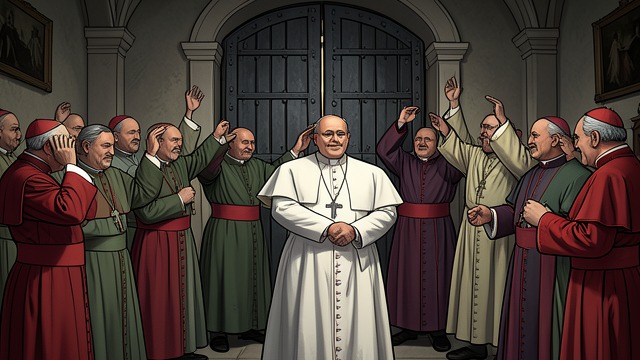
A Warning Against Panic
A vote to continue
Lomeli asks whether the electors want to resume. Tedesco argues that they must not be intimidated and that the explosion may not even be terrorism.
Leadership performed
His words are reasonable, but Lomeli suspects he is also asserting his authority as the leading candidate. The crisis becomes an opportunity for political positioning.
The Full Scale Revealed
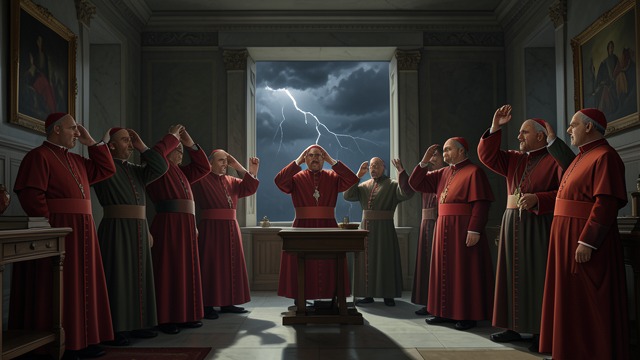
The Full Scale Revealed
Attacks across Europe
Officials report deaths at several religious and civic sites, including churches in Rome and Munich and a Catholic university in Belgium. The campaign is coordinated and still unfolding.
A religious-war fear
Lomeli warns that the world may interpret the violence as the beginning of a religious war. O’Malley sees the attacks as an assault on the Church itself.
Tedesco’s Call for Resistance
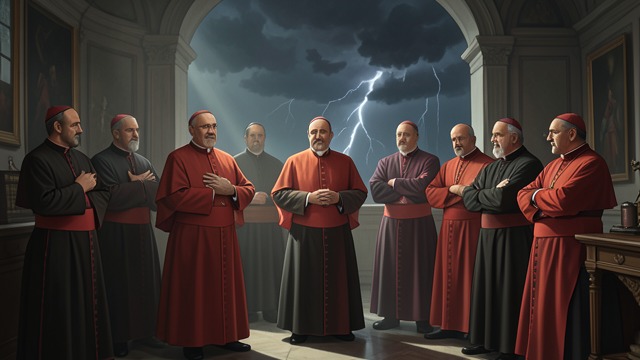
Tedesco’s Call for Resistance
A militant interpretation
Tedesco links the violence to what he considers the Church’s weakness and calls for a firmer defense of Christian identity. He invokes the Battle of Lepanto as a model.
A divisive appeal
His speech draws on real fear but turns it toward confrontation with Islam. The argument tests whether crisis will unite the Church or harden its divisions.
Benítez’s Countervoice

Benítez’s Countervoice
Witness from the front lines
Benítez reminds the electors that the Christian population of Iraq has sharply declined and that he has buried victims of violence in the Middle East and Africa.
Refusal of retaliation
He says the dead would not have wished for violence to be answered with violence. Applause spreads across the room, shifting the debate toward witness and compassion.
During the seventh ballot
Minutes after the blast
After the seventh ballot, before lunch
At lunch after the attacks
Immediately after Tedesco’s speech
