James Ballard and Robert Vaughan's relationship
CrashJames Ballard and Robert Vaughan's relationship is the novel's central fusion of fascination, erotic identification, technological violence, and impending betrayal. What begins as Ballard's deference to an injured, charismatic expert becomes a bond organized around crashed cars, wounded bodies, cameras, and the shared conviction that the automobile can generate a new sexuality. Their intimacy repeatedly moves between admiration and submission, observation and participation, tenderness and threat, until Ballard recognizes that Vaughan's final act of love will be an attempt to kill him.
Identity and First Encounter
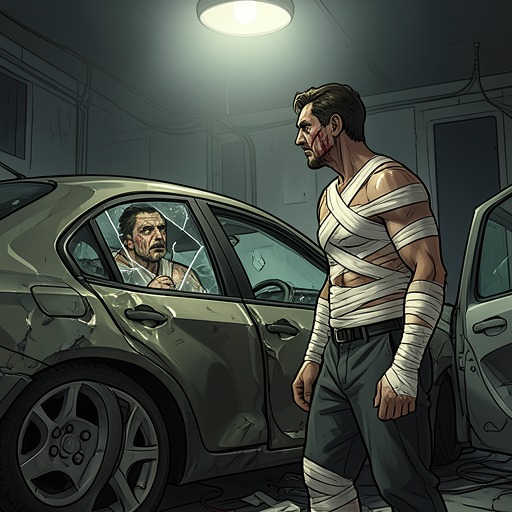
Robert Vaughan enters James Ballard's life as a former television scientist and computer specialist whose public career had promised technical authority over international traffic systems. That career ended when Vaughan was seriously injured in a motorcycle crash: his legs were broken by a truck's rear wheels, and his face retained the impact in laterally displaced features, scars across his mouth and forehead, a broken and reset nose, and two missing upper canine teeth. His scarred appearance, leather jacket, self-cut hair, and aggressive glamour made him both a damaged authority and a living emblem of the collisions he studied.
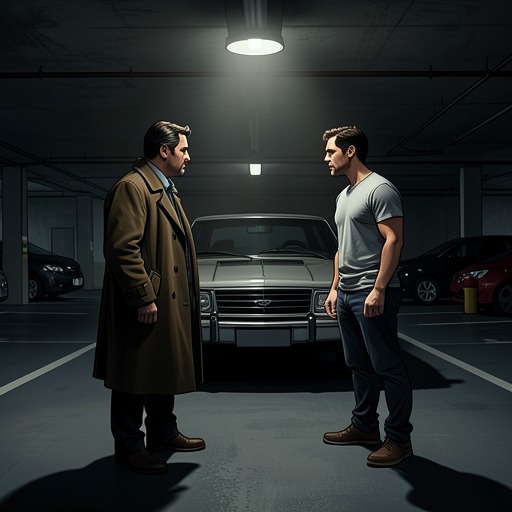
Ballard's first sustained contact with Vaughan occurs while they wait in a physicians' car park for Seagrave and Helen Remington. Vaughan is already photographing the casualty department and surrounding himself with images of wrecked vehicles. Ballard immediately senses that the encounter fixes the whole course of their relationship. Vaughan's handling of his ten-year-old Lincoln Continental establishes his personal grammar: aggressive, distracted, sensitive, clumsy, absorbed, and brutal. Because the Lincoln has lost its second gear during a road race with Seagrave, Vaughan alternately crawls through traffic and drives toward danger, sometimes fumbling at the wheel like a driver using invalid controls before jerking the car to a halt at the last moment. Ballard's hostility gives way to deference, and perhaps to subservience, as Vaughan's erratic mastery becomes the model for his conduct in every other sphere.
Shared Crash Aesthetics
Vaughan teaches Ballard to see the automobile crash not as a merely accidental interruption of traffic but as a system of impacts, postures, wounds, and erotic correspondences. Together they visit the Road Research Laboratory, where calibrated vehicles strike concrete target blocks. Later, in Vaughan's apartment, they watch slow-motion films of test collisions photographed with Vaughan's cinecamera. The silent repetitions first calm Ballard and then arouse him; driving alone beneath the yellow motorway lights, he imagines himself at the controls of the colliding vehicles. Vaughan's images thus convert mechanical research into a private emotional and sexual education.
Their shared practice extends into the highways around London Airport. They follow police broadcasts from one accident to the next, watching firemen and police engineers cut trapped passengers from wreckage and doctors attend dying motorists. Vaughan waits especially for head-on impacts with motorway pillars, treating the crushed vehicle and the serene concrete structure as a single visual composition. His camera makes him an intrusive participant: at times spectators pull him back as he fights ambulance attendants for access to the wrecks. Ballard is drawn into the same spectacle, and the pair's movement from crash site to crash site becomes a ritual through which public injury is transformed into private fantasy.
The relationship also depends on Vaughan's photographs of injured women and damaged cars. Ballard studies images of a young woman recovering from a sports-car accident, moving from a blood-soaked wreck to a chromium wheelchair and then to an invalid car with specially designed controls. Ballard reads her altered body through the geometry of braces, treadles, straps, and buckles, treating the accident as a transformation that has released sexual possibilities previously hidden within an ordinary life. The disturbing force of these photographs is that Vaughan has already articulated desires Ballard cannot yet name. Ballard cannot summon moral anger at Vaughan's intrusion into his private life; instead, the photographs bring a latent homoerotic element to the surface and give his own crash a positive, erotic response.
Affection, Competition, and Bodies
Vaughan governs his relationships with women through the same unstable games that govern his driving. He shifts between irony, politeness, deference, boredom, and cold appraisal, regarding Helen Remington partly through the imagined wound areas of her body. Ballard observes these fluctuations while remaining increasingly implicated in Vaughan's orbit. Vaughan's attention to bodies is never separate from his attention to vehicles: scars, genitalia, seats, dashboards, and instrument panels form one field of observation.
Vaughan also deliberately unsettles Ballard through sexual display. While describing crashes, he turns partly toward Ballard so that the profile of his almost erect penis becomes visible. Ballard understands that Vaughan uses his sexuality casually, as if he might discard it permanently, yet also knows that this provocation keeps him from leaving. The encounter is coercive without being presented as a simple act of domination: Vaughan's display binds Ballard through curiosity, intimidation, and the promise of a shared language that ordinary intimacy cannot provide.
Their connection becomes more explicit after Ballard's involvement with Gabrielle. At the motor show at Earls Court, Vaughan steers Gabrielle, whose legs are shackled and injured, among immaculate cars, presenting his own scars as a sympathetic response to her disability. When Vaughan urges Ballard to walk with Gabrielle and then slips away, Ballard becomes the person who accompanies her through invalid cars and later has sex with her in the rear seat of her small car. The experience intensifies the relationship between Ballard and Vaughan even though Vaughan is not the immediate sexual partner: Ballard has learned to interpret braces, controls, and bodily deformities within the crash-based erotic system Vaughan created.
Ballard's attraction to Vaughan eventually becomes conscious affection. When Vaughan opens the Lincoln's door for him at Shepperton Studios, Ballard realizes that he wants to spend as much time with Vaughan as possible. He identifies jealousy, love, and pride in his feelings, imagining touch and bodily closeness modeled on his earlier intimacy with Catherine. The emotional shift is significant because Ballard no longer regards Vaughan solely as an instructor or predator; he wants reciprocal possession of the scarred body that first commanded his submission.
Sexual Union and Mutual Wounds
Their relationship reaches its most intimate form inside a car after a crash. Ballard and Vaughan expose their scars to one another and to the damaged interior surrounding them, treating wounds as contact points between male bodies and the automobile's broken geometry. Ballard kisses the scars on Vaughan's lips and cheeks, touches the scar on his penis, and then penetrates him. The scene joins bodily tenderness to the material vocabulary of dashboards, windshields, instrument binnacles, and collision points. The car is not a neutral setting for their encounter; its structure organizes the lovers' positions and turns mechanical damage into an erotic anatomy.
Afterward, Ballard experiences profound calm, composed of love for Vaughan and tenderness toward the metal enclosure in which they sit. As Vaughan sleeps, Ballard watches the light move across the landscape and the distant wreckage. When Vaughan wakes, they show their wounds to each other, exposing scars on their chests and hands to the injury sites inside the car. Their shared wounds become a ritual of recognition: they celebrate the rebirth of the traffic-slain dead through their own bodies, while also allowing the car to function as a third participant in their intimacy.
This union does not resolve the relationship into safety. Its tenderness is inseparable from violence, and Ballard's later understanding makes the scene retroactively ominous. The very act that seems to confirm love also reveals the extent to which Vaughan's desire depends on reenactment, injury, and finality. Their sexual contact is therefore both consummation and rehearsal: an intimate passage toward the fatal collision that Vaughan has been imagining throughout their association.
Betrayal, Pursuit, and Ending
Ballard eventually understands that Vaughan's love has always contained a plan of destruction. In the aftermath of his own hallucinatory and traumatic experiences, Ballard thinks of Vaughan as someone who cannot really die in a car crash but will be reborn through twisted radiator grilles and cascading windshield glass. He remembers Vaughan's scarred abdomen, crude treatment of women and automobiles, and submissive tenderness toward him in the same mental sequence. The contradiction is deliberate: Vaughan can be tender and murderous without one state cancelling the other.
Ballard recognizes that even while submitting to their sexual encounter Vaughan knew he would try to kill him. The planned killing would be a final display of casual love, extending Vaughan's logic that the most complete intimacy is achieved when bodies, cars, and death occupy the same event. Ballard's insight does not free him from Vaughan's influence; it confirms how thoroughly Vaughan has reorganized his perception of desire and danger.
The relationship therefore ends not in reconciliation but in an unstable mixture of knowledge, fear, and continued attachment. Vaughan's final violence is prepared by every earlier scene: the crash tests, the motorway excursions, the photographs of wounds, the deliberate sexual provocations, the damaged Lincoln, and the lovers' mutual display of scars. Their bond has transformed Ballard from an observer of accidents into a participant who can recognize his own longing inside Vaughan's destructive project.
Narrative and Thematic Significance
James Ballard and Robert Vaughan's relationship supplies the novel's decisive model for the marriage of sex and technology. Vaughan gives form to impulses that Ballard experiences first as images, bodily reactions, and fantasies; Ballard, in turn, becomes the witness whose attention confirms Vaughan's private mythology. Their relationship is less a conventional romance than a circuit of transmission in which scars, photographs, traffic, and sexual acts carry affect from one body to another.
The bond also destabilizes conventional masculinity. Vaughan's authority derives from scientific expertise, public performance, driving, risk, and violence, yet his power is repeatedly marked by physical damage and erotic vulnerability. Ballard moves from hostility to submission, then from submission to love and sexual agency, while still remaining exposed to Vaughan's violence. Male identity is consequently shown not as stable mastery but as a performance assembled from damaged bodies, technical competence, spectatorship, and the willingness to approach death.
At the same time, the relationship reveals the ethical danger of turning injury into an aesthetic or erotic resource. Vaughan's photographs and Ballard's responses transform injured people into images, metaphors, and imagined sexual possibilities. The novel does not permit that transformation to remain harmless: the gaze becomes intervention, the intervention becomes participation, and participation culminates in a lethal design. Their relationship is powerful because it makes desire and destruction structurally continuous, leaving Ballard with the knowledge that the person who most fully understood his new sexuality was also the person preparing to annihilate him.