before the main action
Narrator's Crash Premonition
The narrator, [James Ballard](entity:character-recall-character-james-ballard-c98791fe7205), later understands his life through the idea that the automobile crash is a rehearsal for death and a hidden erotic script. His marriage to Catherine already depends on fantasies involving violence, infidelity, technology, and mediated images, making the coming accident less an isolated catastrophe than the revelation of an existing psychic condition.
This premise establishes the novel's governing idea: the motor-car is not merely transportation but a technological body in which desire, injury, spectacle, and social identity converge.
June
Narrator's Western Avenue Crash
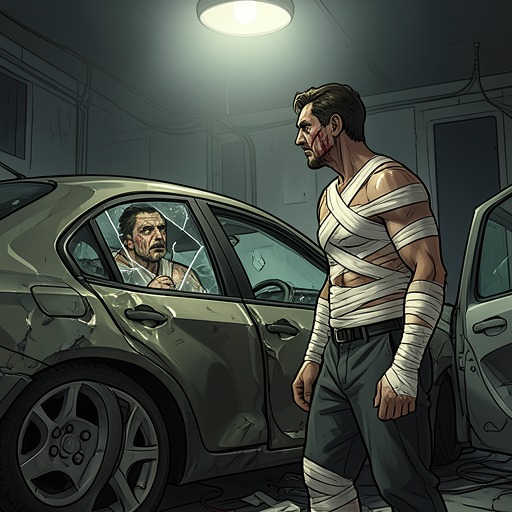
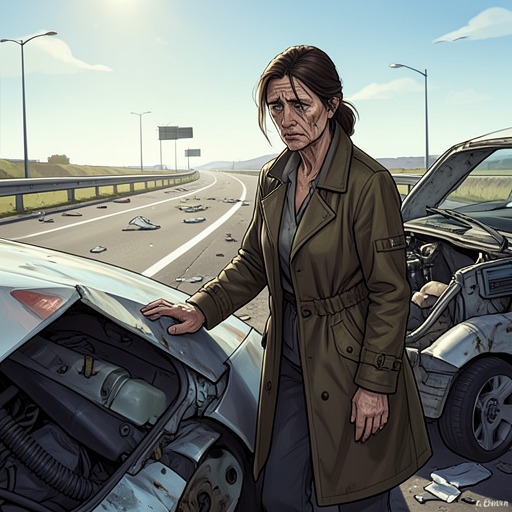
Driving home after leaving [Renata](entity:character-recall-character-renata-a8f4b0e20b8a), Ballard loses control at the intersection below the [Western Avenue flyover](entity:location-recall-location-western-avenue-flyov-90d73a5716be). His car crosses the central reservation and collides head-on with [Charles Remington](entity:character-recall-character-charles-remington-53539ba4983b)'s vehicle; Charles is thrown through the windshield and killed, while Ballard and [Helen Remington](entity:character-recall-character-helen-remington-9d6167ce285b) survive with serious but nonfatal injuries.
The collision fuses the bodies, vehicles, and identities of the participants. Ballard immediately begins to read its wounds and machine damage as signs of an unknown sexual and technological meaning.
the three weeks after the crash
Hospitalized Aftermath
At [Ashford Hospital](entity:location-recall-location-ashford-hospital-7dd8d852c8ed), Ballard undergoes surgery for fractured kneecaps and recovers amid pain, fever, sedatives, and obsessive fantasies. The nurses, doctors, equipment, and bodily functions of the casualty ward become extensions of the crash, while his injuries appear to reproduce the contours of his steering wheel, instrument panel, and controls.
His body becomes an interpretive surface: trauma no longer simply damages him but supplies new erotic apertures and a vocabulary for connecting human flesh with engineered structures.
during Ballard's hospitalization
Catherine's Hospital Visits
Catherine visits Ballard with apparent concern, yet their conversations and sexual contact reveal that the accident has intensified rather than disrupted their marriage's established games of jealousy, imagined lovers, and mediated violence. She discusses the dead man and Helen while treating Ballard's injuries as material for their private fantasies.
The crash restores an excitement that had faded from their relationship. Their intimacy becomes increasingly organized around the technological spectacle of death rather than ordinary affection.
late in the hospital recovery
First Sexual Awakening
A nurse's ordinary act of positioning Ballard's penis beside a dressing triggers his first erection since the crash. The moment crystallizes his new tendency to experience medical care, wounds, bodily fluids, and mechanical surfaces as erotically continuous.
The accident has altered the threshold between sensation and interpretation. What once would have been neutral clinical contact now belongs to the emerging sexuality generated by trauma and technology.
shortly after leaving hospital
Return to the Motorway
Still weak, Ballard resumes driving and returns to the site of the collision with [Renata](entity:character-recall-character-renata-a8f4b0e20b8a). He stops at the impact point, has sex with her in the car, and studies the scattered safety glass as the geological residue of countless crashes.
Revisiting the scene turns memory into ritual. The road junction becomes both crime scene and erotic shrine, while the replacement car begins to function as a reconstructed version of his injured body.
shortly after the return to the crash site
Meeting at the Wrecking Yard
At the crash location, Ballard notices a scarred man photographing him from a parked American car. The stranger later appears at the airport car park while Ballard is having sex with a prostitute, observing the scene with professional detachment.
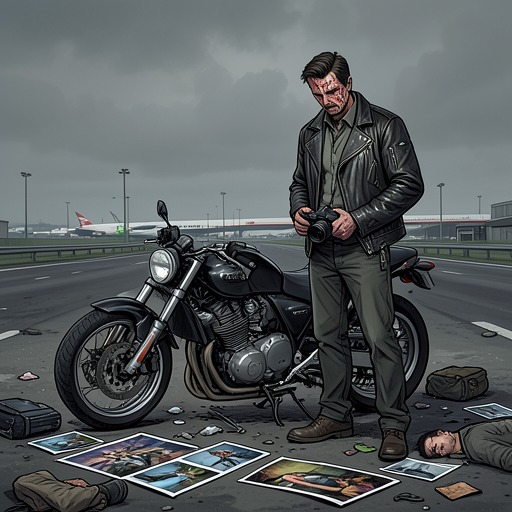
Ballard recognizes him as [Robert Vaughan](entity:character-recall-character-robert-vaughan-9b2a3bddf74f), a former television computer specialist whose public career ended after a motorcycle accident. Vaughan's camera, body, and aggressive manner announce a new figure who will transform Ballard's private obsession into a shared system.
the weeks after their first meeting
Vaughan's Accident Archive
Vaughan shows Ballard photographs of crashes, injured people, hospital scenes, and sexual encounters staged around damaged cars. His photographic album includes [Gabrielle](entity:character-recall-character-gabrielle-d9430c4a3c52)'s accident and recovery, Ballard's own hospitalization, and the sexual relationships formed through automobiles.
The archive reveals Vaughan's method: he treats people as temporary occupants of a technological tableau and searches for the exact junctions where wound, posture, bodywork, and desire become interchangeable.
the early convalescent period
The Rental-Car Experiments
Ballard hires a succession of vehicles and drives repeatedly along the routes surrounding [London Airport](entity:location-recall-location-a9b4c9a7ddfb), including the roads near [Stanwell](entity:location-recall-location-stanwell-738ed5b3970a) and [Western Avenue](entity:location-recall-location-western-avenue-85ae76b1fe72). He has sex with [Renata](entity:character-recall-character-renata-a8f4b0e20b8a) and airport prostitutes in these cars, testing how different interiors and controls alter bodily sensation and memory.
The rental cars become laboratories in which Ballard attempts to reproduce and extend his original crash. His recovery is therefore not a return to normality but an escalating experiment in the erotic possibilities of the automobile.
after Ballard's first visits to the wrecking yard
Helen's Return
Ballard encounters Helen at the police pound while she searches for Charles's car. She recognizes him as the driver who killed her husband, yet accepts a lift to [London Airport](entity:location-recall-location-a9b4c9a7ddfb) and begins to examine the identical replacement car with a mixture of hostility, curiosity, and attraction.
Their shared access to the wreck and its technology gives grief an unexpected erotic channel. Ballard imagines that sex with Helen might resurrect Charles through the physical logic of the collision.
the following weeks
Helen's Car Affair
Helen and Ballard begin having sex almost exclusively inside his car, often on deserted service roads and near the airport. Their encounters repeatedly re-stage the collision that killed Charles, translating widowhood, guilt, and revenge into postures framed by vinyl, glass, chrome, and controls.
Helen cannot respond sexually in an ordinary bedroom, but the automobile unlocks her desire. The car becomes the medium through which she converts mourning into a new, impersonal sexuality.
during Catherine's absence in Paris
Northolt Stock-Car Accident Reenactment
Ballard takes Helen to the stock-car stadium at [Northolt](entity:location-recall-location-northolt-2c31fa6032d5), where [Seagrave](entity:character-recall-character-seagrave-b8619b60647c) participates in a staged reconstruction of a fatal road accident. Vaughan directs the event, but the performance becomes a real and violent collision that concusses Seagrave and exposes the gap between simulated danger and actual injury.
Vaughan's interest is not entertainment but controlled access to trauma. He immediately treats the injured stunt driver as an experimental subject and draws Helen further into his orbit.
immediately after the Northolt reenactment
Seagrave's Household Experiment
Vaughan brings the concussed [Seagrave](entity:character-recall-character-seagrave-b8619b60647c) to his home, where Vera, a television producer, [Gabrielle](entity:character-recall-character-gabrielle-d9430c4a3c52), and other associates gather amid drugs, cameras, and damaged bodies. Seagrave speaks openly of crashes that would mutilate film actresses, while Vaughan encourages his fantasies and promises that the imagined violence will eventually be realized.
The household reveals Vaughan's social mechanism: he recruits wounded or unstable people into a collective theater of automotive violence, converting their fears and appetites into material for his own project.
after Seagrave's concussion
Vaughan's Television Project
Vaughan explains that he has left [N.C.L.](entity:organization-recall-organization-n-c-l-827b223d8413) and is developing a new television project centered on automobile accidents, their psychology, and their erotic implications. He shows Ballard photographic studies of crashes, injured women, and sexualized vehicle interiors, presenting technology as a system that can reorganize desire.
Ballard understands that Vaughan is not merely recording an existing subculture. He is manufacturing a mythology in which the crash becomes the central ritual of modern life.
about a week after the film-set meeting
Road Research Laboratory Crash Test
Ballard, Helen, and Vaughan attend an open day at the [Road Research Laboratory](entity:location-recall-location-road-research-labora-e79db9009fa1). A motorcycle is catapulted into a saloon car carrying plastic family mannequins, and the slow-motion replay displays the elegant, grotesque choreography of dismemberment, shattered glass, and collapsing metal.
The test gives Vaughan a controlled spectacle that resembles both scientific research and pornography. Ballard sees the mannequins as more conceptually real than the spectators, while Helen begins to accept the laboratory's technological violence as a field of professional commitment.
after the Road Research Laboratory visit
Vaughan's Questionnaires
Vaughan gives Ballard a file of questionnaires completed by people connected to his project, including [Seagrave](entity:character-recall-character-seagrave-b8619b60647c), Vera, [Gabrielle](entity:character-recall-character-gabrielle-d9430c4a3c52), and others with crash histories. The subjects are asked to devise deaths for celebrities using an elaborate catalogue of injuries, vehicle impacts, and genital mutilations.
The responses show that Vaughan's fantasies have spread beyond himself. Seagrave's exclusive focus on film actresses, especially [Elizabeth Taylor](entity:character-recall-character-elizabeth-taylor-f99d33df851c), reveals the death scenario that will eventually govern Vaughan's own actions.
shortly after the crash-test visit
The Car-Wash Encounter
After a motorway accident, Ballard drives Vaughan and Catherine to an airport car wash. While the machine's rollers and water engulf the vehicle, Vaughan has sex with Catherine in the rear seat, arranging her body as though she were another component of a damaged car.
The scene completes Catherine's entry into Vaughan's system. Her marriage to Ballard now incorporates Vaughan as a sexual and technological intermediary, and the car wash turns cleansing into another ritual of contamination, impact, and repetition.
the following weeks
Ballard's Vaughan Obsession
Ballard becomes Vaughan's driver and companion, helping him pick up prostitutes, visit crashes, steal cars, and survey the motorways around [London Airport](entity:location-recall-location-a9b4c9a7ddfb). Vaughan's body, scars, sexual habits, and driving postures become as fascinating to Ballard as the cars themselves.
Their relationship shifts from observation to dependence. Ballard increasingly accepts Vaughan's belief that every vehicle and wound contains a latent sexual code, while Vaughan uses Ballard as chauffeur, witness, collaborator, and eventually intended victim.
during the motor-show period
Gabrielle's New Sexuality
At the [Earls Court](entity:location-recall-location-earls-court-d22e5eea66c8) motor show, Vaughan guides [Gabrielle](entity:character-recall-character-gabrielle-d9430c4a3c52), whose legs were damaged in a crash, through displays of new and specialized cars. Ballard later has sex with her in [Gabrielle's invalid car](entity:object-recall-object-gabrielle-12b79bf4ce69), where braces, auxiliary controls, and scars become the true sites of arousal.
Gabrielle's body demonstrates Vaughan's central theory in its most extreme form: injury creates new organs of sensation, and technology supplies the structures through which those organs can be imagined and used.
during Vaughan's escalating project
The Actress Death Design
Vaughan studies [Elizabeth Taylor](entity:character-recall-character-elizabeth-taylor-f99d33df851c)'s movements, photographs her body, and marks her images with prospective wound sites and vehicle impact points. He imagines a unique collision involving her, a limousine, and the perfected sexual symbolism of a crash.
Elizabeth Taylor becomes less a person than the final surface on which Vaughan hopes to inscribe his theory. Her celebrity gives the projected death the status of a public ritual and a definitive work of technological art.
before Seagrave's death
Catherine's Vaughan Fantasy
Catherine and Ballard begin incorporating Vaughan into their sexual fantasies, imagining his body, anus, scars, and car as objects of desire. Catherine's curiosity about whether Ballard would have sex with Vaughan brings the narrator's latent homoerotic fixation into explicit focus.
The fantasy prepares the later physical encounter between Ballard and Vaughan. It also shows how their marriage can absorb betrayal without collapsing, because every lover becomes another instrument in their shared system of representation.
the months before the ending
Vaughan's Crash Culture
Vaughan and Ballard visit increasingly frequent crashes, steal cars from airport lots, and use prostitutes to rehearse different positions and impacts. Vaughan's battered Lincoln becomes a mobile archive of semen, blood, damage, and improvised experiments.
His conduct grows less controlled as his pursuit of [Elizabeth Taylor](entity:character-recall-character-elizabeth-taylor-f99d33df851c) becomes urgent. The difference between research, performance, assault, and self-destruction steadily disappears.
three days after the first false reports about Elizabeth Taylor
Seagrave's Fatal Crash
[Seagrave](entity:character-recall-character-seagrave-b8619b60647c), dressed in [Elizabeth Taylor](entity:character-recall-character-elizabeth-taylor-f99d33df851c)'s wig and clothing, drives a customized sports car into a collision at [Harlington](entity:location-recall-location-harlington-bd1030fcaacd). He dies in the crash, while another television personality is badly injured in the second impact and Vaughan carries away a bloodstained fragment of her car interior.
Vaughan is devastated because Seagrave has symbolically pre-empted the death reserved for Elizabeth Taylor. The accident confirms that the imagined scenario has become an autonomous reality that can no longer be controlled by its author.
immediately after Seagrave's death
Vaughan's Self-Injury
After [Seagrave](entity:character-recall-character-seagrave-b8619b60647c)'s death, Vaughan begins deliberately injuring himself: trapping his hand in car doors, reopening old wounds, and sliding his body against dashboards during abrupt braking. Blood and semen accumulate in the Lincoln as he drives faster and behaves with increasing agitation.
The injuries reveal that Vaughan can no longer remain an observer of crash violence. His body is becoming the next experimental vehicle, and his self-destruction is now inseparable from his pursuit of the final collision.
about a week after the self-injury begins
Acid Highway Journey
Vaughan gives Ballard an LSD-laced sugar cube and drives him along the [Northolt](entity:location-recall-location-northolt-2c31fa6032d5) expressway and outer circular motorway. Under the drug's influence, Ballard sees cars as angelic machines, roads as celestial runways, and the entire traffic system as a metaphysical landscape prepared for their reception.
The acid trip externalizes the novel's central imagery. Technology becomes both paradise and threat, while Vaughan appears as guide, lover, parent, and executioner within Ballard's transformed perception.
during the acid journey
Vaughan Attacks the Car
Vaughan urges the intoxicated Ballard to drive across the central reservation into oncoming traffic. Ballard briefly relinquishes control, but Vaughan steers them away and eventually stops beneath an overpass beside a breaker's yard.
The apparent rescue is also a rehearsal for murder. Vaughan has demonstrated that he can make Ballard's car, body, and altered consciousness serve his final design, while Ballard's trust in him reaches its most dangerous point.
immediately after the acid trip
Vaughan's Failed Killing Attempt
As the drug wears off, Ballard leaves the Lincoln and rests in an abandoned car. Vaughan accelerates toward him, swerves, destroys part of the wrecking-yard fence, and escapes without stopping to see whether Ballard has been killed.
The act ends the illusion that their relationship is purely exploratory or mutually protective. Vaughan has now attempted to convert Ballard into a crash victim, although his violence remains entangled with a distorted form of affection.
the days after the acid trip
Catherine's Marked Car
Ballard recovers at home while Catherine continues her ordinary movements through the airport. Her sports car is found with a long, deliberate-looking dent along its side, clearly matching the bumper of Vaughan's Lincoln.
The damage functions as a message and a rehearsal. Vaughan has shifted his attention from Ballard to Catherine, but Ballard recognizes that she is also a stand-in for the more important death he is still preparing.
the following days
Vaughan Pursues Catherine
Vaughan repeatedly follows Catherine around the airport roads, flyovers, intersections, and traffic lanes. He mimics her driving, cuts across her path, waits at favorite collision points, and tests head-on, side-impact, rear-end, and rollover possibilities without yet striking her.
Ballard watches rather than intervenes, understanding the pursuit as an elaborate courtship and death rehearsal. Catherine also accepts the danger with an ironic calm, allowing the three-way relationship to proceed according to Vaughan's violent logic.
near the end
The Stolen Replacement Car
Vaughan's damaged Lincoln is left outside Ballard's apartment, where it deteriorates under the trees and is vandalized by youths. Soon afterward, Ballard sees his own replacement car being driven violently away from the garage.
He understands that Vaughan has taken the vehicle needed for the final design. The identical car carries the imprint of Ballard's original crash and gives Vaughan the means to turn Ballard's identity into the instrument of [Elizabeth Taylor](entity:character-recall-character-elizabeth-taylor-f99d33df851c)'s death.
ten days after the replacement car is taken
Vaughan's Final Crash
Vaughan drives Ballard's car at maximum speed along the [Western Avenue flyover](entity:location-recall-location-western-avenue-flyov-90d73a5716be) and attempts to collide with the limousine carrying [Elizabeth Taylor](entity:character-recall-character-elizabeth-taylor-f99d33df851c). The car jumps the rails and plunges through the roof of an airline coach; Vaughan dies amid the crushed bodies and machinery, while Elizabeth Taylor survives.
The crash fulfills Vaughan's long-imagined death while failing to produce the exact union he designed. His body becomes the final crash artifact, and the spectators, police, and surviving actress turn the event into a public spectacle.
immediately after Vaughan's death
Aftermath at the Flyover
Ballard and Catherine visit the accident site, where his car lies beside the destroyed airline coach and the actress stands protected from the crowd. The spectators gather not only to witness injuries but to absorb the transformed vehicles as models of their own lives and deaths.
Ballard experiences the site as a visit to his own possible death. Vaughan's imagined ritual has become a communal event, confirming that the eroticism of the crash belongs not to one madman alone but to the technological culture surrounding them.
the final evening
Last Visit to the Police Pound
Ballard and Catherine return to the police pound and sit together in the wreck of Vaughan's Lincoln, performing a brief ritual sexual act. They then walk among the seized vehicles, carrying the residue of their encounter into the dark collection of damaged machines.
The visit transforms Vaughan's abandoned car into a memorial and a relic. Catherine and Ballard no longer merely observe his system; they inherit and continue it through their own bodies and rituals.
the ending
The New Crash Zodiac
Ballard marks the crushed controls, seats, and steering column of his own wrecked car with semen, defining Vaughan's final presence across the deformed interior. He realizes that he is already designing the elements of his own future crash.
The novel closes without moral resolution or escape. Traffic continues across the flyover and aircraft carry the traces of Vaughan outward toward countless vehicles, while sex, technology, injury, and death become the sustaining grammar of the modern landscape.