Vera and Seagrave's marriage
CrashVera and Seagrave's marriage is one of the novel's clearest examples of domestic life being reorganized by the erotic and technological logic of the automobile crash. Vera remains associated with care, vigilance, and the ordinary obligations of a wife and mother, while Seagrave, a former stunt driver, has been drawn into Robert Vaughan's experiments with danger. Their marriage therefore becomes less a secure private unit than a contested space in which injury is watched, interpreted, and repeatedly converted into material for Vaughan's fantasies.
Domestic Setting and Unequal Roles
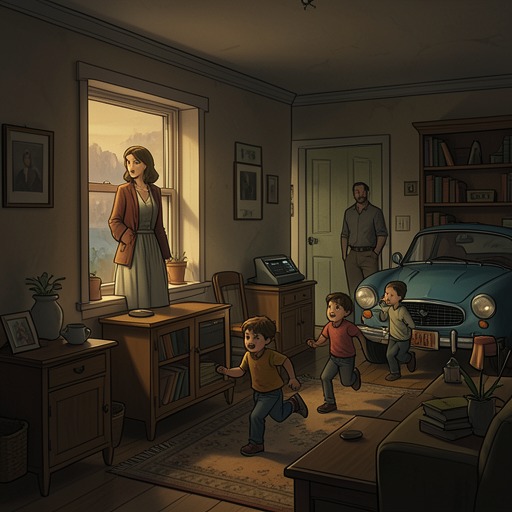
Vera and Seagrave live above or beside Seagrave's failing garage and salesroom in Stanwell, a business devoted to hot-rod and customized cars that has clearly declined since his brief heyday as a racing driver. The showroom contains a fibreglass replica of a 1930s Brooklands racer beneath faded bunting, an image of a vanished masculine glamour that shadows the household. The family home is consequently inseparable from the culture of modified vehicles, racing, and mechanical display in which Seagrave once made his identity.
Vera is described as a handsome, restless woman of about thirty, wearing a simulated Afro wig, while her small child watches from between her legs and touches the long scars on her thighs exposed by her mini-skirt. The detail joins maternal responsibility to a visibly marked body, but it does not make Vera passive. She is the person who recognizes that Seagrave needs supervision, challenges Helen Remington about his condition, and tries to prevent him from returning to stunt-driving work. Her role is practical and protective even within a household whose emotional and economic life has been shaped by cars and crashes.
Seagrave's Dependence on Vaughan
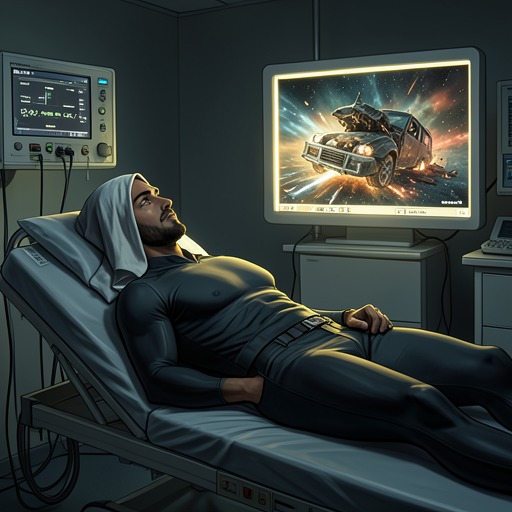
After Vaughan collides with the small car carrying two air hostesses, Helen Remington accompanies the injured Seagrave and Vaughan to Seagrave's home because she distrusts Vaughan's motives. Seagrave, dazed and exhausted, initially fails to recognize his own living room. Vera remonstrates with Helen as though the doctor were responsible for her patient's symptoms, while the narrator realizes that Vaughan is using Seagrave as an experimental subject. The scene exposes a painful division in the marriage: Vera knows that Seagrave is vulnerable, yet she absolves Vaughan of responsibility, or at least behaves as though the danger can be managed without confronting its source.
Vera's response is set against Vaughan's manipulative authority. When Helen points out that Seagrave is expected to perform stunt-driving at the studios the next day and asks whether he can be stopped, the narrator answers that Vera or Vaughan should be consulted, adding that Vaughan seems to call the tune. The observation places the husband between two competing powers. Vera has the intimate claim of marriage and family, but Vaughan controls the dangerous world in which Seagrave still seeks recognition. Seagrave's dependence is not simply professional: Vaughan supplies the language, excitement, and permission through which the former driver can continue to imagine himself as a participant in the crash culture that has already damaged him.
The Marriage Under the Pressure of Crash Fantasy
At home, Seagrave stares across the mountain of derelict cars at the bottom of the garden and describes his fantasies of high-speed pile-ups and hard head-on collisions. He tells Vaughan that the entire subject is Vaughan's defining obsession, and Vaughan answers by asking whom they should begin with. Seagrave then ignores Vera's attempt to calm him and tells Vaughan whom he would choose, imagining a woman's breasts cut up on the dashboard. The exchange demonstrates how far the marital household has been invaded by Vaughan's vocabulary: Seagrave's desire is articulated through the destruction of a woman's body, and Vera's efforts at restraint disappear beneath the men's conspiratorial fascination with impact.
The marriage is also surrounded by scenes in which sexuality and injury are made deliberately unstable. Vaughan watches while Seagrave unbuttons his shirt and places his small son's mouth on his nipple, squeezing the skin into a parody of a breast. The act is witnessed by Vaughan with a detached seriousness rather than treated as an ordinary family interaction, making the home itself part of the novel's grotesque theatre of damaged bodies, displaced erotic roles, and violated boundaries. Vera's position is not explained through a private confession; instead, the marriage is revealed through these public, disturbing arrangements in which her husband, child, and domestic space are exposed to Vaughan's gaze.
Vera also belongs to the wider network of crash survivors and observers through which Vaughan organizes his world. She is present with Gabrielle and Helen in the garden while aircraft roar over them, and she helps shepherd Gabrielle through the grass. Later, Gabrielle and Vaughan move through the motor show at Earls Court, where Gabrielle's leg braces and injured body are made to confront immaculate cars. The contrast clarifies the different forms of bodily experience within the group: Vera is linked to the labor of managing damaged people, while Vaughan turns damage into display and Seagrave repeatedly seeks to re-enter it as spectacle.
Seagrave's Death and Vera's Aftermath
The marriage reaches its terminal point at Harlington, where three cars collide at a high-speed intersection. A customized fibreglass sports car and a silver Mercedes coupe strike at right angles before a chauffeur-driven government saloon hits the sports car from behind. Seagrave is found dead in the sports car, trapped beneath the buckled overhang of the instrument panel. He is still wearing Vera Seagrave's leopard-skin coat, his platinum hair held by a nylon hair-net, while a black wig lies beside him like a discarded disguise. The remnants of costume and the crushed cockpit make his death appear as the final convergence of his racing identity, his theatrical self-presentation, and Vaughan's crash aesthetic.
Vera's marriage does not end in a conventional scene of mourning. At a concourse filling station, the narrator sees her speaking to a girl beside the pumps, dressed in a heavy leather jacket and preparing to leave with suitcases in the rear seat of her car. She initially fails to recognize the narrator and looks past him toward Catherine Ballard's elegant figure in the open cockpit of a sports car whose bodywork has been lacerated by a minor collision. When asked whether she is leaving, Vera says that she is trying to find Vaughan. The answer shows that Seagrave's death has not released her from Vaughan's orbit. Even after the husband whose vulnerability Vaughan exploited is dead, Vera remains drawn toward the man who helped make that death imaginable and, in the novel's moral structure, bears responsibility for its surrounding culture of experimentation.
Narrative Significance
Vera and Seagrave's marriage functions as a damaged counterpoint to James Ballard and Catherine Ballard's marriage. It contains a child, a failing business, bodily scars, and practical care, yet it cannot keep the crash outside the home. Seagrave's need for danger defeats Vera's attempts at containment, while Vaughan's presence converts marital vulnerability into an experiment. The relationship therefore reveals how the novel's automobile culture does not merely destroy individual drivers: it colonizes domestic bonds, turns protection into complicity, and makes the family home another site where injury can be rehearsed, displayed, and finally fatalized.
The marriage also exposes the limits of interpreting bodily damage only as metaphor. Vera must deal with a husband who is actually disoriented, physically endangered, and finally dead, while the surrounding men treat those conditions as evidence of an erotic future. Her protective interventions are repeatedly overruled by the prestige of risk. In that sense, the marriage embodies the novel's broader argument that modern technology and masculine spectacle can transform care into helpless witnessing, leaving Vera with departure as her remaining action but not with any clear escape from the system that produced Seagrave's death.