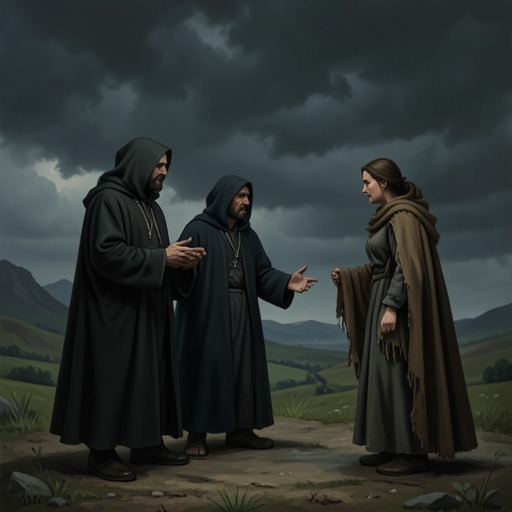
Ördögfiak
Csongor és TündeÖrdögfiak are the three little devils Kurrah, Berreh, and Duzzog, a collective whose small inherited stock of enchanted possessions becomes important to the play’s action. First presented as dispossessed siblings with a shoe, a whip, and a cloak as their sole inheritance, they later appear as a coordinated force: they agree to bind Mirígy for a promised reward, accept Tünde’s orders to keep watch, and ultimately spring from hiding to seize Csongor. Their movement between comic bargaining and effective capture gives them a practical, shifting place in the play’s supernatural world.
Identity and Inheritance
The three are identified together as devils, while the opening cast list names Kurrah, Berreh, and Duzzog individually. Their shared identity is neither an anonymous crowd nor a single figure: the dialogue assigns speech and action to particular members, but repeatedly lets them act as a group. That structure matters especially when they deliberate together and when the stage directions show them moving in concert.
Kurrah describes them as orphaned children and says that the shoe, whip, and cloak are their inheritance and their only possession. The claim gives their magical equipment the character of a meager patrimony rather than an abundance of treasure. The three objects are also distinctive: their inheritance consists not of money or land, but of portable enchanted gear, which can pass into other hands and alter what its wearer can do.
The cast list identifies the trio as Manók as well as Ördögfiak. Their later appearance in ambushes connects that identity to action: they are small supernatural beings who can hide, lie in wait, rush out, and restrain a target. The play does not establish a wider hierarchy or organization for them; their collective life is defined by their sibling bond, shared goods, and coordinated encounters with the other characters.
The Inherited Objects
The shoe, whip, and cloak are presented together as the siblings’ entire estate. The exchange does not spell out every power of each object, but its placement in the play’s action makes their inheritance consequential: the trio’s property is not merely a sign of poverty, but a set of portable magical possessions that becomes involved in Csongor’s adventures. Their claim over the goods gives the siblings a concrete stake in the action beyond their later service as watchers and captors.
The objects also distinguish the little devils’ position from that of the travelers they encounter. The siblings possess an inheritance yet describe themselves as orphaned and deprived; their goods are both their only property and the means by which they enter a larger chain of exchanges and confrontations. The play’s emphasis on the three items makes material possession the point at which their private circumstances meet the wider plot.
The Plan Against Mirígy
Later, the little devils recognize Mirígy as the old wicked woman who is digging with her claws. They propose to bind her, tie her together with linden rope, and peg her into a hollow linden tree. The method is specific and physical: they intend not simply to drive her away, but to restrain her and confine her within the tree. Their agreement turns suspicion into a collective plan of capture.
The motive they voice is reward. They expect Tünde to see what they have done and give them an immeasurable reward, and Berreh and Duzzog affirm the proposal together. The episode shows the trio acting from an openly stated expectation of payment, while also making them useful to Tünde’s effort to deal with Mirígy. Their practical alliance is therefore transactional: they volunteer force and concealment in exchange for a promised benefit.
Tünde subsequently gives them a watch assignment in the surrounding area. They are to hide in ambush, watch for anyone who rests at the foot of the tree, hold that person there bound, and come back to report. The order expands their function from pursuing Mirígy to guarding a place and detaining anyone who approaches it. It also establishes a clear sequence of duties—conceal themselves, observe, seize, restrain, and report—rather than an indiscriminate attack.
Ambush and Capture
The later ambush shows the little devils carrying out the essential action Tünde required. As Csongor speaks of being unable to escape his beloved, the stage direction says that the Manók rush from their hiding places and seize him. Duzzog then orders him to stop. The capture is sudden, and its staging fulfills the earlier instruction that anyone resting at the tree should be held there bound.
That action gives the trio’s watchfulness a direct consequence for Csongor: the seekers’ meeting is interrupted by restraint at the tree. Their attack is not presented as a battle or as a change in allegiance; it follows Tünde’s command and their assigned role as sentries. The contrast with their earlier claim of orphaned poverty is sharp. They first enter the play through the narrow inventory of what they own; later, coordinated concealment and force make them agents capable of changing another character’s immediate course.
Narrative Function
Ördögfiak occupy an unusual middle ground between comic figures and plot-operating helpers. Their inheritance and expectation of reward give their speech a material, transactional edge, while their linden-rope plan and concealed ambush make their physical actions consequential. They are not merely owners of enchanted objects or ornaments of the supernatural setting: they bargain, make plans, receive instructions, and carry out a capture.
Their repeated group identity is central to that function. The play introduces three named individuals, gives Kurrah the declaration of their shared poverty, and lets Berreh and Duzzog join in affirming the plan against Mirígy. Later, Tünde addresses them as a coordinated watch, and the stage direction brings them rushing together from hiding. The change is not an account of personal transformation so much as a change in their dramatic task: from a trio defined by its sole inheritance to a trio whose concealment and collective action shape the movement of the plot.