A három világi törekvés
Csongor és TündeA három világi törekvés presents wealth, power, and knowledge as three rival answers to the question of happiness—and shows why none can satisfy Csongor’s longing. Through the Merchant’s confidence in riches, the Prince’s authority, and the Scholar’s hard-won admission of ignorance, the play gives each worldly ambition its own voice before measuring all three against the unhappiness of love.
The Three Pursuits
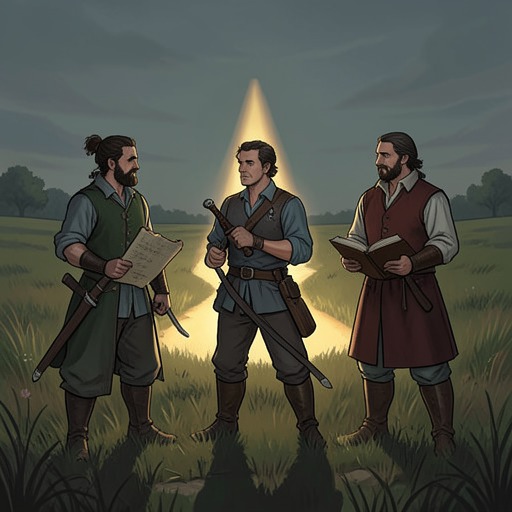
The three figures embody distinct forms of worldly reach. The Merchant claims a global sphere of trade: the two Indies and the shores of the New World know him and his ships. He imagines multiplying his wealth until he carries half the world’s treasure in his pocket. His ambition is expressed not only as possession but as command over access: no door, he believes, will remain closed to such splendor.
The Prince represents authority rather than accumulation. When he enters, Csongor addresses him as a god, or as whatever name belongs to a being with power. The greeting gives political rank an almost divine scale, setting the Prince apart from ordinary human limits. Yet Csongor’s need is not for dominion: he asks the Prince for direction, hoping that someone whose realm knows no night can tell him where to go.
The Scholar embodies the pursuit of knowledge. He appears in reflection, and his eventual account of his studies overturns the authority his title might promise. He has labored through nights and days only to say that he knows nothing. The admission is not simply a failure: he adds that he would not exchange this ignorance for an army that believes it knows. His words distinguish honest intellectual humility from confidence unsupported by understanding.
Wealth and the Promise of Access
The Merchant imagines riches as an instrument that can remake the conditions of life. With enough treasure, he says, he could turn night into day and day into night. The extravagant reversal makes wealth seem able to master even the divisions of time, while the reference to the world’s shores and his ships grounds that fantasy in commercial reach.
Love, too, appears within this vision as something wealth might unlock. The Merchant imagines it bound by a golden chain and admitting him through a secret door. The image makes desire sound like a possession to be secured: the chain is both a sign of preciousness and a means of control, while the hidden entrance suggests that love has thresholds money might open. His confidence therefore sharpens the contrast between acquiring access and attaining happiness. The speech describes what he expects wealth to do; it does not establish that love can actually be bought or commanded.
Csongor’s Appeal to Power and Knowledge
Csongor turns to the Prince and asks for a destination. He appeals to the Prince’s distance-reaching power and to the breadth of his realm, which, in Csongor’s formulation, does not know night. The request is direct and practical: tell him where he must go. The contrast is telling. The Prince appears to possess immense authority, but Csongor seeks guidance toward a happiness that political power alone cannot provide.
The Scholar seems another possible guide. Csongor waits, reasoning that the learned man may know a place of bliss and make him happy through his counsel. But the Scholar’s arrival and confession frustrate that hope. His years of effort have brought him to the limits of what he can claim to know, not to a dependable answer for Csongor’s search. The Scholar’s frankness gives his failure dignity, even as it leaves the protagonist without the promised direction.
The Pursuits Revisited
Later, Csongor recognizes the figures as old acquaintances and recalls their appearance among the travelers he has encountered. Their return turns the earlier encounters into a pattern: the Merchant’s riches, the Prince’s status, and the Scholar’s intellectual labor are not isolated ambitions but recurring possibilities that Csongor tests against his desire for happiness.
In the later reflection, the unhappy condition of love remains distinct among these pursuits. Csongor sees it moving like a solitary, moaning dove, while the image of knowledge’s sun-cloth lowered from its height and reduced to smoldering embers gives learning its own diminished aftermath. The contrast does not erase the differences between commerce, rule, and study. Instead, it places each beside a happiness that none has secured: worldly reach may promise control, but neither power nor knowledge has ended love’s sorrow.
Narrative Significance
The episode works through contrast rather than a single abstract definition of happiness. The Merchant speaks in the language of ships, treasure, doors, and golden bonds; the Prince is approached through the scale of command; the Scholar’s authority culminates in an admission that he does not know. Each pursuit has a characteristic promise, and each is tested against Csongor’s specific need for a way forward.
The sequence also refuses to treat the Scholar’s confession as equivalent to the Merchant’s boast. The Merchant expects wealth to open every door, whereas the Scholar recognizes the boundary of his knowledge and values that recognition above an army’s false certainty. Yet humility is not the answer Csongor asked for: it does not reveal the road to bliss. By returning the three worldly figures to Csongor’s memory beside the image of unhappy love, the play gives the concept its decisive meaning: wealth, political authority, and learning may each command attention, but none by itself resolves the longing at the center of his journey.