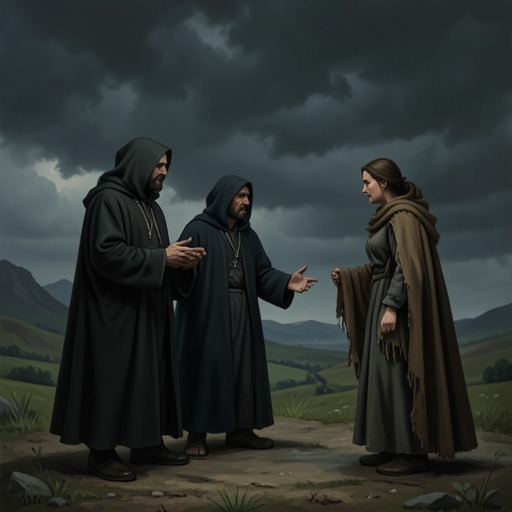
Láthatatlanná tevő palást
Csongor és TündeThe Láthatatlanná tevő palást is an enchanted cloak that conceals the person wearing it, making invisibility one of the magical advantages at stake in Csongor’s journey. The play defines its power in direct, practical terms: the cloak hides its wearer from every observer. Its importance lies not only in that capacity but also in the way the cloak belongs to a set of coveted objects whose possession is decided through rivalry, exchange, and comic misadventure.
Identity and Function
Kurrah explains the cloak’s operation to Csongor: it conceals, and whoever puts it on cannot be seen by anyone. The description makes invisibility the cloak’s essential property; the evidence gives no further account of how it is made or any limit on its concealment. Its function is therefore presented as immediate and absolute, a wearable means of withdrawing from sight.
That power distinguishes the cloak within the group of magical equipment sought by the travelers. It offers concealment, while the other objects are associated with movement and action: the boots are worn and whipped, and the whip is part of the travelers’ competition. The cloak’s particular promise is different. Rather than making its user faster or stronger, it changes whether others can see that user at all.
Contest and Possession
The cloak enters a struggle over who should obtain the magical goods. When the travelers cannot all possess the things they want, the proposed solution is to lay the goods before them and have them race up the mountain; the one who arrives first is to claim them. The objects thus become prizes in a contest, and the cloak’s exceptional power is bound to a moment of competition rather than to quiet, settled ownership.
The cloak’s concealment makes it a consequential prize, but the evidence does not say that it determines the race or specify which traveler first takes it. The distinction matters: the play establishes what the object can do, and how the travelers compete for the goods, without turning the cloak’s power into an independently narrated act of escape or deception in these passages.
Exchange and Comic Misuse
Later, Duzzog rejects a suggestion to steal the magical things back and proposes an exchange instead. He imagines a joke for the moment when the travelers try to move in the boots and whip them: the dispute over the equipment can be prolonged through substitution and comic interference rather than resolved by straightforward recovery. The cloak is part of the larger context of these coveted objects, though the passage does not name it as the specific item exchanged in that plan.
This episode gives the equipment a social life beyond its powers. The objects are not simply tools waiting for a user; they are things people compete over, lose, and may try to recover or switch. In that economy, the cloak’s promise of invisible wearability exists alongside the practical and comic complications of getting hold of the magical goods at all.
Balga’s Dressing Scene
The cloak’s later recurrence belongs to a brief stage direction: Balga begins to dress, and the following action describes him putting his foot into a boot. This supplies a concrete image of the magical equipment entering ordinary bodily use, but it does not explicitly state in the supplied passage that Balga puts on the cloak, becomes invisible, or makes use of its power. The distinction between the cloak and the boot remains important: the evidence identifies the cloak’s concealment separately from the boot that Balga steps into.
As a result, the object’s dramatic presence is more securely established than a complete sequence of its later use. Its defining capacity has been explained, it belongs to the equipment the travelers contest, and magical gear recurs in Balga’s dressing. The available scenes do not confirm a final owner or show the cloak’s concealment operating in that later moment.
Narrative Significance
The Láthatatlanná tevő palást makes visibility itself an object of possession: to wear it is, according to Kurrah, to become unseen by anyone. That cleanly stated power contrasts with the messy circumstances surrounding the equipment—competition, proposed theft, exchange, and practical attempts to wear it. The cloak’s significance therefore rests both in its magical function and in its place within a comic contest over who can claim and use extraordinary things.
The evidence also sets a boundary around what can be said of the cloak. It is not shown here as a symbol with a separately explained meaning, nor do these passages demonstrate a particular wearer’s invisible actions. Instead, the play gives the object a sharply defined capability and situates it among goods whose possession is unstable. Its drama lies in the distance between an absolute promise of concealment and the visible scramble to acquire the equipment.