Mirígy and Ledér’s mother-daughter relationship
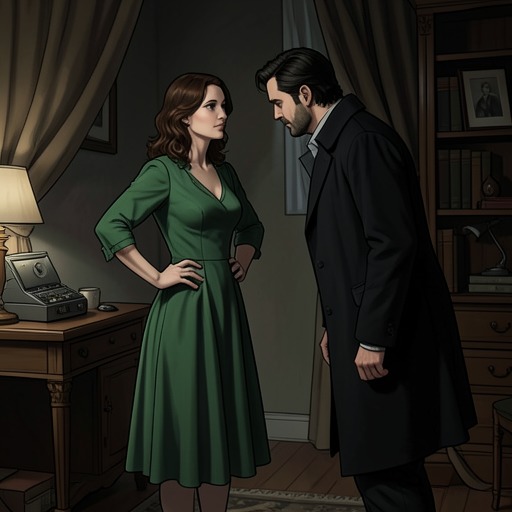
Csongor és TündeMirígy and Ledér’s mother-daughter relationship is presented as a bond in which maternal language and practical care coexist with manipulation. Mirígy calls Ledér her daughter and later invokes her dependence on a sick father, yet she also remakes Ledér’s appearance and directs her toward Csongor as part of a scheme. The relationship’s defining tension is that Mirígy’s care does not secure Ledér’s freedom: it equips her for a purpose chosen by her mother.
Identity and Introduction
Mirígy addresses Ledér as her daughter and, in an affectionate diminutive, as her fox-girl. That name recalls an earlier transformation: Mirígy says she dressed Ledér in fox skin out of fear after she herself had been frightened and then left her in the brush. The account links their relationship to a history of concealment and separation, not simply to the immediate plot in which Ledér appears.
The transformation is described as deliberate and reversible. Mirígy says she will change Ledér back and cover her with beautiful golden hair. Ledér’s appearance is therefore something her mother can alter, and the shift from fox disguise to golden-haired beauty prepares the daughter for a new role. The passage presents their kinship through concrete acts of dressing, leaving, and restoring rather than through an account of family life apart from the plot.
Maternal Care and Dependence
In a later appeal, Mirígy asks Ledér to acknowledge that a sick and suffering father is at home and that Ledér is the only one available to support and tend him. The appeal places Ledér in a position of responsibility within the family: she is represented as the sole person able to provide assistance and care. Mirígy’s words draw on a specific obligation, making family need part of the pressure surrounding Ledér’s choices.
The appeal does not establish the father’s identity or explain the wider circumstances of his illness. What it does show is Mirígy presenting Ledér’s return to family duty as a matter of necessity. The mother speaks as someone who knows how to frame the daughter’s obligations, but the evidence does not show whether Ledér accepts this appeal or how she responds to it.
Transformation and Csongor’s Pursuit
Mirígy’s restoration of Ledér’s appearance has an explicit purpose: she expects Csongor to fall in love with her. Ledér is thus brought into a plan centered on Csongor’s desire. The change from fox disguise to golden hair is not merely a return to an earlier appearance; within Mirígy’s stated scheme, it is preparation for attracting him.
Later Mirígy tells Ledér that a handsome young man is waiting for her. When Ledér laments her condition as a lost girl, Mirígy urges her to leave her sorrow behind and presents the prospective encounter as a solution. The contrast is pointed: Ledér’s grief is acknowledged, but Mirígy redirects the conversation toward the young man and the opportunity she has arranged. Her maternal role becomes inseparable from steering her daughter toward an encounter intended to affect Csongor.
Complicity and Conflict
Mirígy’s plan is not presented as a free choice made by Ledér. When Ledér appears uncertain about where to go, Mirígy draws her away and insists that she come with her. She addresses her as a foolish child, but the affectionate form of address accompanies an act of direction: Mirígy decides the course of their movement and does not leave Ledér to choose independently.
Mirígy also makes clear that she has obtained Ledér for Csongor. She says that she procured her for him and desires him to find hateful love in the arrangement. This statement exposes the difference between the plan’s outward promise of a handsome suitor and its actual aim: Mirígy wants the encounter to produce an unwanted or repellent form of love for Csongor. Ledér is the means through which that aim is pursued, while the evidence does not establish that she knows the full design.
Significance of the Relationship
The relationship is shaped by a repeated double movement: Mirígy identifies Ledér as a daughter to be comforted or summoned, then treats her appearance and actions as things to arrange. The recollection of fox skin and abandonment gives this pattern a history; the restoration of Ledér’s golden hair turns it into present action, and Mirígy’s insistence that Ledér accompany her makes the maternal authority visible as control.
Family language consequently carries more than tenderness. Mirígy invokes Ledér’s duties toward a sick father, calls her daughter and child, and claims to have procured her for Csongor. These distinct appeals place Ledér within a network of obligations and plans whose terms are set by Mirígy. The relationship’s significance lies in that unresolved contradiction: Mirígy acts as mother, but the evidence repeatedly shows maternal care being used to direct Ledér toward an outcome serving Mirígy’s purposes.