
Hiding and Being Seen
Dark Lies the IslandSeveral characters seek privacy or invisibility, yet their bodies, fears, and actions keep making them visible to others at decisive moments.
increasing Bearing strength in each event
 decreasing
Bearing strength in each eventdecreasingJonathan’s Public Breakdown
A Private Crisis in Public
The failed entrance
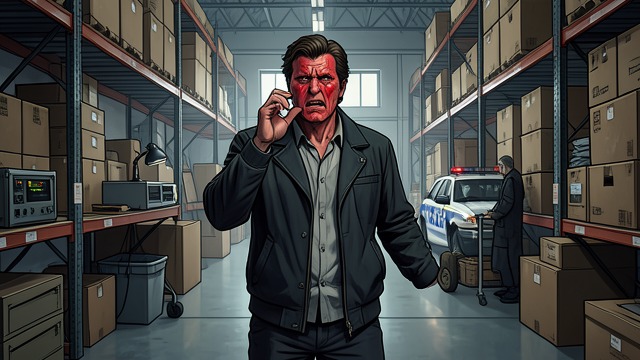
Jonathan approaches the automatic doors at Do-It-Rite! repeatedly, but they do not register him until he follows behind an ordinary customer. The small humiliation heightens his sense that the world is arranged against him.
Inside the warehouse, he prowls among staff and shoppers while trying to locate Aodhan. His thoughts become increasingly detached from the practical purpose of his visit.
The crowd as witness
Jonathan’s threat and slap occur in a public aisle, and staff members watch without intervening. His later destruction of the sign draws a police car into the car park.
He cannot keep the crisis inside his own mind; his actions make it visible to strangers and law enforcement. The episode shows the danger of treating privacy as control when behavior has already crossed into public harm.
Sara Behind the Glass
A House That Reflects
Visibility without companionship
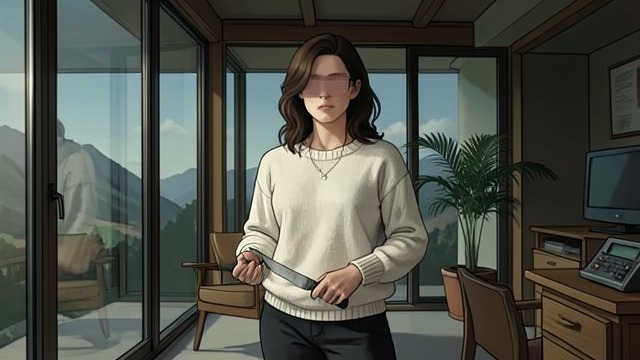
Sara lives alone in a house made of glass and angles, where the dark windows reflect the interior and seem to reveal faces outside. The design offers views across the bog but also makes it difficult for her to feel unseen or safe.
She switches lamps on and off, trying to control what the glass allows her to imagine. The house turns privacy into an unstable question: the landscape is outside, but her fears seem to occupy the same surface.
A body in crisis
Sara’s family communicates by calls and text, while her self-harm remains hidden behind ordinary messages about weather and art. She can appear composed to the people at a distance even as her attention is fixed on knives and the possibility of cutting.
When she throws the knives into the darkness, the action remains invisible to her family. The story contrasts the polished appearance of the house and her messages with a crisis that cannot be read from outside.
Patrick’s Photograph
A Reflection Kept
The camera as witness
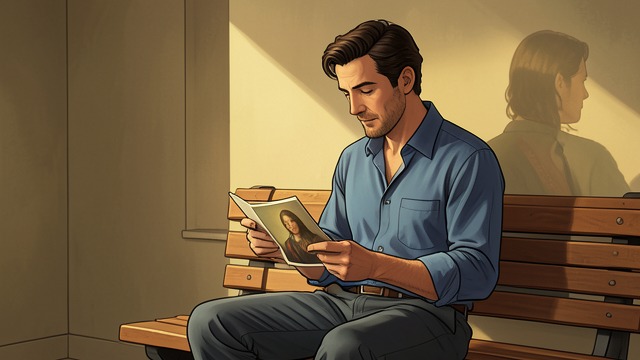
Silvija photographs Patrick beneath the chestnut trees and tells him to look through the lens rather than at it. On the bench, her reflection appears faintly in an amber glass, present inside the image she has made of him.
Patrick preserves the photograph because it contains more than his own likeness. It holds a trace of the woman whose attention shaped his experience of the city and of art.
Presence after disappearance
After Silvija leaves, she stops answering messages and becomes unreachable. Patrick cannot know where she is or whether she will return, and the image cannot replace a living relationship.
Its value lies precisely in its incompleteness. The photograph makes visible a moment of mutual presence while preserving the distance that later defines their separation.
Saturday afternoon, outside Do-It-Rite!
An October night at the holiday house
Late summer 2005, after Silvija leaves Berlin
