Bill Knott
Dark Lies the IslandBill Knott is a surveyor and former haulage worker whose instinct is to measure the world in roads, distances, and travel times. At the Water’s Edge Hotel, his persistent route calculations become a recurring counterpoint to the narrator’s anxiety and to events that cannot be controlled by local knowledge alone: when the hotel floods, Bill’s confidence that it has not flooded in sixteen years proves no protection against the water.
Identity and Local Expertise
Bill appears among the regulars at the Water’s Edge, where he is identified as a surveyor. He had also worked in haulage when young, a background that helps explain why he considers himself an authority on the roads. The narrator observes that the locals’ chief interest often seems to be how far one place lies from another and how long a journey will take in the condition of the roads. Bill embodies that habit especially clearly: he turns conversation into an estimate, then qualifies it with the possibility of traffic or a slower route.
His manner is practical rather than abstract. Asked about the distance to Belmullet, he proposes an hour and twenty minutes if there is no tailback out of Newport, then allows that some people would make the trip in an hour. The narrator says he does not know, increasingly impatiently; Bill nevertheless returns to the question of how fast a driver would need to travel from the Westport direction. The exchange shows both Bill’s confidence in his specialist knowledge and the limits of its usefulness to someone who is not asking for another estimate.
The Hotel and the Flood
Bill’s place in the hotel’s everyday life is established through small acts of sociability. He sits with a Bushmills near the bar, whose window looks across the water towards Mweelrea, and the narrator sets down a fresh drink for him. Their conversations take place amid the hotel’s routines, but the water is never merely scenery: the building lists westward, and the account has already made its slope towards the Atlantic part of its physical character.
When the narrator urgently asks whether the hotel will flood, Bill answers that it has not done so in sixteen years and will not flood now. The assertion is grounded in a remembered interval, but it mistakes the past for a guarantee. As the water rises, the Belarusian residents carry boxes of old curtains from the attic to block the doorways. The attempt fails as soon as the last box reaches the bottom of the stairs: the doors pop open and the waters of Killary enter. The narrator moves everyone upstairs to the function room, where a stocked bar and working disco lights offer temporary refuge. Bill’s earlier certainty is thus set against a sudden physical change that no estimate or precedent can contain.
Routes Persist Through Crisis
Even after the flood has entered the hotel, Bill continues to think in routes. While people are being moved upstairs, he considers how travelling past Lough Fee and around its far side might bring them near the N59. The detail is not a plan that stops the flooding; it is an extension of the way Bill habitually understands a problem, by tracing a road through the landscape.
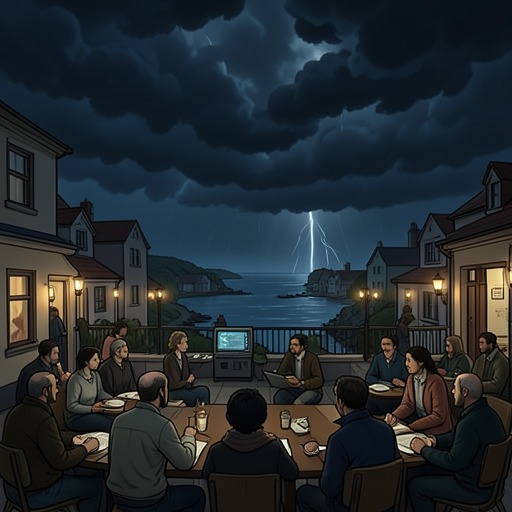
That way of seeing persists when the displaced group gathers in the function room. Bill dances there alongside John Murphy, while the Belarusians occupy the darker corners and the Hartys talk in a booth. The room has become a makeshift shelter and gathering place, yet ordinary social habits survive inside it. During this scene Bill again asks how long it would take to get to Loughrea. His question echoes his earlier calculations for Belmullet: even amid flood and disruption, distance and travel time remain his preferred measures of the world.
Character and Narrative Function
Bill’s repeated route questions supply a dry, recurring rhythm to the hotel scenes. Their effect comes from the gap between his steady interest in journey times and the narrator’s mounting concerns: the narrator is trying to keep the hotel operating, asks directly whether it will flood, and finds the surrounding landscape a source not of poetic inspiration but of distress. Bill, by contrast, returns to familiar calculations. The difference is not simply that one man is calm and the other anxious; Bill’s expertise is real, but its domain is limited.
The flood makes that limitation visible without making Bill’s knowledge worthless. He can discuss the N59 and imagine a way around the landscape, but he cannot make the hotel safe by citing the sixteen years in which it did not flood. His role is that of a local observer whose practical speech keeps recurring as circumstances change. The result is both comic and quietly serious: a conversation about roads continues inside a place overtaken by water, while the old measures of time and distance fail to answer the immediate question of what comes next.