Carl O'Connor
Dark Lies the IslandCarl O'Connor, called Doctor Sot and addressed professionally as Doctor O'Connor, is a physician whose care for patients coexists with alcohol dependence, recurring headaches, and visions he struggles to contain. In the outreach episode at Slieve Bo, his medical mission becomes an encounter with the limits of professional authority; its abrupt end is marked by the destruction of Elizabeth, his eleven-year-old Megane, and his belated remembrance of Sal.
Identity and Medical Work
Carl practises at the O'Connor surgery, where the remaining patients are mostly old and fatalistic. During an afternoon surgery running from noon until two, he sees people whose lives resist neat clinical resolution: a woman whose dead twin’s voices have become benevolent, an elderly patient with a persistent heart-sick appearance, and a sixty-year-old crane driver who describes himself as being in a state of constant excitement. Carl prescribes the crane driver a week of Valium and a new hobby, then leaves for what he calls a mission.
His professional identity also extends beyond the surgery. When a representative of the North Western Health Board appears to favour younger, more conventionally appealing staff for outreach, Carl volunteers and presses his case on the phone. The scene establishes both his determination to be included and his awareness that institutional preference may not follow experience or commitment. He identifies himself at the camp as Doctor Carl O'Connor of the Health Board, making his formal credentials part of his first attempt to establish who he is there.
Headaches, Whisky, and Visions
Late in January, Carl’s headaches return. He drinks John Jameson whiskey to manage them, carrying small bottles in the compartment of his leather satchel and replacing them often enough that he avoids buying them repeatedly from the same off-licence. On a cold, iron-grey morning, he drives towards the 24-hour Tesco in an eleven-year-old Renault Megane. Its heater judders without overcoming the cold, while his fingers on the steering wheel look corpse-like to him. He has found that steady drinks keep at bay the visions that often accompany the headaches.
The narration distinguishes the headaches, the visions that precede them, and Carl’s own improvised response: alcohol brings temporary relief, but does not make the experiences easier to handle. His remark to the car about a small devil scraping a blade inside his head gives bodily discomfort a sharp, almost comic voice without converting it into a diagnosis. The whisky is not simply a private habit; it is woven into his management of symptoms and into the risks of a day when he will drive far from the surgery.
During surgery he tries not to look towards the white sky, since skies and mirrors are the fields of his visions. He can recognise the experiences as hallucinations, yet that recognition does not make them manageable. The contrast between his medical work and his own uncertain treatment of distress gives his professional competence a human limit: he listens to patients and prescribes remedies, while trying to contain his own recurring symptoms with whiskey and avoidance.
Outreach at Slieve Bo
The outreach journey takes Carl into an unfamiliar settlement of improvised shelters, old caravans, a generator, children, dogs, and a brightly coloured van. Rather than meeting a conventional clinic, he encounters a camp whose circumstances unsettle the expectations brought from his surgery. He announces himself as a doctor and a representative of the Health Board; Joxie, the young man who receives him, answers simply that he is Joxie. The exchange leaves the doctor’s institutional title intact but places it in a setting where it cannot by itself define the encounter.
By the time Carl is preparing to leave, he has eaten, and the people around him are gathered in the dark. Joxie calls the visit an education. The group laughs, and Carl laughs with them until he weeps. The outreach has thus shifted from a formal task into a shared, emotionally exposed moment, although the narration does not claim that the encounter resolves the problems that brought him there.
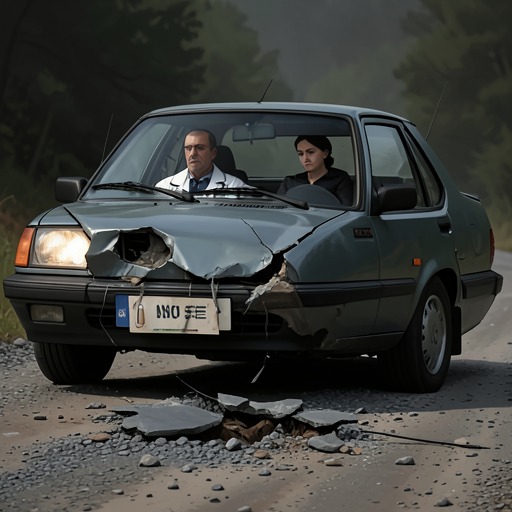
Carl starts Elizabeth and immediately drives her into a ravine. The crash sobers him at once. The travellers help him out of the car, and the remains of the Megane smoke in the darkness. He retrieves the remaining bottles of whiskey and the chocolate cake he had bought for Sal earlier and forgotten to give her, then sits on the hard-packed soil with a handkerchief against his bleeding head. The scene ends not with a report on the outreach service but with the wreckage of the car and the objects recovered from it.
Sal, Elizabeth, and the Ending
Carl’s domestic life appears in the details he carries into the day. In the supermarket he buys a chocolate cake for Sal, described as the happiest woman alive, alongside mouthwash, spearmint gum, and eight small bottles of Jameson. Later, after embracing her, he says he has a call to make before surgery; there are not many calls these days. His departure for outreach sits beside this ordinary intimacy, while the cake’s eventual presence at the crash site reveals how easily his intention to bring it home is displaced by the day’s events.
Elizabeth is more than transport in Carl’s account of his life. He names the Megane after his mother, and regards car and mother as alike in their martyr-like perseverance and lack of natural advantages. Its failure therefore carries an explicitly personal association. After the crash, he sighs over both Elizabeth and Sal, though the cake shows that Sal was not present at the camp and that he has forgotten the gift meant for her. The narration describes the relief that can accompany the death of an old parent, an image that complicates the loss rather than reducing it to either grief or gratitude.
Carl’s arc culminates in a material reversal: the doctor who sets out to provide outreach care ends the journey injured, with his car destroyed and his whisky and unpresented cake salvaged from the wreck. The final image gathers his divided forms of dependence—on alcohol to keep the visions at bay, on a long-serving vehicle he has made into a companion, and on the domestic life represented by Sal—without claiming that he has overcome any of them.