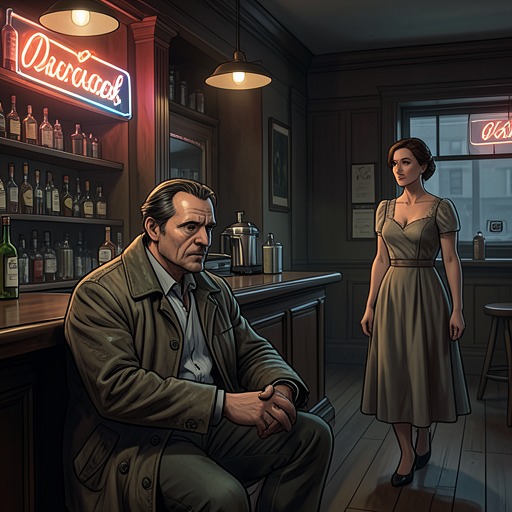
Daniel
Dark Lies the IslandDaniel’s life in Leytonstone is shaped by a lost relationship that he cannot leave behind: each day he looks for Alicia in the London crowds, sees her features dissolve into those of strangers, and carries the fixation into work, drinking, and an isolated domestic routine. His eventual encounter with her in the Ducks turns that private, repetitive grief into a face-to-face reunion, but does not erase the rupture between them.
Identity and Background
Daniel is an Irish migrant living and working in London. At twenty-five, he threads fibre-optic cables through office buildings, saving money without a settled purpose and with no intention of returning to Ireland. His life has narrowed around routine: workdays, solitary weekends, and an evening refuge in a shared house off Leytonstone High Road.
The house is shared with three Connemara men who work in IT and drink heavily. Their lager is described as 9.8 per cent alcohol by volume; when Daniel comes home, they offer vague smiles and watch wildlife programmes, switching to the BBC for football scores. Their company is present but not intimate. Daniel can settle among them, yet the scene emphasizes how little conversation or direction his home life provides.
Life in Leytonstone
Daniel’s job brings him into contact with office workers who resemble Alicia. He tries not to stare, but the resemblance repeatedly catches him: his heartbreak is renewed as he passes through photocopier rooms, where slender, dark-haired women seem to carry her image. He is generally rational, yet worries that the depth of his fixation could take a darker turn. The narrative presents that worry as his own concern, not as an action he takes.
Leytonstone amplifies his sense of unease. He lives in a house of pre-war terraces on a street marked by a sign warning of traffic-calming humps, whose wording acquires a metaphorical resonance in the account of his stalled life. January darkness arrives early; the housemates have already been drinking for hours when he returns to his usual armchair. On television, a pastoral wildlife scene competes with the football scores, an incongruous pairing that mirrors the gap between an imagined escape and the ordinary surroundings in which Daniel remains.
Weekends are hardest. On Saturday afternoons he walks through a local park, passing fathers with pit bulls, children, and men near the public toilets. A park bell-ringer appears behind him on the path and seems, to Daniel, to look directly into him as the closing bell guides him out. He then walks past bus stops, kebab stalls, and traffic before turning towards home. The sequence makes his loneliness spatial: the city offers movement, but each route ends in the same house and armchair.
Alicia and the Repeating Search
Daniel’s attachment to Alicia has become a daily pattern of searching. He sees a woman approaching across Stratford station’s concourse and, for a moment, believes the illusion will hold; as she comes closer, the features disappear and reform as someone else’s. Nevertheless, he looks for Alicia among the commuters each morning and evening, although she now lives in another country and he has not thought of himself as a romantic man.
The search extends beyond the station. Daniel sees Alicia in the office women who pass through the buildings where he works, and the resemblance repeatedly reopens the heartbreak. The narrative links the visual uncertainty at Stratford with his difficulty accepting her absence: the face he wants to recognize cannot remain stable in the crowd, but the act of looking continues. The repetition gives his grief a daily structure rather than a single moment of recollection.
The relationship itself lasted three months. The account compresses its ending into the image of Alicia taking Daniel’s heart from him, establishing the scale of his emotional injury without explaining the circumstances of their separation. That brevity matters: the story gives the reader little about the breakup, while showing in detail how long its consequences persist.
The Reunion at the Ducks
The possibility of seeing Alicia becomes startlingly real during a Saturday night at the Ducks in Leytonstone. Daniel has been drinking Magners, first pouring a bottle over ice and then continuing until his vision doubles. The crowded lounge, its pool tables and mirrored bar, multiplies around him; he shuts one eye to reduce the doubled images. In that impaired state, he sees a woman approach. At first she seems like another brief illusion, but this time the recognition holds: she comes to him and says his name.
The setting sharpens the reversal. The woman Daniel has spent his days looking for appears not at Stratford station or at work, but in a Leytonstone pub, while he is drunk and alone. His first response is uncertainty about speaking; he opens his eye, the room threatens to double again, and then he is relieved that the image remains singular. The encounter brings the absent figure into the room, but does not immediately resolve what their renewed contact means.
Alicia acknowledges that Daniel is on his own on a Saturday night. He answers by referring to how often he sees her: walking towards him in the street, below at Stratford station, and among the offices. His reply makes clear that the reunion cannot be detached from his prolonged searching. Alicia tells him he looks sad; he agrees that seeing her every day would make him sad. He has not sobered, and the conversation therefore unfolds with his earlier drinking still shaping the scene.
Change and Narrative Significance
The reunion changes the status of Daniel’s pursuit without providing a demonstrated reconciliation. Before the encounter, Alicia is a recurring image attached to strangers and to the routines of commuting and work. At the Ducks, she stands before him and addresses him directly. The visual illusion that had repeatedly failed now persists, yet their shared past remains marked by the brief three-month relationship and its painful end.
Daniel’s arc is consequently defined by a contrast between movement and stasis. He crosses London for work and walks through Stratford and Leytonstone, but his attention circles back to Alicia, while his money accumulates without a purpose and his weekends return him to the same house, park, and pub. The reunion interrupts that circuit, but the evidence does not show what follows. Its significance lies in bringing the object of his repeated search into direct contact with the lonely, alcohol-soaked life formed in her absence—not in confirming that the relationship is restored.