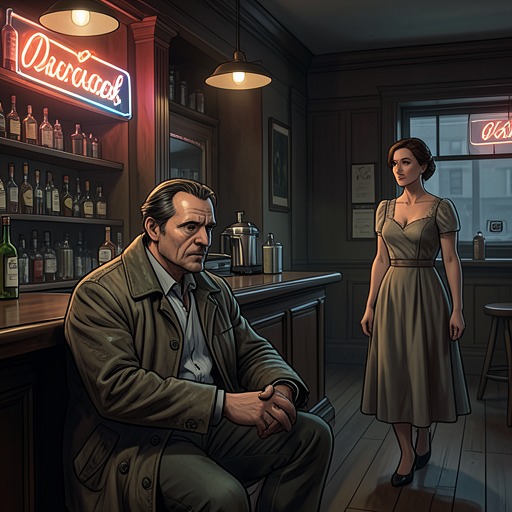
Daniel and Alicia’s Reunion at the Ducks
Dark Lies the IslandDaniel and Alicia’s Reunion at the Ducks turns a chance sighting into an encounter suspended between romantic recognition and uncertainty. In the lounge of the Ducks in Leytonstone, Daniel sees Alicia through the doubling effects of drink, hears her say his name, and receives a kiss on the cheek; she soon leaves for a disco in Essex, while he is left asking the barman whether the meeting was real. The scene’s tenderness is genuine, but its return to intimacy does not become a reunion in any lasting sense.
Setting and Sudden Recognition
Daniel is drinking alone in the lounge of the Ducks, where a busy night is gathering around him. He has bought a bottle of Magners and poured half into a glass of ice; after several bottles, he is seeing double. Shaven heads, pool balls, and the images reflected in the mirrors multiply until he shuts one eye to halve the crowd. In that altered field of vision, he sees Alicia approaching.
The encounter is first described as though it might be another brief illusion: she crosses Daniel’s myopic field, but keeps coming. She bends toward him in his chair, in the familiar local setting of the Ducks in Leytonstone, and says his name. Daniel opens his closed eye, expecting the world to double again; instead, the image holds. His relief is inseparable from disbelief, and his attempt to make his response sound casual cannot disguise how startling her presence is.
The Former Relationship Returns
Alicia laughs, leans closer, and kisses Daniel’s cheek. She says she knew he was somewhere east, but greets the coincidence with surprise. Daniel asks what she is doing there; she asks whether he is alone on a Saturday night. Their exchange quickly establishes that they are not strangers meeting for the first time, even before the narrative names the history between them.
That history is compressed into a sharp reversal: they had been together for three months, and then Alicia took Daniel’s heart out and ate it. The figurative violence makes the separation’s emotional force explicit without supplying details of how it happened. Her easy laughter and renewed physical affection now coexist with the remembered injury. The scene does not present their past as resolved; it shows how little contact is needed for its hurt and its attraction to return together.
An Affectionate Encounter with an Exit
Daniel says he does not want to put Alicia out. He sips his Magners, and the narration notes that she is not getting up in a hurry. Yet the pause has an end: Alicia says she has to go because her group is taking a bus to a disco somewhere in Essex. The party bus and Daniel’s sardonic reference to her uncle still being warm in the ground make death part of the exchange’s dark humour, rather than a subject the two discuss at length.
Alicia calls Daniel funny, moves in, and kisses his cheek a second time. He closes his eyes. She says she will see him around home sometime and tells him to be careful; Daniel answers, “Right so,” as she takes her leave. The repeated kiss briefly renews their physical closeness, but the promised future is only an uncertain encounter around home, not a plan to resume the relationship. Her departure turns the scene’s possibility of renewed intimacy back into separation.
Doubt and the Scene’s Aftermath
As Daniel approaches the barman, the barman sucks his lips as though warning him and asks whether he is sure. Daniel asks him to tell the truth: had he just been talking to a girl? The question follows directly from the earlier double vision and makes the scene’s uncertainty explicit. Alicia had approached, spoken to him, laughed, kissed him, and left; nevertheless, Daniel’s intoxicated perception leaves him needing another person to confirm what happened.
The barman identifies her as the black-haired woman and asks how Daniel knows her, speculating that she might work in community outreach. Daniel does not explain their former relationship. Instead, he says, “Okay,” and orders another Magners. That small return to the drink does not settle whether the encounter offers hope or merely reopens an old wound. Structurally, the scene moves from a blurred image that becomes unmistakably present to a real-seeming intimacy that ends in doubt: reunion occurs as a moment of recognition and touch, not as reconciliation.