Doctor Sot’s Outreach Visit to Slieve Bo
Dark Lies the IslandDoctor Sot’s Outreach Visit to Slieve Bo is an informal health-service visit that draws the doctor into the travellers’ camp and exposes how closely his work, alcohol dependence, headaches, and visions are entangled. A plan to assess the travellers for Outreach becomes a personal excursion: Doctor Sot offers health leaflets and advice, shares whiskey from his satchel, crashes his car, and remains at the camp overnight, where a figure in a mirror appears to be Mag.
From referral to initiative
The visit begins with Doctor Sot volunteering for an Outreach assignment. At the North Western Health Board, he is told that the new-age travellers could be assessed to see whether they qualify for the service. Rather than wait for that assessment, he proposes going to meet them in the meantime, presenting the visit as a friendly introduction and an opportunity to offer leaflets on nutrition and chlamydia. His persistence helps secure agreement, though the outing he imagines is not yet an official Outreach session.
The workday establishes the conditions he brings with him. Doctor Sot’s surgery, which runs from noon until two, is slow, and his patients include people living with bereavement, persistent voices, and a long history of distress. His own headaches are less severe during the appointments, but he avoids looking towards the white sky: skies and mirrors are associated with the visions that accompany his headaches. The visit therefore emerges from a professional setting in which care is routine, while his private symptoms remain present but difficult to address.
Before setting out, he tells Sal that he is leaving on a mission. She responds with surprise at how quickly the opportunity has arrived, but is familiar with his excursions and disappearances. The contrast is important: what Doctor Sot casts as work has already become another caper in the pattern of his married life.
At the travellers’ camp
Doctor Sot arrives at Slieve Bo and introduces himself as Doctor Carl O’Connor of the North Western Health Board. He meets Joxie, who receives the visit with wary informality. Doctor Sot speaks about nutrition, including the benefits of oily fish such as mackerel and its Omega 3. The exchange is not a formal consultation: he understands the visit as a chance to break the ice, and the travellers smoke roll-ups and drink green tea while he considers how to make the encounter more convivial.
He opens his leather satchel and offers a naggin of whiskey to strengthen the tea. The gesture makes the boundary between doctor and visitor harder to maintain. The same satchel has served him as a discreet place for small bottles of John Jameson, which he drinks to keep his headaches and the visions that may precede them in check. At the camp, alcohol is no longer simply his private remedy; it becomes part of his attempt to establish ease with the people he has come to meet.
As evening passes, Doctor Sot sits in the trailer and drifts in and out of the moment. Someone gives him a saucer of curried vegetables; he eats, and the food helps restore his sense of himself. Mag has not appeared. He picks up his satchel and makes for his eleven-year-old Megane, known to him as Elizabeth, while the adults, children, and dogs are gathered around in the dark.
The crash and its aftermath
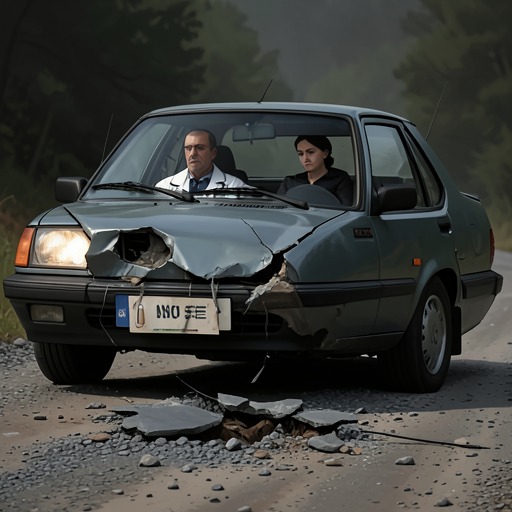
The departure turns abruptly into a car accident. Doctor Sot and the travellers laugh together, and he laughs until he weeps; with his eyes still full of tears, he starts Elizabeth and drives her into a ravine. The impact sobers him immediately. The travellers help him out of the car, which is destroyed. He retrieves the remaining naggins and the chocolate cake he had bought for Sal but forgotten to give her, then sits on the camp’s hard-packed ground with a handkerchief against his bleeding head.
His first responses are personal rather than administrative: he laments Elizabeth and Sal. The loss of the car is compared to the relief that accompanies an old parent’s death, a feeling that complicates his grief for the vehicle named after his mother. The Outreach visit has thus produced no simple professional success story. It has instead left Doctor Sot stranded, separated from the familiar means of getting home, and dependent on the hospitality of the people he came to visit.
Sal is not alarmed that he has been caught out at Slieve Bo. She knows that he may disappear for days and has heard of his waking in ditches across the north-west. At the camp, the travellers give him a place in one of the old caravans. By nine there are no lights there apart from the cold points in the sky; children and dogs sleep around him, while he remains awake with a naggin and the uneaten cake on his lap.
The mirror and Mag
Unable to settle, Doctor Sot approaches a mirror on a cupboard door. He cautiously checks it three times. The first two times it appears clear, without the malevolence he fears; on the third, a figure appears. It is Mag, outside the caravan, looking in and smiling. Doctor Sot leaves the caravan to join her, and the serenity of her smile is immediately understood in the narration as psychotic.
The appearance is left within the story’s uncertain relation between illness and vision. Doctor Sot has already described headaches as a presage of visions, and has identified skies and mirrors as places where the strangeness occurs. The mirror scene follows a day of drinking, a crash, and an unsettled night, but the account does not reduce Mag’s appearance to a confirmed medical explanation. Instead, the episode places the doctor’s professional identity beside his own vulnerability: the man who assesses other people’s needs cannot confidently separate what he sees from the condition through which he sees it.
Significance of the visit
The visit crosses several boundaries without resolving them. A health-board assignment becomes a self-directed journey; an introductory conversation becomes an informal shared drink; the doctor’s attempt to offer care is accompanied by the habit he uses to manage his symptoms. The camp first appears as a place where he is an outsider, but after the crash it becomes the place that shelters him for the night.
Doctor Sot’s departure from ordinary routine also recurs in Sal’s response. She treats his absence as familiar rather than exceptional, while his own recollection of earlier disappearances makes Slieve Bo one episode in a larger pattern. The visit therefore advances neither a neat account of successful outreach nor a stable account of supernatural revelation. It shows a doctor moving between institutional responsibility, self-medication, intimacy, and uncertain perception, with the travellers’ hospitality carrying him through the immediate consequences of his failed drive.