Ellie
Dark Lies the IslandEllie is the daughter of Jonathan Prendergast and Saoirse, born into a marriage her father remembers as an unusually fortunate domestic idyll. By seventeen, she has become the point where that ideal collides with adolescence: Jonathan watches her enter a world of sex, fashion, music, drugs, and despair, but her choices and heartbreak resist the protective story he wants to tell about her. Her relationship with Aodhan McAdam brings that tension into the open, while her father’s narration makes both his devotion and the limits of his perspective unmistakable.
Identity and Family Background
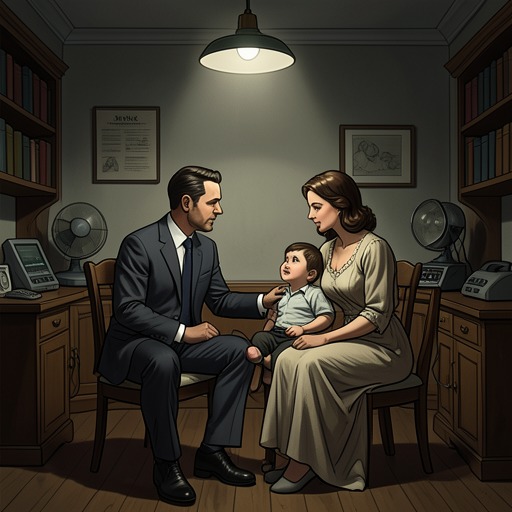
Ellie is born in the third year of Jonathan and Saoirse’s marriage. Jonathan remembers pushing her stroller along the promenade as a ferry sounded nearby, and recalls her as a placid baby who slept eight hours from her first day and seemed untouched by teething pain. She was, in his description, the living image of Saoirse and a beautiful child around whom the family’s sense of domestic good fortune gathered. The seasonal rituals of their south County Dublin life—Easter eggs, trips with buckets and spades, Halloween masks, and Christmas decorations—frame the family as a settled unit of three.
That remembered perfection is qualified by Jonathan’s own anxiety. He feared that some tragedy might undo their apparent happiness, even as he presents the family’s life as secure and lovingly shared. He and Saoirse married young and had Ellie early; by the time she enters her teens, they feel unusually close to the adolescent culture she is navigating, as if they have never entirely left that world themselves. Their familiarity does not mean they can master it: the account makes their parental closeness a source of recognition, but also of heightened involvement in Ellie’s changing life.
Adolescence and Her Father’s Gaze
At seventeen, Ellie is described primarily through the intensity of Jonathan’s response to her. He catalogues her hair, colouring, build, sidelong glance, hoarse laugh, and a gesture in which she puts the tip of her tongue at the corner of her mouth to signal sardonic dismissal. Her style is conspicuously revealing and adorned: hot pants, ripped tights, cropped tops, piercings, crimson lipstick, and thigh-high boots. The detail records her visible self-presentation, but its framing belongs to her father, who experiences her as a sexual taunt to men and reads her appearance through alarm and fascination.
Ellie also shares Saoirse’s difficulty pronouncing the letter R: Jonathan notes that a rabbit becomes a “wabbit.” The trait links mother and daughter across generations, though his description treats it as an endearing family resemblance rather than a source of conflict. Elsewhere, he places Ellie’s adolescence within a sequence of drugs, music, fashion, melancholy, suicidal ideation, and sex. This broad inventory shows the range of concerns he associates with her teenage years, but it remains his framing of that world; the narration does not turn the list into a clinical account of Ellie’s inner life.
Aodhan and the Public Insult
Ellie’s relationship with Aodhan becomes a major source of distress in the family. Jonathan discovers graffiti at the back of a shelter used by rugby players: “ELLIE P THE BLO-JOB QUEEN.” The insult reduces her to a sexual reputation in a public, crudely legible form. Its use of the initial P particularly enrages Jonathan because he connects it to his own surname and to his dead father’s name, Prendergast. He responds by power-walking the length of the pier and back three times, crying and smoking a pack of cigarettes. His reaction registers the injury to Ellie, but also shows how quickly her humiliation becomes entangled with his own family identity and rage.
The graffiti is followed by a painful domestic confrontation. After Aodhan has received oral sex from Ellie and left, Jonathan concludes that the relationship is over. He finds Ellie inconsolable and recognizes that the household is facing an exceptionally bad Saturday morning. At breakfast, her distress shifts between sobbing and anger; Jonathan describes the scene through the strain it places on the family as well as through his sympathy for his daughter. His attempt to have a conversation about respect has failed to protect her from the experience or to control what happens next.
Ellie’s response is direct. She tells Jonathan that she wants Aodhan back, then repeats that she wants Aodhan back specifically and insists that she wants him back that day. She catches Jonathan by the lapels of his pyjamas as she says it. The gesture turns her grief into physical insistence: she is not simply asking her father to interpret the breakup for her, but demanding that he face the strength and immediacy of her own desire. Her insistence sits sharply against Jonathan’s conclusion that the relationship is finished.
Narrative Role and Significance
Ellie is central to Jonathan’s account of how parental love can become anxious surveillance. He remembers her infancy through images of ease and perfection, then narrates her adolescence through sexualized clothing, public insult, heartbreak, and the volatile rhythms of family life. The contrast is not evidence that Ellie has ceased to be loved; rather, it reveals the difficulty of sustaining an idealized picture of a child once she has an independent sexual and emotional life. Jonathan’s fear of catastrophe, visible from the time she was a baby, gives his later reactions an anticipatory quality, while the events themselves resist his wish to keep danger at a distance.
Her story is also mediated by a father who openly describes his own reactions, sometimes with comic exaggeration and sometimes with raw distress. The insult on the wall bears Ellie’s name, but Jonathan’s response is shaped by his dead father’s surname; the breakup belongs to Ellie, but he is the one who declares it over before she insists otherwise. That gap matters. Ellie’s spoken demand for Aodhan back briefly interrupts the narrative’s tendency to define her through Jonathan’s protectiveness, giving her desire its own force even though the account remains filtered through his perspective. The available episodes establish neither a final reconciliation with Aodhan nor a settled resolution of the family’s conflict.