Ernestine and Kit’s partnership
Dark Lies the IslandErnestine and Kit’s partnership joins domestic intimacy to a practiced, criminal collaboration: they travel together, read situations together and divide the work of approaching children, while presenting themselves to strangers as harmless older women. Their attempted abduction of Allie reveals the alliance at its most organized and its most consequential. They can coordinate a near-seamless deception, yet their eventual failure turns the planned rescue of a child into her abandonment and sends the pair back toward the secluded bungalow they share.
Identity and Shared Life
Ernestine and Kit are introduced as two women in their sixties, travelling through north County Sligo in a neat Japanese car. The summer landscape appears open and welcoming: they pass a vintage-car gathering at Kilmore, visitors bound for Inishfree, and busy village pubs. Their admiration for the country’s fine weather and scenery places them comfortably among the day’s holidaymakers. That ordinary, companionable outing is the surface under which their partnership operates.
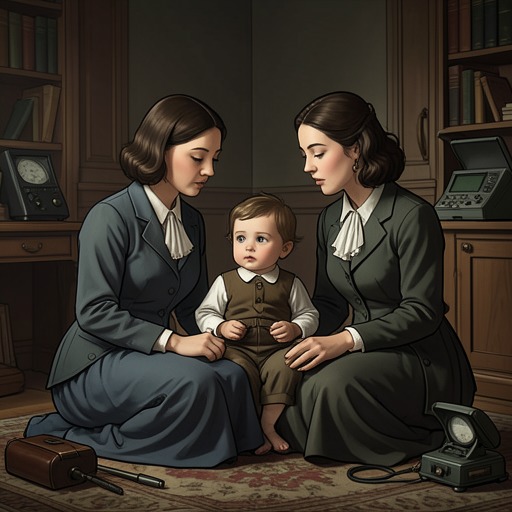
Their shared home is a bungalow in the midlands, with floral-patterned walls and a windbreak of pines. In the quiet winter months there, they discuss how others might perceive them in public. They imagine that strangers could take them for maiden aunts, former nuns or older lesbians, and recognize that their gentle, aunt-like smiles help sustain the appearance of kindness. Their public identity is not simply incidental: it gives their movements a plausible, reassuring face.
The pair’s companionship extends into routine domestic habits. After their day out, they plan to buy wine in Enniskillen; at home they drink New Zealand Cabernet Sauvignon by the crate while Lyric FM plays late into the night. Ernestine leafs through power-tool catalogues, while Kit sits with a late-night haze and occasionally trills. The mundane detail of their return home makes the partnership legible as a shared life, not merely a temporary criminal arrangement.
Method and Division of Roles
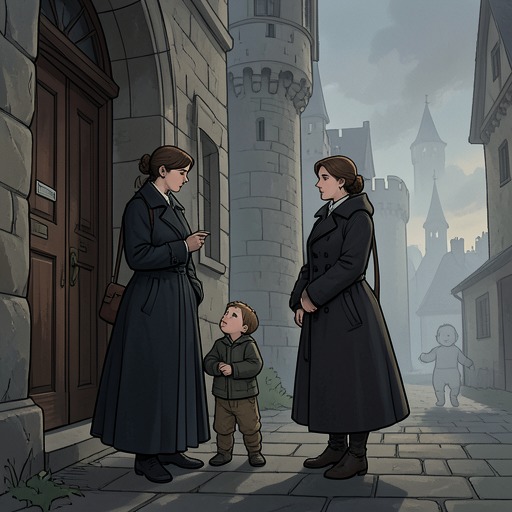
At the castle, Ernestine and Kit watch a family whose young daughter wanders away from her parents and is briefly overlooked. Their attention is divided but coordinated: Kit tracks how the moving crowd might offer cover, while Ernestine keeps her eyes on the girl. Their readiness to exploit the parents’ distraction follows from a deliberate reading of the setting, rather than a spontaneous encounter.
They wait for the family to move from the café into the castle, then follow at a distance and blend into the visitors among the stone walls, coats of arms and chain mail. The castle’s turns and crowded passages provide opportunities for the child to be out of her parents’ sight for short intervals. Kit gives the cue to move; Ernestine draws near with wine gums and a friendly manner, while Kit stays positioned to help. The pair’s roles are complementary: one initiates contact, the other watches the circumstances and assists when the opening comes.
Their conduct depends on an appearance of care. When Allie becomes separated from her family, Ernestine and Kit present themselves as helpers, and the people around them accept that explanation. The public persona they had earlier imagined—gentle, kindly, aunt-like—becomes an operational disguise. Their partnership is therefore built not only on coordination but on the gap between how strangers read their gestures and what the women intend to do.
The Attempt to Take Allie
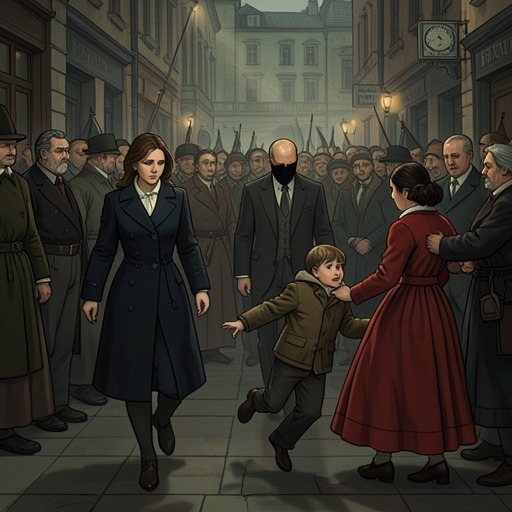
The opportunity to take Allie arrives amid a family argument. The father shouts at the boy, the mother scolds the father, and the boy remains absorbed in his video game; in the commotion, the little girl is momentarily forgotten. Kit tells Ernestine to move. Ernestine approaches with wine gums and speaks to the child, while the two women continue acting as if they are offering comfort rather than preparing to take her.
At the decisive moment, Ernestine tells Kit to take Allie. Kit lifts the child into an embrace that is also meant to restrain her, while Ernestine urges Kit to go. The attempted abduction is brief and coordinated, but the plan does not carry them away cleanly. They soon return to the family, presenting the episode as a response to a distressed child who could not see her relatives. In a chorus of soothing reassurances, the family accepts their account and thanks them for helping. Allie remains with her parents, still crying, while Ernestine and Kit leave with smiles and waves.
The pair reach the car park just in time. Allie’s father appears in the rearview mirror as their Toyota pulls away, but he cannot stop them; even if he reads the registration, the plates are false, fitted that morning at the garage attached to the bungalow. The preparation behind that detail shows how the partnership extends beyond improvising in public: the women have taken steps to make their car harder to identify.
Failure, Abandonment and Return
Once clear of the scene, they drive well above the speed limit through Sligo, Leitrim and Cavan, then cross from Northern Ireland at the bridge where Blacklion gives way to Belcoo. They plan for failure as well as success, and crossing the jurisdictional boundary is part of their effort to manage the risk. Only after reaching the other side do they speak freely again. Ernestine admits that she would not like to see her blood-pressure reading; Kit rebukes her for calling attention to it. Their brief exchange registers the strain of the escape without disrupting their shared course.
The failed attempt does not end the partnership or their interest in taking a child. At an Asda near Enniskillen, they hear an announcement that a toddler has been found and that its parents should come to customer services. The women take the chance: Ernestine hurries to the desk and claims the child as her own, while Kit stays behind her to keep watch. Their earlier performance as concerned helpers is now replaced by an immediate attempt to remove another child from public view.
This second attempt also collapses. They conclude that the child is not worth the effort or risk, stop at a lay-by, and Kit carries the toddler across a ditch and leaves it under hawthorn bushes in the heat. The Toyota departs for home. The child is left alone, and the day’s failure has therefore produced not a safe retreat for the toddler but a grave consequence of the women’s decision to abandon the plan.
Narrative Significance
The partnership is drawn through sharp contrasts between surface and action. Summer crowds, family outings, tea and scones, wine shopping and familiar domestic routines surround a methodical effort to exploit children’s vulnerability. The women’s imagined identities as benign older companions are useful precisely because their apparent gentleness is trusted by those around them. Their collaboration turns that trust into cover.
The repeated movement between public spaces and the bungalow also gives the partnership a practical geography. They use crowds and the castle’s winding interior to approach Allie, a prepared car and false plates to leave, the border crossing to complicate pursuit, and the bungalow as the destination to which their daily life returns. Their partnership is neither presented as a successful criminal enterprise nor reduced to a single failed incident: the attempt at the castle is followed by a renewed attempt in the supermarket. Its defining pattern is the union of ordinary intimacy, deliberate preparation and repeated risk-taking, with consequences that fall on the children they target.