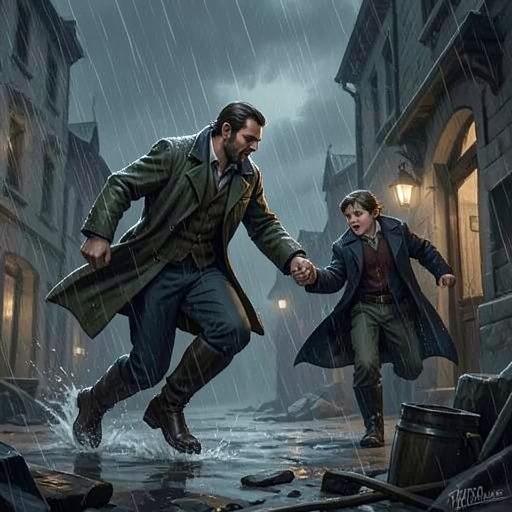
Evan’s spell
Dark Lies the IslandEvan’s spell is Elsie’s explanation for why Suze remains attached to Evan, and her claim that she can defeat it becomes an ominous measure of the power he exerts over the household. The novel leaves the word’s literal status uncertain: what follows gives it force through pressure, confinement and fear, but never confirms a supernatural mechanism.
Naming the Spell
When the narrator asks whether Suze still loves Evan, Elsie answers that Suze does not, but that Evan has a spell on her and Elsie can beat it. Her distinction separates affection from influence: Suze’s attachment, in Elsie’s account, persists not because of love but because Evan has power over her. Elsie’s confidence casts that power as something she can resist, even as the phrase hints at the difficulty of doing so.
The claim comes against a background the narrator has glimpsed rather than fully witnessed. In Cork, he saw Suze on the couch of the Togher flat amid children and dope smoke; he had never seen Elsie there, though he had heard her crying in a distant room. That fragmentary view makes Elsie’s explanation more than an abstract theory: it belongs to a household already marked by strain, but the evidence does not specify what first gave Evan his hold over Suze.
A Household Under Pressure
In January, at the old farmhouse outside Gort, the narrator says that they became a kind of family. The arrangement does not make him comfortable. He goes out to the caravan at night for solitude and space, to think of May-Anne and look at her photograph, while the dogs offer him a strange comfort. Elsie considers his withdrawal snobbish and wants him beside her on the mattress; Evan and Suze agree with her. The narrator identifies this disagreement as the start of trouble, placing competing needs for closeness and separation within the household before the later confinement.
The spell’s meaning sharpens when the narrator concludes that Elsie no longer has the better of it. After days and nights locked in the caravan, without food or water and unable to open its rusted-shut windows, he is weak and disoriented. The women whisper through the door for hours, while Evan comes at night and makes tapping noises across the roof. The narrator reports that the girls’ words were awful and filthy but withholds their content; what matters to him is the change in power. His earlier confidence in Elsie’s ability to beat the spell has given way to the sense that Evan’s influence has outlasted her resistance.
Captivity and Uncertainty
The narrator’s account makes the spell legible through material control rather than through any demonstrated magic. A padlock on the chain keeps him in the caravan; deprivation weakens him; voices at the door and tapping overhead extend the ordeal into the night. The dogs, held on the same length of chain, call to him as he believes he is dying. These circumstances give the word a coercive, embodied meaning, while leaving open whether the narrator’s supernatural language describes anything beyond fear and domination.
During a feverish waking, he sees Evan outside a caravan window holding a child in each arm and looking in. The narrator says that this is the first time he has seen the children calm, and takes the vision as proof that there is no God but that there is a devil. The episode intensifies the spell’s ominous atmosphere, but does not settle whether the sight is supernatural, a fever dream, or an interpretation shaped by captivity. The account instead holds those possibilities in tension.
Memory as Resistance
When fear and physical distress ease, the narrator recalls a summer day at Garrettstown with May-Anne. They run together on the windy beach, exhilarated by sea and sand, and he buys her a 99 before they take the bus back to town. Her question about the seaside shop’s pork-pie hats bearing the words “kiss-me-quick” fixes the memory in an ordinary, particular moment. Against the locked caravan and Evan’s night-time presence, this recollection offers the narrator a different form of closeness: a remembered bond with his daughter that the household’s spell cannot erase, even as his captivity leaves the outcome unresolved.