Everett Bell
Dark Lies the IslandEverett Bell is a member of the Real Ale Club whose sardonic wit sits alongside an openly acknowledged history of depression and personal loss. He is both a critic of easy optimism and a tender companion: within the club, he turns private hardship into bleak humor, while his presence helps sustain its bonds of teasing, care, and shared conviction.
Identity and Place in the Club
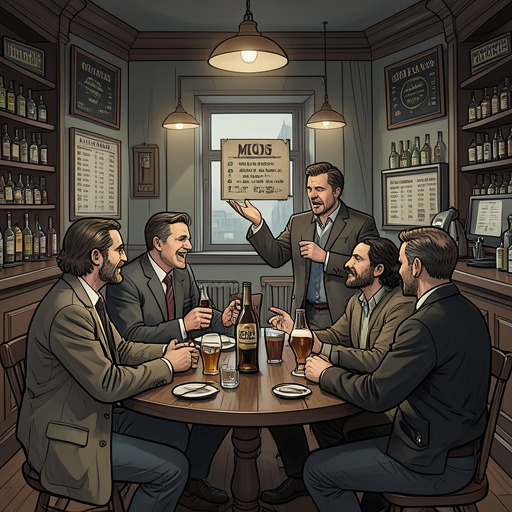
Everett belongs to the Real Ale Club’s Merseyside branch, a group whose outings, drinking customs, and beer reports furnish a substantial part of his social world. The club’s conviviality is never quite separable from its awareness of age and bodily vulnerability. During a train journey, the members recall visiting Mo in hospital after an operation; their joking welcome came with the practical solidarity of turning up together, even if their appearance in the ward drew worried looks from the staff. Everett’s place in the group is therefore not simply that of a comic observer: he is among the companions who share its rituals and its care for one another.
His humor can be caustic, but the narration distinguishes that sharpness from cruelty. When the club discusses a Welsh seaside resort, Everett guesses that it is “down on its luck,” attributing the decline of the old North Wales resorts to holidaymakers choosing package trips to Southeast Asia. The line is characteristically unsentimental: he does not disguise decline with a cheerful account. Yet the same portrait describes him as tender, making his pessimism one element of a more complex attachment to the people around him.
Grief and the Joke That Contains It
Everett’s bleakest recurring joke gives his depression a specific personal history. His father died, and the family’s inheritance brought further difficulty: his brother received the house, his sister the money, and Everett describes himself as having received “the manic depression.” He repeats the line in familiar club settings, including the Lion and the Ship, turning an account of bereavement, family division, and illness into a compact piece of dark comedy.
The joke does not make the loss disappear. Instead, its repeated use shows how Everett makes painful experience speakable among companions who know the story. Its rhythm is both self-mocking and accusatory: the inheritance has been divided into property and money for others, while his own share is an illness. The club’s response is not presented as a cure or a resolution; the significance lies in the shared familiarity that allows the line to recur without reducing Everett to it.
Wit, Conflict, and Club Politics
Everett’s pessimism also shapes his part in the Real Ale Club’s disagreements. After the branch adopts its own beer-scoring scale from zero to ten, challenging the traditional national system of zero to five, the national organization objects and the club faces the possibility of losing its charter. Everett’s response is blunt: he says they should disregard the organization. His stance contrasts with Mo’s concern about losing festival invitations and the branch’s history. The dispute is not merely about numerical precision; it pits institutional recognition and continuity against the branch’s conviction that its expanded scale better serves drinkers and brewers.
On the club outing, Everett also lends his voice to its teasing exchanges. At one point he remarks that the Welsh resort is pleasant if one avoids encountering a she-wolf, while John Mosely adds a comparison to Edward Scissorhands. The dry joke belongs to the group’s familiar repertoire of comic misfortune. Elsewhere, Everett raises a palm to reassure the narrator that his comments about the outing are not personal. That small gesture gives his humor a social counterpart: he can puncture the mood, but he is also attentive to how his words land.
Companionship and Narrative Role
The club’s rituals repeatedly place Everett among companions confronting physical and emotional limits. When they visit Mo after his operation, their jokes about his changed voice are framed as gentle, and their collective presence matters as much as the banter. Later, when Mo is marked by scratches and bruising, the members regard him with affection; Everett’s line about a she-wolf continues the pattern of transforming hardship into shared humor. The jokes do not erase injury or illness, but they give the group a way to stay together in their presence.
Everett’s narrative importance rests on this balance between bleakness and tenderness. His outlook resists easy consolation, whether he is assessing a declining resort or rejecting the club’s national organization, yet he remains part of a community that makes room for grief, illness, and affection. The recurring joke about his inheritance is a concise emblem of that tension: he speaks from pain in the language of comedy, without pretending that the pain has been settled.