Faces at the windows
Dark Lies the IslandFaces at the windows are a recurring, unresolved presence in Sara’s home, where glass becomes a boundary between her private room and an apparently watching outside. Their return links an uncertain visual experience to a frightening episode beyond the doors, without settling whether the faces are real or imagined.
Appearance and Recurrence
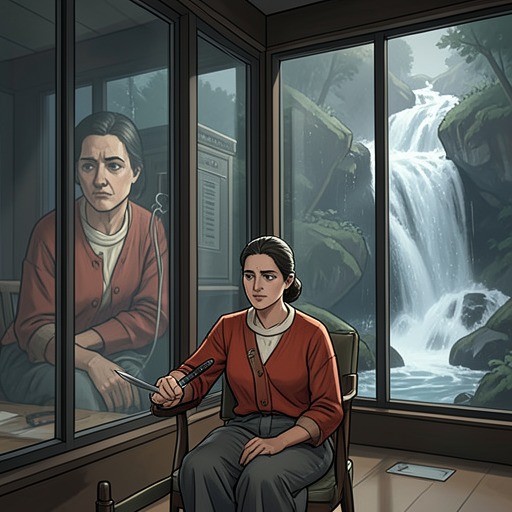
Sara waits for faces to form in the plate glass. Their features are incomplete: she may see an open mouth or the sharp outline of a nose. The uncertainty is part of the image; the windows seem to offer just enough shape to suggest watchers, but not enough to identify them.
The faces return at night. Sara switches off the sound on UK Memories and turns off the lamps, then sits by the stream and lets darkness cover the glass in the hope that it will banish what is outside. Instead, the stream’s murmur comes to resemble voices gathered beyond the house. The attempt to make the windows blank sharpens the sense of an unseen presence.
Encounter and Uncertainty
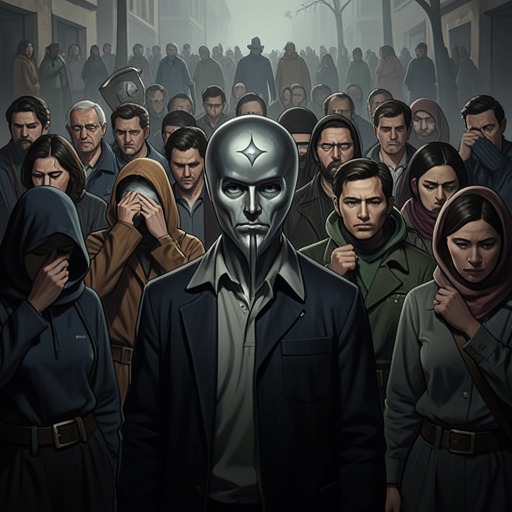
On another night, after a phone call, Sara turns off the lights and searches the dark for calm before stepping outside through the glass doors. A sudden, frightening encounter leaves her unable to call out; she gets back inside and shuts the door. From the floor, she sees faces crowding the window from every angle. They disappear at once, after which she turns her phone on.
The sequence joins the faces to a concrete episode of fear while withholding a clear explanation of either. Sara’s account of the experience carries a tension between belief and disbelief: she is affected by what she sees, but the narrative does not confirm that the faces belong to actual people outside. The glass marks no secure division between an ordinary room and a threatening world; it is the surface on which the threat repeatedly takes form.
Explanations and Significance
Sara’s father tells her that she is not mad but addicted to the internet. The explanation does not account for the faces, the frightening sensation at her throat, the menace she perceives in door handles, or her medication. The faces therefore remain part of a wider distress that his diagnosis fails to resolve, rather than a mystery the text definitively answers.
The repeated movement between lit and dark rooms, windows and doors, seeing and doubting gives the image its force. The faces are both an apparent intrusion into Sara’s private space and an uncertain perception that the narration never verifies independently. Their disappearance brings no explanation or lasting reassurance; the windows remain a threshold where fear returns.