Garavogue River
Dark Lies the IslandThe Garavogue River is more than a landmark: its current and banks set the terms for care, risk, and vulnerability in the lives of people who move through its landscape. For Donie, it is a place where he watches over ducks and once helped reunite a family of them; later, the riverside becomes the scene of an assault that no bystander intervenes to stop.
Setting and the river’s force
The river’s force is most clearly described where it breaches before a bridge. There, the current runs quick and vicious, capable of sweeping a mallard fledgling away from its brood. The danger is seasonal and familiar rather than exceptional: in summer, young ducks are often carried off by the water, making the river a recurring test of whether someone will notice and act.
The Garavogue is also part of a wider, unsettled landscape. During the hotel flood at Killary, a harbour wall disappears beneath water, and an otter moves inland rather than towards its usual tide-line rocks. These separate waters echo one another in the narrative: water is not a passive backdrop but a force that can alter routes, threaten familiar spaces, and send animals towards higher ground.
Donie’s watch and acts of care
After arriving by train, Donie heads down to the river to check on the ducks. He keeps watch for the full half-hour, even when everything seems to be flowing well enough. The routine fits his careful attention to everyday particulars: his watch is deliberate, bounded, and repeated, an ordinary duty he takes seriously.
That attentiveness has a history. Two years earlier, Donie had climbed down the stone steps one careful step at a time, gauging their slickness, then crossed the rocks where the water diverges to retrieve fledglings swept away from their brood. On another occasion, schoolgirls applauded as he worked. The account presents the moment through the vulnerable birds held in his hands and the families he had helped reunite: his care is practical, physically cautious, and directed towards restoring a small piece of order disrupted by the current.
The riverside assault
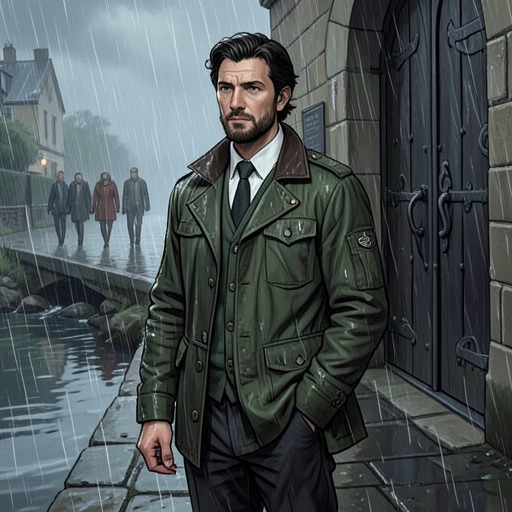
The same riverbank becomes a place of danger when a thin-bearded, pale-eyed stranger sits beside Donie as he finishes his food. The man’s attention unsettles Donie before the encounter becomes physical. Donie raises his voice to shield himself from what the man says, but the stranger continues to approach and then knocks him down on the riverside path.
People are nearby, yet no one comes forward. They interpret the scene as a fight between men they consider mad, leaving Donie alone on the ground while the stranger departs. The river setting sharpens the reversal: a place associated with Donie’s patient protection of vulnerable creatures offers him no comparable protection when he is at risk.
Narrative significance
The river links care with exposure. Its current can separate ducklings from their families, prompting Donie’s repeated, cautious intervention; at the same time, the path beside it leaves him vulnerable to a stranger and to the passivity of onlookers. These episodes give the Garavogue a human significance without reducing it to a symbol: it remains a moving, forceful environment, while the people at its edge reveal different capacities for attention, care, and response.