Llandudno
Dark Lies the IslandLlandudno is a Welsh seaside town visited on the Real Ale Club’s July outing. Its bay, beach, promenade and terraces frame a comic pub crawl in oppressive heat, while an encounter between Mo and a former partner briefly disrupts the group’s beer scoring. Elsewhere, the name belongs to a broader geography of Irish lives in Britain: the town is a destination, a point of cultural comparison, and one stop in a narrative shaped by travel across borders and between homes.
Setting and the Club Outing
The Real Ale Club’s July trip begins at Lime Street on a Saturday described as exceptionally hot. The group travels in T-shirts, bound for Llandudno after hearing that it had several good pubs. The narrator is responsible for both the club’s publications and its outings, a combination that has made his role controversial. The journey is marked by a passing question about Rhyl before the town comes into view.
Llandudno arrives as a distinct coastal panorama: the shadow of Great Ormes Head rises over a crescent of bay, beach, promenade and terraces. The group notes its arrival at 1:55 p.m. and links arms on the hot pavement before turning onto the promenade. This approach makes the resort both a picturesque destination and a place experienced under the immediate pressure of the day’s heat.
Pub Crawl and Beer Scoring
The first stop is the Heron Inn. The group finds a recently refurbished pub whose taps offer mostly disappointing keg beer, though a Phoenix Tram Driver is available on cask at 3.8 per cent alcohol. The six men sit down with a round, but the beer does not meet expectations. The visit establishes the gap between the club’s hopes for a rewarding outing and the mixed quality it finds in practice.
At the Otter, the setting is less inviting: families are strained by the heat and children are crying. The pub is moderately busy, and the group chooses St Austell Tribute from a limited selection. The beer proves to be in notably good form, prompting discussion of its score. This movement from an underwhelming first stop to a more successful second tasting gives the outing its central rhythm: Llandudno is assessed one pub and one pint at a time.
The club’s scoring discussion is part of its shared method for turning pub visits into a collective judgement. The group’s arrival together, linked arm in arm along the promenade, contrasts with the fine distinctions they make over the beers. The town is not merely scenery for the outing; it provides the route and sequence through which the group’s tastes, expectations and social habits become visible.
Mo and the Former Partner
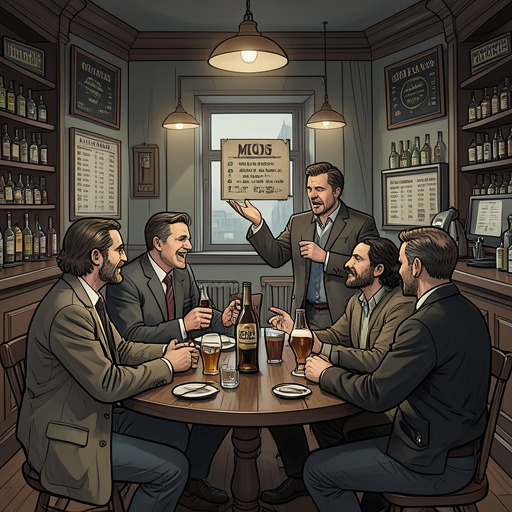
At one pub, the landlady looks towards the table and counts the visitors. When Everett confirms that there are six, she squints more closely, drops a glass, and asks whether Mo is Maurice. Mo freezes, stares, and then softens. The sudden recognition cuts across the club’s routine: for a moment, the pub crawl becomes a meeting between Mo and someone from his past.
Mo subsequently explains that the woman is an ex, and John Mosely tells the others to leave him be. The encounter is brief and its history remains unspecified, but the change in Mo’s expression gives it weight. Llandudno’s pubs hold two kinds of recognition at once: the club’s public business of rating beer and the private return of a relationship the group cannot fully know.
A Wider Geography of Belonging
Llandudno also sits within the book’s larger pattern of movement between Ireland and Britain. In one conversation, a character describes the difference between the two countries through the contrast, “Ireland is magical,” and “England is ironical.” The line makes geography a matter of interpretation and identity, not simply a route on a map.
A separate passage challenges the phrase “the mainland campaign,” arguing that the term treats the rest of the United Kingdom as the mainland while seeming to erase the speaker’s own position. The distinction matters to characters living and acting in Britain while carrying an Irish perspective on the names used for places and political space. Llandudno’s role as an outing destination is lighter than these debates, but it belongs to the same mobile world: a Welsh stop on a club itinerary, encountered within a book attentive to how travel, borders and naming shape belonging.