May-Anne
Dark Lies the IslandMay-Anne is the unnamed narrator’s daughter and the person he most tenderly remembers while living apart from her. Though she appears only in recollection in the available scenes, her importance is decisive: the narrator’s concern for her gives shape to his account of fatherhood, and a shared day at Garrettstown becomes a mental refuge during his imprisonment in a caravan outside Gort.
Identity and Background
The narrator calls May-Anne his daughter and describes her affectionately as his “dotey pet.” By the time he settles at a farmhouse outside Gort, he has not seen her since a day at Garrettstown beach in early summer. His separation follows his expulsion from Fiona Condon’s home; he says Fiona’s barring order prevented him from getting near his daughter. He has not arranged to collect his belongings, and the few clothes he takes to the caravan stand in contrast to what matters most to him: the loss of contact with May-Anne.
The narrator’s account of himself as a father is conflicted rather than uncomplicated. He says he loves May-Anne, but also that he has never felt comfortable being a father. His love sits alongside fear: the thought of her moving through a world populated by people he regards as dangerous frightens him. When he imagines men around the bus station in Cork, he asks whether he would want his daughter sharing the same air as them. This fear is his perspective, not an account of anything May-Anne herself experiences.
The Garrettstown Memory
During his captivity, the narrator recalls taking May-Anne to Garrettstown on a windy, blustery summer day. He remembers the sea and sand lifting their spirits and the two of them running about together before they had to catch the bus back to town. The memory is precise in its small domestic details: at a seaside shop, he buys her a 99, while she notices novelty hats bearing the phrase “kiss-me-quick” and asks what it means. He explains it as an old seaside saying, probably from England.
May-Anne turns the phrase into a game, repeating it in a cartoon duck’s voice. The narrator answers with quick pecks on her cheek and nuzzles the back of her neck until she squeals. Recounted amid deprivation and confinement, this exchange preserves their intimacy through ordinary play: it is not an idealized account of an entire relationship, but a particular, affectionate scene that the narrator can return to when other comforts have disappeared.
Separation and Captivity
The memory returns when the narrator is locked in the caravan for days, with its windows rusted shut and no food or water brought to him. In the midst of physical weakness and fear, he grits his teeth and closes his eyes; the sweats seem to ease, and he can see the beach day clearly. The recollection gives him a temporary focus beyond the immediate confinement, connecting the present ordeal to a time when he and May-Anne were together and free to move along the shore.
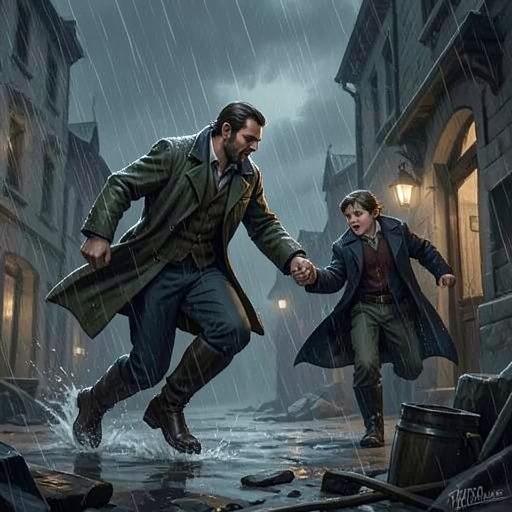
The material circumstances of his escape sharpen that contrast. After finding two old tins of tomato soup beneath the caravan’s sink, he discovers that a section of the floor is rotten and partly replaced with plywood. At night he removes the chemical toilet, loosens the plywood, and squeezes through the opening beneath the caravan. The dogs in the yard watch silently as he reaches a Fiesta and gets it started. When the farmhouse lights come on and its occupants begin shouting, he drives away with a tyre damaged on the rough road. The tyre’s repeated three-beat slap calls back the “kiss-me-quick” game in his mind, and the sound carries his thoughts from the people he is leaving to May-Anne, whom he addresses inwardly as his sweetheart. Her remembered phrase thus accompanies his physical escape, though the account does not establish that he reaches her or reunites with her.
Fatherhood and Narrative Significance
May-Anne is present in the narrative largely through the narrator’s recollection, affectionate language, and anxiety about separation. The limits of that perspective matter: the reader learns the father’s longing and fear, but receives little independent information about the daughter’s life or feelings. The beach memory is especially powerful because it is concrete and shared—a bus journey still to come, a seaside purchase, a question, a joke—rather than a general statement of love.
Her place in the story also gives emotional weight to the narrator’s precarious circumstances. At the farmhouse, he arrives with very few possessions and without access to his daughter; during captivity, he uses the remembered day as a refuge; in the escape, its playful phrase resurfaces amid danger. May-Anne does not cause or control these events, but the bond the narrator describes makes clear what his isolation has cost him and what remains in his thoughts as he gets away.