Mo
Dark Lies the IslandMo, also known as Maurice, is a Real Ale Club regular whose boisterous circle sees only part of him. A reunion with Barbara turns the club’s seaside outing into an intimate, disarming scene; later, Mo’s account of their separation reveals a depth of longing that sits uneasily beside the group’s teasing, beer-soaked camaraderie.
Identity and Place in the Club
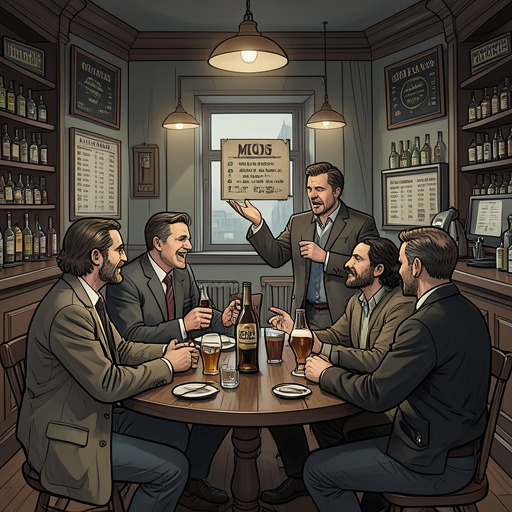
On the July outing to Llandudno, Mo is among the “biggish lads” travelling in T-shirts on a punishingly hot day. The trip is organized by the narrator, who is handling both publications and outings for the club, a combination described as controversial. Mo’s companionship with the group is expressed through the club’s ordinary rituals: travel, food and drink, and the affectionate irreverence with which members keep one another company.
The group’s care is especially visible in its recollection of Mo’s operation earlier that spring, after which he had lost a testicle. On the night of the operation, the members called at the Royal, stopping first at the Ship and Mitre for a guest bitter from Clitheroe. They felt they needed the fortification before visiting the hospital, where their large physiques and the cloud of beer breath they brought to Mo drew worried looks from medical staff. The jokes about his remaining testicle working overtime are pointed but carefully qualified as gentle teasing: the club’s rough humour doubles as a means of staying close to a vulnerable friend.
Barbara and the Llandudno Reunion
During the outing, the club stops at a pub where Barbara is working behind the bar. When she squints at Mo, drops a glass, and calls him “Maurice?”, Mo freezes. His expression shifts as he recognizes her; he stares, softens, and stammers her name back to her. The use of his full name marks the sudden breach between the familiar club nickname and the personal past that Barbara brings into the room.
Mo rises and crosses to the bar. For several moments, he and Barbara simply hold hands over the counter, wordless and absorbed in one another. Their shared quiet breaks into giggling when they become conscious of the club watching. Barbara blushes and pours the beer, spilling some into the slops gully; meanwhile, the narrator and Everett carry the drinks back to the table, leaving the two of them huddled together at the far end of the counter. The scene gives their recognition its own space within the noisy outing: the group witnesses the reunion, but does not interrupt it.
The club had not thought of Mo as a romantic. Tom Neresford’s remark that the quiet ones are the ones to watch turns that assumption into a joke, but also registers the group’s surprise at seeing Mo so wholly taken up by another person. Barbara is not introduced merely as a passing acquaintance. Mo’s reaction, and the group’s recognition that there is a story between them, establish that this encounter reopens a substantial emotional history.
The Relationship in Mo’s Recollection
Later, Mo describes the practical arrangements that sustained the relationship across distance. Barbara came over early in 1986, lived and worked in a pub near Theydon Bois on the Central line, and called him from a phone box. Mo was in a phone box in Galway; their calls depended on arranging specific times, including Tuesday at eight and Friday at ten. His memory makes separation concrete through the repeated, scheduled act of trying to reach each other.
Mo calls the distance physical pain. Their plan was that he would follow in the summer. He remembers arriving at Victoria Coach Station at six in the morning with eighty pounds in his pocket, where Barbara was waiting. They then had what he calls an “absolute dream” of a month, lying in the park and sharing a song. The period of closeness is vivid but limited: the song’s declaration of summer love and its image of being “close to the edge” carry both the exhilaration of their time together and a suggestion of emotional precariousness already present in Mo’s chosen memory.
Billy Stroud identifies the song as Art of Noise, and Mo snaps at him to shut up. The interruption shows how exposed the recollection has made him. For the club, music and banter are familiar social currency; for Mo, the song belongs to an intensely personal month with Barbara, and its recognition by someone else threatens to turn that memory into another occasion for joking.
Vulnerability and the Limits of the Reunion
The Llandudno reunion does not erase the history of separation. Later, Mo arrives at the Ox with terrible scratch marks down his left cheek and is wordless as he stares into the ale placed before him. John Mosely discreetly suggests that a “Slattern” will set him right, while Billy signals to Big John to give Mo some time. The passage does not explain the scratches or identify their cause, so they remain a visible sign of distress rather than evidence for a specific account of what has happened.
Mo eventually tries to continue his story despite Big John telling him to leave it. He recounts Barbara’s move, the calls between Galway and Theydon Bois, the planned journey, and their month together. The shift from his silent arrival to this detailed account makes the memory itself a form of exposure: he cannot easily keep the pain private, even among friends who are trying to protect him from speaking further. His comic, sociable place in the club therefore coexists with a more fragile emotional life, and his reunion with Barbara stands as a moment of recognition rather than a simple resolution.