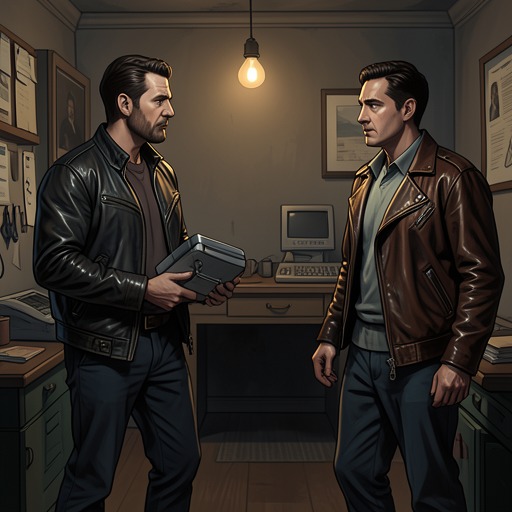
Patrick’s attempt to retrieve the clamped White Hitachi
Dark Lies the IslandPatrick Mullaney’s attempt to retrieve the clamped White Hitachi is a small, costly reversal in which recovering a vehicle does not restore security. The van is essential to his plans, but its release fee exceeds the money in his pocket; once he gets it back, he still faces a dangerous father, his brother’s release, and contraband hidden under the floorboards. The errand ends not in relief but in tears, with Patrick driving toward Tee-J unable to afford even a bottle of Coke.
The van and the pressure around it
Patrick sets out to get the White Hitachi back from the clampers, walking past an industrial estate under the sensation that traffic is watching him. The van’s loss is not an isolated inconvenience. He is thirty-six, sleeping in lay-bys, and remembers how a good wind could make the Hitachi’s walls give and return like a melodeon. In a coffee shop in Carrick, the solidity of the walls had struck him so forcefully that he patted them; the memory gives the clamped vehicle’s precariousness a physical measure.
The pressure around the van also includes Enya’s father, who has threatened to take Patrick’s head off the next time he sees him. Patrick did not know Enya was fifteen and a half when they went on their one date: they shared a Meat Supreme at an Apache Pizza, then had sex in a handicapped toilet at a Topaz station. As he walks to the clampers, however, Patrick worries less about the father’s threat than about whether Enya will remember their night badly. He tries to quiet that concern by deciding that she does not seem like the remembering kind, an evasion that sits uneasily beside the threat he is trying to avoid.
The price of getting back on the road
At the kiosk, Patrick asks about the White Hitachi and says it was taken in illegally. The exchange offers no real opening: the worker’s face looks to Patrick like a dose of cancer, and the answer to his protest is that the van was taken in. When the price is named as three hundred, Patrick objects that the van is not worth that much. The worker replies that its value is not his problem.
Patrick then offers an account meant to make the fee negotiable: he says he had gone to the doctor with his daughter, who has spina bifida, and that although he has the handicapped sticker, it is lost, leaving him to carry her home. The kiosk’s response remains unsympathetic. Patrick says he does not have three hundred; the worker returns the problem to him, and when asked how much he has, Patrick can offer no solution that changes the demand. His appeal to the council and to the treatment of fathers of children with spina bifida likewise produces no concession. The scene places Patrick’s personal pleading against an impersonal transaction: the fee is fixed, and the circumstance he presents does not move it.
The plans depending on the van
Patrick has only two hundred and seventy euros and change, while the clampers’ minimum release charge is three hundred. He has repeatedly fingered the roll of notes in his jeans, measuring what little he possesses against the amount required. Getting the Hitachi back is only the first condition of what he means to do next; the van is also where he believes three hundred and fifty-nine DVDs and a wire cutters are hidden under the boards.
His next plan is to take those items to Doggie Mannion, whom Patrick calls The Dog, and sell them for a euro apiece if he is lucky. He regards this as his only available move and wants the goods out of the van. The plan is conditional twice over: he first has to retrieve the vehicle, and then the DVDs and wire cutters must still be where he left them. The clampers’ fee therefore threatens more than mobility; it obstructs the only immediate way Patrick can think of to dispose of the goods and get some money from them.
The van also connects Patrick’s predicament to Tee-J’s impending release. Patrick imagines that, once the vehicle is out of the clampers and he has stayed clear of Enya’s father, he will spring his younger brother from the juvenile detention unit. He corrects his own dramatic formulation: Tee-J is due for release after serving the full six months. The jail pickup is not an escape plan but a family obligation framed in Patrick’s extravagant inner language. The contrast between the grand idea of springing Tee-J and the ordinary fact of a scheduled release makes Patrick’s self-dramatizing style part of the episode’s comedy, without making the practical strain any less real.
Recovery without relief
When Patrick finally drives into the juvenile detention unit, the better news is that the van has three-quarters of a tank of petrol and the DVDs remain under the boards. The worse news is that he has not even the price of a bottle of Coke for Tee-J. The errand’s central reversal is complete: Patrick has recovered the vehicle and preserved the hidden goods, but the money needed to do so has left him unable to offer his brother even a small welcome.
Thinking of the story he gave the clampers, Patrick imagines what it would mean actually to have a child with spina bifida. By the time he parks in the visitors’ car park, he is sobbing uncontrollably. He wipes his tears as he crosses the lot beneath a summer sky that feels white and massive; it leaves him headachey, out of sorts, and clairvoyant. His final certainty is that nothing good is coming. The recovered Hitachi has not ended the danger surrounding Patrick. It has carried him onward, with less money and no greater sense of control.