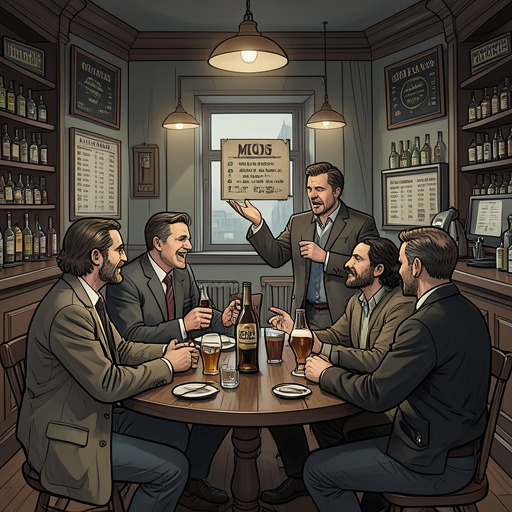
Real Ale Club's 0 to 10 beer rating system
Dark Lies the IslandThe Real Ale Club Merseyside branch’s nought-to-ten scoring system is a locally adopted alternative to the National Beer Scoring System (NBSS), devised to record differences in ale with greater precision. Its importance lies not only in how members rate beer: the dispute over the scale becomes a test of whether the branch will preserve its institutional standing or defend a method it considers better for drinkers and brewers.
The National Scale and Its Limits
The NBSS traditionally ranked beers from zero to five. Zero meant a beer was fit to be returned, while one indicated barely drinkable ale; two was so-so, and three earned mild appreciation. Four described a beer at its best, while five represented an exceptional rarity. A seasoned drinker might award only a handful of fives over a lifetime of drinking. The scale thus treated its highest score as a distinction to be used sparingly, but the branch believed that five steps could not capture all the differences that mattered between beers.
A Finer-Grained Alternative
The Merseyside branch had already adopted its own system after a meeting at Rigby’s: members marked beers from zero to ten. The expanded scale, they argued, allowed finer distinctions in quality and a more considered account of a beer’s nuances. A hoppy note reminiscent of summer hedgerows might move a beer from seven to eight; the contribution of good oak casking could lift it further, toward the rare heights of the nines. These examples make the scale more than a simple increase in available scores: it gives members a vocabulary for explaining why a beer merits one mark rather than another.
Billy Stroud proposed going further by allowing decimal scores such as 7.5 and 8.5. The club declined to adopt that refinement, drawing a boundary at whole numbers. Its members sought added subtlety without making the scale indefinitely divisible; the choice preserved a practical limit while distinguishing their approach from the national system.
Institutional Dispute and the Vote
The national organization responded badly to the branch’s independent practice, sending a formal warning by email. The Merseyside members nevertheless continued to submit beer reports using their zero-to-ten marks, and there was talk that the branch could lose its charter. The prospect mattered materially: Mo argued that losing recognition would also mean losing festival invitations and putting the branch’s history at risk. The disagreement therefore concerned not just how to score ale, but what the branch stood to lose by maintaining its independence.
Everett Bell took the opposing view, dismissing the national organization’s objection and insisting that the branch’s system was better. Tom Neresford framed the change as a positive responsibility rather than an act of defiance: the members had not devised it merely to be awkward, he said, but for the benefit of ale drinkers and makers. The narrator reports a lump in the throat, suggesting that the argument had become a collective expression of commitment as well as a decision about procedure.
John Mosely’s support settled the question. He agreed that the branch should continue scoring from zero to ten, and the narrator said that the other members’ resolve was enough. The decision did not establish that the charter was safe or that the national organization would accept the scale; the evidence instead leaves the threatened institutional consequence in the background while showing the branch choosing its own standard.
Meaning Within the Club
The scale gives the branch a shared means of distinguishing beers more finely, while the dispute exposes competing ideas of what membership and continuity require. Mo’s emphasis on the charter, festival invitations, and the branch’s history sets those benefits against Tom Neresford’s insistence on serving drinkers and makers. The members’ final choice aligns their continued practice with the quality of their judgments rather than with the national five-point convention.
The account then places the decision amid the club’s outing in Llandudno: six members link arms on a hot pavement and head for the Heron Inn. The first stop proves disappointing, with mostly keg beer on the taps, although the pub does serve Phoenix Tram Driver on cask, at 3.8 per cent, which the group drinks. The modest result gives the scoring debate an immediate practical setting: the system is meant to register distinctions encountered in real pubs, even when the first venue does not live up to expectation.