Silvija
Dark Lies the IslandSilvija is a Berlin fashion photographer whose forceful artistic vision and precarious life become central to Patrick’s memories of a formative summer. Their relationship brings him into close contact with her work and her past, but also ends in separation: she urges him to make a life of his own, and he leaves Berlin without regaining contact. Through her, the novel links artistic creation to uncertainty and discipline, while showing how Patrick’s desire to turn another person’s experience into material for his writing meets the limits of intimacy and understanding.
Identity and Work
By her own reckoning, Silvija is Berlin’s most brilliant fashion photographer, though brilliance brings little financial security. The magazines that commission her work tend to fold after one or two issues, and she does not expect a call from Vogue. Her photographs resist the conventional task of clearly displaying a product: assigned to shoot a high-heeled boot, she may show only its blurred sole while placing a model in a dangerous-looking alley, among glittering shards of glass. The shoe becomes nearly incidental to the image’s charged world.
When Patrick questions whether the boot is visible, Silvija answers, “I do not photograph the motherfucking boot, Patrick. I photograph the motherfucking life!” The declaration makes her approach both an artistic principle and a challenge to commercial expectations. She does not treat photography as a transparent illustration of an object; she uses the assignment as a way into the life around it. The work’s obscured product and forceful atmosphere express her refusal to let a client’s stated subject dictate the limits of the image.
Her artistic practice exists alongside persistent economic precarity. Silvija and Patrick supplement magazine work by shoplifting, breaking and entering, and taking paid work from younger designers building portfolios. Those clients are often difficult, and the work is unstable rather than a reliable route to security. Her creative authority therefore coexists with dependence on irregular commissions and improvised means of making ends meet.
Berlin and Artistic Creation
Silvija works in a city undergoing rapid change. The Berlin designers had mostly lived and worked in Prenzlauer Berg, but by 2005 affluent newcomers from around the world were arriving for inexpensive lofts and childcare, and gentrification was spreading through its old tenements and squares. Silvija dismisses the new residents as “Motherfucking breeders.” As the fashion crowd moves north toward the riskier neighbourhoods of Wedding, she and Patrick work in a changing urban landscape where creative activity and displacement occupy the same streets.
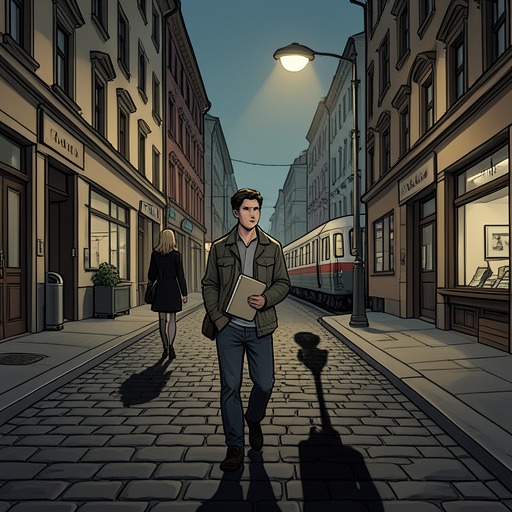
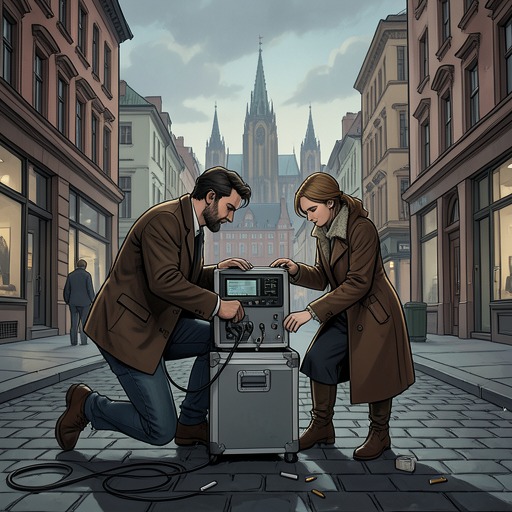
Their days are marked by a practical, improvised rhythm: they buy bottles of pils at a corner shop, carry photographic equipment through the city, and pause on the hill in Mauerpark. There they share an earpiece and listen to Nina Simone’s version of “Lilac Wine.” Such moments place artistic work within ordinary routines rather than apart from them. Silvija strides through the city while Patrick carries the gear; her impatience with conventional polish is matched by a way of working that keeps them amid the textures and pressures of urban life.
Silvija also gives Patrick a compact theory of making art when he complains that his stories lack lustre. She tells him that worry is part of working, that a story comes from the subconscious rather than the front of the brain, and that the writer’s task is to remain available to it. A period in which nothing seems to be happening may be part of the process; the result cannot be commanded, and success depends partly on luck. Patrick continues to search for a shorter explanation, while recognizing that he will not find one. Her advice does not promise control or guaranteed achievement. Instead, it asks him to tolerate uncertainty without mistaking it for failure.
Past and Intimacy with Patrick
Silvija’s history reaches Patrick in fragments rather than as a complete account. She tells him pieces of it late at night, when she is tired and affected by drink and hash, describing violence and upheaval she witnessed and experienced. Patrick admits that he had selfishly wanted a story from her that he could take and recast to give his own work a gravity he felt it lacked. Faced with what she actually shares, he finds that he cannot process its detail and says he has made himself forget most of it. His response exposes the distance between wanting another person’s history as artistic material and being able to receive that history on its own terms.
The fragments establish a childhood and young adulthood shaped by exploitation, confinement, and displacement. Silvija tells Patrick that as a child she exchanged sexual acts for money for soup, and that she was once confined and abused before escaping. She later spent years moving through squats in Barcelona, where she was held captive by a man and forced to eat cat food, and experienced homelessness in Genoa. During that period she became fixated on reading street names backward. Berlin is where she eventually recovers, discovers her abilities, and develops what the narration describes as a protective shell. These are pieces of a life rather than a fully narrated autobiography; the gaps matter, because Patrick receives them in scattered confidences and cannot claim to master them.
The relationship between Silvija and Patrick joins creative companionship with romantic and sexual intimacy, but does not resolve into a stable future. Patrick remembers her as compelling and difficult to possess, and his account is colored by his attachment to her and his wish to keep her in view. Her directness about his writing sits beside her refusal to let him turn her past into an easy source of literary authority. The intimacy gives him access to parts of her experience, not ownership of it.
Separation and Aftermath
Silvija eventually tells Patrick that he needs to find a life of his own. He responds angrily that she needs to see a doctor, and he experiences her decision as being cast aside. Depressed and lost in the city without her, he stays for a time with other artists in Mitte, but finds them false by comparison and forgets their names. The contrast shows how completely Silvija has become his measure for the people and creative life around him, even as the relationship has ceased to provide him a place in hers.
When Patrick is due to leave for the airport, Silvija comes to the station. They hug awkwardly on the platform; she leaves the embrace at once, says she will email and that he may phone, and the encounter ends without reconciliation. In the following six years, she does not answer his emails or calls, and eventually the phone line is dead. Patrick qualifies what this silence means: she changed phones frequently, so the dead line proves nothing by itself. He insists on believing that she remains somewhere among Europe’s cities, still beautiful, foul-mouthed, and inviolate. The uncertainty becomes the final condition of his attachment: there is no confirmed reunion, but neither does he accept that silence can settle the question of where she is or what became of her.
Narrative Significance
Silvija’s influence on Patrick is clearest where it resists being turned into a simple lesson. Her work insists on life beyond the advertised object; her advice asks a writer to remain open to processes he cannot control; and her personal history challenges Patrick’s impulse to borrow suffering for literary prestige. The same person who gives him a way to think about art also marks the boundary of what he can understand or claim. He hears fragments, admits his failure to process them, and later searches for a more succinct account of artistic creation despite her warning that there may be none.
Her presence also complicates the romance of artistic precarity. Silvija’s independence and creative force are real, but they coexist with precarious commissions, illicit ways of supplementing income, and a past of severe hardship. Patrick’s lasting image of her is shaped by love and absence, while the narrative preserves the limits of that image: he cannot know whether she is in Trieste, Zagreb, or Belgrade, and his faith that she remains out there is a belief, not a report of her eventual fate. In that unresolved distance, Silvija remains both a person who acted on her own terms and the figure through whom Patrick confronts the difference between remembering someone and possessing their story.